Welcome to Changzhou Tenjan Steel Tube Co., Ltd
Sunny@tenjan.com



Selecting the optimal steel for industrial applications takes a clear grasp of material properties and how they perform in the field. We see engineers and procurement specialists weighing strength, durability, and cost day after day. Drawing on experience at Tenjan Steel Tube since 2004, we share practical insight to support these choices. Here, we clarify the distinctions between alloy steel and carbon steel and offer a framework to make confident selections across varied environments.
The primary distinction between alloy steel and carbon steel lies in their chemical composition, specifically the presence and quantity of alloying elements. Carbon steel, the most common type, consists mainly of iron and carbon, with carbon content typically ranging from 0.05% to 2.1% by weight. Small amounts of other elements like manganese, silicon, and copper are also present, but not in quantities sufficient to be classified as alloying elements. Its properties are largely determined by its carbon content, which influences hardness and strength.
Alloy steel, conversely, incorporates additional alloying elements beyond carbon, such as chromium, nickel, molybdenum, vanadium, and tungsten. These elements are added in specific proportions to enhance particular properties not achievable with plain carbon steel. For instance, chromium and nickel improve corrosion resistance and toughness, while molybdenum enhances strength and hardenability. The precise combination of these elements dictates the steel’s metallurgical properties, making alloy steels highly customizable for specialized applications.
| Alloying Element | Primary Influence on Steel Properties |
|---|---|
| Chromium | Hardness, wear resistance, corrosion resistance |
| Nickel | Toughness, strength, impact resistance |
| Molybdenum | Hardenability, high-temperature strength |
| Vanadium | Strength, toughness, grain refinement |
| Manganese | Strength, hardenability, deoxidizer |
Understanding the mechanical and physical properties of steel is crucial for material selection. These properties dictate how a material will perform under various stresses and environmental conditions. We observe significant differences between alloy and carbon steels in areas like strength, hardness, ductility, and resistance to corrosion and temperature. These variations directly impact their suitability for specific industrial applications.
Carbon steel’s strength and hardness increase with higher carbon content, but this often comes at the expense of ductility. For instance, our ASTM 1045 carbon steel, used in rebar couplers, offers good strength. However, alloy steels generally exhibit superior tensile strength and yield strength due to the strengthening effects of their alloying elements. For example, 4140 Steel Pipe and 25CrMo4 Steel Pipe, both chromium-molybdenum alloy steels, provide excellent strength and toughness suitable for demanding applications like automotive components and construction machinery. The controlled addition of elements allows alloy steels to achieve high hardness while maintaining adequate ductility, often through specific heat treatments.
Carbon steel offers limited corrosion resistance without protective coatings, as it readily rusts in moist environments. Its performance at elevated temperatures is also restricted, with significant loss of strength and creep occurring beyond certain thresholds. In contrast, alloy steels are engineered for enhanced environmental performance. Chromium, for instance, significantly improves corrosion resistance, as seen in stainless steels (a type of alloy steel). Elements like molybdenum and vanadium enhance high-temperature strength and creep resistance, making alloy steels like DIN 17175 Steel Pipe ideal for high-pressure boilers and petroleum cracking units. Our 09CrCuSb steel pipe demonstrates excellent atmospheric corrosion resistance due to its chromium, copper, and antimony content.
The selection of steel for a specific application is a balance between performance requirements and economic factors. Each steel type offers distinct advantages, making them optimal for different industrial uses. We consider both the technical suitability and the overall cost implications, including material cost, fabrication, and long-term maintenance.
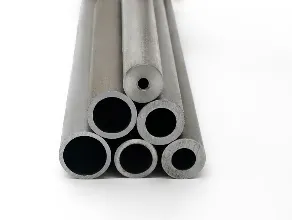
Carbon steel is widely used where high strength-to-weight ratio is not critical, or where cost is a primary concern. Its excellent weldability and formability make it suitable for general structural applications, such as our ASTM A500 steel pipe. Products like Seamless Carbon Steel Tubes and ST35 seamless pipe are common in fluid transport systems and general machinery. For example, our JIS G3461 steel pipe is specifically designed for boiler and heat exchanger applications where moderate temperatures and pressures are present.
Alloy steels are preferred for applications demanding superior mechanical properties, wear resistance, or environmental performance. In automotive and motorcycle components, 41Cr4 Alloy Pipe and 8620 alloy pipe provide the necessary strength and hardenability. For high-pressure and high-temperature environments, such as those found in high-pressure boilers and geological drilling, Seamless Alloy Steel Tubes like our 4130 seamless pipe and 25CrMo4 steel pipe are indispensable. Our special-shaped alloy steel tubes also cater to unique engineering requirements where standard profiles are insufficient.
| Steel Type | Key Properties | Typical Applications | Tenjan Product Examples |
|---|---|---|---|
| Carbon Steel | Good strength, cost-effective, weldable | General structural, fluid transport, basic machinery | ST35 Seamless Pipe, ASTM A500 Steel Pipe, JIS G3461 Steel Pipe |
| Alloy Steel | High strength, wear resistance, corrosion/temp resistance | Automotive, high-pressure boilers, heavy machinery | 4140 Steel Pipe, 25CrMo4 Steel Pipe, 4130 Seamless Pipe |
The choice between alloy and carbon steel also impacts manufacturing processes. Carbon steel generally offers good machinability and weldability, particularly lower carbon grades like 1020 Steel Pipe. This reduces fabrication costs and complexity. Our 1215 steel pipe, a free-cutting carbon steel, is specifically designed for superior machinability.
Alloy steels, while offering enhanced properties, can be more challenging to fabricate. Their higher hardness often requires specialized machining tools and techniques. Welding alloy steels may necessitate pre-heating and post-weld heat treatments to prevent cracking and maintain desired mechanical properties. However, advancements in heat treatment, such as quenching and tempering, significantly enhance their performance, as seen in our quenched and tempered steel pipe offerings. We also provide cold-drawn and cold-rolled processes for both carbon and alloy steels, ensuring superior dimensional accuracy and surface finish for products like our Precision Pipe&tube and EN10305-1 steel pipe.
Effective material selection is a systematic process that aligns technical requirements with economic realities. We approach this by first defining the application’s critical parameters: operating environment, load conditions, temperature, and desired service life. This initial assessment helps narrow down potential steel types.
Next, we evaluate the required mechanical and physical properties. For instance, if high tensile strength and wear resistance are paramount, an alloy steel like SCM440 Steel Pipe or 16MnCr5 steel pipe would be considered. If corrosion resistance is a factor, specific alloy additions become critical. Conversely, for applications prioritizing cost and ease of fabrication, a suitable carbon steel grade like S235JR Seamless Pipe or STKM11A steel pipe might be sufficient.
We then consider manufacturing processes, including machinability, weldability, and the feasibility of heat treatments. Our experience with diverse products, from seamless steel tubes to special-shaped carbon steel tubes, allows us to advise on optimal processing methods. Finally, a thorough cost analysis, encompassing raw material, fabrication, and long-term performance, guides the final decision. We ensure all materials, whether carbon or alloy, meet stringent standards like ASTM, EN, DIN, and JIS, and undergo ISO-certified quality control, including PMI and NDT inspections.
Choosing the correct steel is a critical decision that impacts project success and longevity. Our team at Tenjan Steel Tube offers unparalleled expertise in precision steel tubing, encompassing both alloy and carbon steel solutions. We provide tailored guidance and high-quality products, ensuring your projects benefit from optimal material selection.
Contact us today to discuss your specific requirements. We are ready to assist you in finding the perfect steel solution.
Email: Sunny@tenjan.com
Tel:+86 51988789990
Phone:+86 13401309791
Alloy steel usually costs more than carbon steel due to the inclusion of expensive alloying elements and often more complex manufacturing processes. Carbon steel, particularly lower grades, is generally more economical for applications where its properties are sufficient.
Certain grades of carbon steel, like ASTM A106 Gr.B steel pipe and ASTM A192 steel pipe, are specifically designed for high-temperature and high-pressure service in boilers. However, for extremely demanding conditions, alloy steels like 25CrMo4 steel pipe or JIS G3441 steel pipe offer superior performance and safety margins.
We maintain ISO-certified quality control throughout our manufacturing process, from raw material sourcing to finished product. This includes rigorous PMI (Positive Material Identification) and NDT (Non-Destructive Testing) inspections to guarantee material integrity and compliance with international standards like ASTM, EN, DIN, and JIS.


Home Product Capabilities Case Studies Blogs About Get a Quote
Pipe & Tube Manufacturing Process Shapes & Profiles Pipes & Tubes Material Standard Steel Pipes & Tube Rebar Couplers Cold Drawn Steel Profiles & Bars
Oil & Petrochemical Industry Automotive & Motorcycle Components Mechanical Engineering Components Mining Construction Support Structures High-Pressure Boiler System Construction Machinery Geological Drilling Agricultural Machinery Parts Industrial Fluid Transfer Systems


© 2024 Changzhou Tenjan Steel Tube Co., Ltd All rights reserved. Privacy StatementTerms-ConditionsSitemap
