Welcome to Changzhou Tenjan Steel Tube Co., Ltd
Sunny@tenjan.com



ASTM A106 steel pipe has earned its place as a default choice for high-temperature and high-pressure piping systems. I’ve seen it specified repeatedly in power plants, refineries, and petrochemical facilities where the cost of failure—whether measured in downtime, safety incidents, or regulatory consequences—makes material selection a serious decision. The standard covers seamless carbon steel pipe across three grades, each calibrated for different strength requirements. What follows is a detailed look at the specifications, mechanical properties, and practical considerations that matter when specifying or sourcing this material.
ASTM A106 defines seamless carbon steel pipe for high-temperature service through three grades: A, B, and C. The grade designation reflects differences in chemical composition and mechanical properties, giving engineers flexibility to match material selection to operating conditions. Carbon and manganese content drive the strength differences between grades, while also affecting weldability. Seamless Carbon Steel Tubes produced under this standard typically go through hot-finished or cold-drawn processes, with cold drawing delivering tighter dimensional tolerances and better surface quality for precision applications.
Chemical Composition Limits for ASTM A106 Grades (Weight % Max, unless range specified)
| Element | Grade A | Grade B | Grade C |
|---|---|---|---|
| Carbon (C) | 0.25 | 0.30 | 0.35 |
| Manganese (Mn) | 0.27-0.93 | 0.29-1.06 | 0.29-1.06 |
| Phosphorus (P) | 0.035 | 0.035 | 0.035 |
| Sulfur (S) | 0.035 | 0.035 | 0.035 |
| Silicon (Si) | 0.10 min | 0.10 min | 0.10 min |
| Copper (Cu) | 0.40 | 0.40 | 0.40 |
| Nickel (Ni) | 0.40 | 0.40 | 0.40 |
| Chromium (Cr) | 0.40 | 0.40 | 0.40 |
| Molybdenum (Mo) | 0.15 | 0.15 | 0.15 |
| Vanadium (V) | 0.08 | 0.08 | 0.08 |
The manufacturing route for seamless pipe&tube splits between hot rolling and cold drawing. Hot-finished pipes form at elevated temperatures and retain good ductility. Cold-drawn pipes undergo additional working at ambient temperature, which refines the grain structure and increases strength while achieving tighter tolerances. The choice between these processes depends on how critical dimensional precision is for the application.
Grade C delivers higher tensile and yield strengths than Grade B, a direct result of its elevated carbon content. This makes Grade C appropriate when the design requires greater structural capacity under stress. Grade B remains the workhorse specification for general high-temperature, high-pressure service—it’s what most engineers reach for unless calculations specifically call for the added strength of Grade C. The decision comes down to design pressure, operating temperature, and how much margin the system needs.
Mechanical properties determine how ASTM A106 pipes behave under operational loads. Tensile strength, yield strength, and elongation values indicate the pipe’s capacity to handle pressure and resist deformation before failure occurs. These numbers aren’t theoretical—they get verified through testing on every production lot.
Mechanical Requirements for ASTM A106 Grades
| Property | Grade A | Grade B | Grade C |
|---|---|---|---|
| Tensile Strength (min) | 48 ksi (330 MPa) | 60 ksi (415 MPa) | 70 ksi (485 MPa) |
| Yield Strength (min) | 30 ksi (205 MPa) | 35 ksi (240 MPa) | 40 ksi (275 MPa) |
| Elongation (min) | 35% (longitudinal), 25% (transverse) | 30% (longitudinal), 18% (transverse) | 30% (longitudinal), 18% (transverse) |
Hydrostatic testing adds another verification layer. Each pipe gets pressurized with water well above its maximum allowable working pressure, confirming leak-tightness and structural soundness without damaging the material. Non-destructive testing methods—ultrasonic examination and eddy current inspection—catch internal flaws or surface imperfections that could compromise performance down the line. For high-pressure systems, these tests aren’t optional extras; they’re the baseline for safe operation.
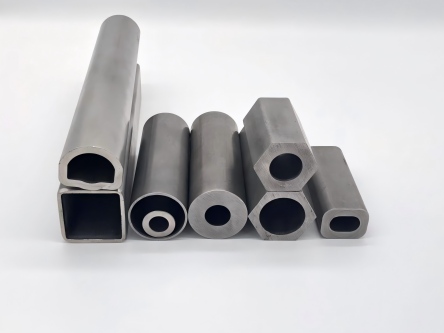
Getting dimensions right matters for system integration. ASTM A106 pipes are specified by outer diameter, wall thickness, and nominal pipe size (NPS). The NPS system provides a standardized reference for pipe sizes, while schedule numbers (Schedule 40, Schedule 80, Schedule 160, and others) define wall thickness for each NPS. A 2-inch NPS pipe will have different wall thicknesses depending on which schedule applies.
Tolerance control on OD and wall thickness directly affects welding quality, flange connections, and overall system performance. Pipes that fall outside tolerance create fit-up problems during installation and can compromise joint integrity. Cold-drawn manufacturing achieves the tighter dimensional control that critical applications demand, reducing the risk of issues during assembly and operation.
The combination of strength and high-temperature resistance makes ASTM A106 steel pipe standard equipment in industries where piping systems operate under demanding conditions. Power generation facilities use it extensively for boiler tubes and steam lines, where temperatures and pressures push material limits continuously. The oil and gas sector relies on it throughout the value chain—upstream production, midstream pipelines, and downstream refining and petrochemical processing.
High-pressure boilers and pressure vessels represent another major application area, where the material’s properties support safe containment under extreme conditions. Construction machinery and hydraulic systems also use ASTM A106 Gr.B Steel Pipe when robust fluid conveyance is required. The specification’s range of grades gives engineers options for matching material capability to specific operating requirements.
ASTM A106 pipe handles steam applications well—that’s a core part of what it was designed for. The material composition provides thermal stability and pressure capacity for steam transport, including superheated steam in industrial settings. Boiler tubes and steam lines in power plants commonly use this specification because it delivers reliable performance under sustained high-temperature, high-pressure conditions. The key is ensuring the selected grade and wall thickness match the specific steam parameters involved.
Quality control for high-temperature, high-pressure piping starts with raw material verification and extends through every manufacturing step. ISO certification indicates a supplier maintains consistent quality management systems, but the real assurance comes from specific testing protocols. Positive Material Identification (PMI) confirms that the delivered material matches the specified chemical composition—a critical check when material mix-ups could have serious consequences.
Non-destructive testing through ultrasonic and eddy current methods detects hidden flaws that visual inspection would miss. These tests identify discontinuities that could become failure points under operational stress. Full process control from billet to finished product, combined with compliance to ASTM, EN, DIN, and JIS standards, provides the documentation trail that code-mandated applications require. Mill test certificates establish complete traceability for every pipe. For more on preventing manufacturing defects, 《Analysis of Key Causes and Prevention Strategies for Cracking in Seamless Steel Tubes during Bending and Flattening》 covers the topic in detail.
Quality control for seamless steel tubes follows a multi-stage approach. Raw material inspection verifies chemical composition and physical properties before manufacturing begins. In-process monitoring tracks parameters like temperature and drawing speed to ensure consistency. Final product testing includes mechanical tests (tensile, yield, elongation), hydrostatic testing, and NDT inspections. Mill test certificates tie everything together, providing traceability that allows any pipe’s history and compliance status to be verified. Skipping any of these stages introduces risk that responsible operators won’t accept.
Supplier selection affects more than just price and delivery. A supplier’s manufacturing capabilities—particularly in seamless pipe&tube production and cold-drawn processes—determine whether they can consistently deliver the precision that ASTM A106 applications require. Quality certifications and inspection protocols like PMI and NDT should be standard practice, not premium add-ons.
Experience across multiple industries indicates depth of knowledge about how these materials perform in different applications. Suppliers who work with automotive, power generation, and high-pressure boiler applications understand the varying requirements each sector brings. Custom fabrication capability matters when standard sizes don’t fit the project, and global supply chain presence helps ensure consistent availability. The right supplier relationship reduces procurement headaches and quality concerns over the long term.
The standard doesn’t specify a single maximum temperature because the answer depends on grade, wall thickness, and system pressure. Industry codes like ASME B31.1 (Power Piping) and B31.3 (Process Piping) provide the actual guidance. Grade B typically performs reliably up to approximately 800°F (427°C), with pressure deratings applying at higher temperatures. Specific applications require consulting the relevant code to determine allowable stress values at the intended operating temperature.
ASTM A106 welds well, with Grade B being the most common choice for welded construction. The material responds to standard welding procedures, though thicker walls and higher carbon content (as in Grade C) may require pre-heating and post-weld heat treatment to prevent cracking. ASME Boiler and Pressure Vessel Code Section IX covers welding qualifications and procedures for code work. Following proper procedures maintains the mechanical properties and structural integrity that the base material provides.
These specifications are functionally identical. ASTM A106 is the material specification from the American Society for Testing and Materials. ASME SA106 is the same specification adopted by the American Society of Mechanical Engineers for boiler and pressure vessel construction codes. Pipes meeting ASTM A106 requirements also satisfy ASME SA106, which simplifies procurement for code-mandated applications. The dual designation reflects the material’s established role in pressure equipment construction.
For critical applications demanding precision and unwavering reliability, partner with Changzhou Tenjan Steel Tube Co.,Ltd. As a vertically integrated manufacturer since 2004, we specialize in ASTM A106 Gr.B Steel Pipe seamless and custom-shaped steel tubes, backed by ISO-certified quality and comprehensive NDT. Contact us for tailored, high-performance tubing solutions. Email: Sunny@tenjan.com, Tel:+86 51988789990, WhatsApp:+86 13401309791.


Home Product Capabilities Case Studies Blogs About Get a Quote
Pipe & Tube Manufacturing Process Shapes & Profiles Pipes & Tubes Material Standard Steel Pipes & Tube Rebar Couplers Cold Drawn Steel Profiles & Bars
Oil & Petrochemical Industry Automotive & Motorcycle Components Mechanical Engineering Components Mining Construction Support Structures High-Pressure Boiler System Construction Machinery Geological Drilling Agricultural Machinery Parts Industrial Fluid Transfer Systems


© 2024 Changzhou Tenjan Steel Tube Co., Ltd All rights reserved. Privacy StatementTerms-ConditionsSitemap
