Welcome to Changzhou Tenjan Steel Tube Co., Ltd
Sunny@tenjan.com



Hydraulic tubes carry the lifeblood of industrial machinery, and bending them to fit complex layouts without weakening the structure is trickier than it sounds. Get it wrong, and you’re looking at leaks, failures, or worse. The process sits at the intersection of material behavior, manufacturing precision, and quality verification. Every bend we produce needs to hold up under pressure, literally.
Whether a tube bends cleanly or fights back comes down to its metallurgical DNA. Tensile strength, yield strength, elongation, and how quickly the material work-hardens all play their part. Materials with high ductility, like Seamless Carbon Steel Tubes and certain alloy steels, can stretch and compress without cracking. The bend radius matters enormously here. Push for a tighter curve, and localized stress spikes. Wall thinning shows up on the outer edge while the inner surface bunches and wrinkles. Material stress analysis tells us where the limits are before we start cutting and shaping.
Cold drawing pulls a tube through a die, shrinking its diameter and wall thickness while stretching it longer. The result is a tube that bends more predictably and holds together better under stress. Tenjan produces cold-drawn precision steel tubes specifically for applications where bend quality and structural integrity cannot be compromised. Our tubes, including EN10305-1 Steel Pipe and DIN 2391 Steel Pipe, handle the demands of critical hydraulic systems.
| Feature | Cold Drawn Tubes | Hot Rolled Tubes |
|---|---|---|
| Dimensional Accuracy | High precision, tight tolerances | Moderate precision, wider tolerances |
| Surface Finish | Smooth, bright, reduced surface defects | Rougher, scaled surface |
| Mechanical Strength | Increased tensile and yield strength | Lower strength, requires further processing |
| Ductility/Bendability | Enhanced, allowing for tighter bend radii | Moderate, limited for complex bends |
| Grain Structure | Refined, uniform | Coarser, less uniform |
The cold drawing process does more than resize the tube. It refines the grain structure, which bumps up both yield and tensile strength. The surface comes out smooth and uniform, reducing fluid friction inside hydraulic lines and giving corrosion fewer places to start. Dimensional accuracy tightens up considerably, so components fit the way they should. All of this feeds directly into how well the tube bends and how long it lasts in service.
Precision bending requires the right technique matched to the geometry. Mandrel bending uses an internal support tool that prevents the tube from collapsing or wrinkling when you push it into tight curves. Rotary draw bending pulls the tube around a rotating die, giving excellent control over the final shape. CNC tube bending machines bring repeatability and precision that manual methods cannot match, which matters when you’re producing complex hydraulic line configurations. These methods follow established tube bending standards to keep performance predictable.
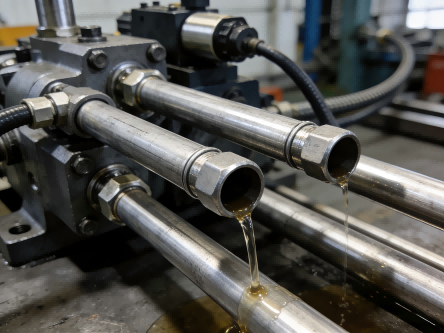
Defects during bending can compromise an entire hydraulic system. Wrinkling forms on the inside of the curve where compressive forces bunch the material. Ovality distorts the round cross-section into something closer to an oval. Wall thinning on the outside radius weakens the tube’s ability to hold pressure. Cracking means the material gave out entirely. Proper tooling selection, adequate lubrication, and controlled bending speeds reduce these risks. Inspection catches problems before they become failures.
Several factors determine whether a bent tube will perform reliably. The bend radius needs to match the tube’s outer diameter and material properties, tight enough to fit the application but not so aggressive that the material overstretches. Wall thinning must stay within limits that preserve the pressure rating. Ovality needs to be minimal so flow remains unobstructed and fittings seal properly. Non-destructive testing methods verify that the finished bend has no hidden weaknesses. Miss any of these, and the tube becomes a liability.
For a deeper look at what causes tubes to fail during bending, see our analysis: 《Analysis of Key Causes and Prevention Strategies for Cracking in Seamless Steel Tubes during Bending and Flattening》.
The material you start with determines what bends you can achieve. Ductility and strength need to balance so the tube can deform without breaking. We supply alloy and carbon steel grades suited to different hydraulic bending requirements. ST52 Steel Pipe and E355 Steel Pipe weld well and offer solid mechanical properties for general hydraulic work. When higher strength is needed, 4140 Steel Pipe and 25CrMo4 Steel Pipe deliver better toughness. Our engineers work with clients to match the material specification to the operating pressures, temperatures, and environmental conditions the tube will face.
Quality verification runs through every stage of our manufacturing process. ISO-certified protocols govern how we work. Positive Material Identification confirms that the tube is actually made from what the specification says. Non-destructive testing, including ultrasonic and eddy current methods, finds internal and surface defects that visual inspection would miss. These checks confirm that bent tubes meet both industry standards and the specific requirements each customer brings to us.
Precision bending for hydraulic lines comes with its share of headaches. Springback, where the tube partially unbends after you release it, requires compensation built into the process. Wrinkling and cracking become more likely as wall thickness decreases or bend radii tighten. Ovality can interfere with flow and make connections unreliable. We address these challenges through CNC equipment, carefully matched tooling, and process controls that monitor what’s happening in real time. Post-bend inspection confirms the results.
When your hydraulic systems need precision-bent tubes that perform under pressure, Tenjan has the expertise and manufacturing capability to deliver. Our cold-drawn seamless tubing and advanced bending processes handle demanding applications reliably. Reach out to discuss your project. Email us at Sunny@tenjan.com or call +86 51988789990. WhatsApp is available at +86 13401309791.


Home Product Capabilities Case Studies Blogs About Get a Quote
Pipe & Tube Manufacturing Process Shapes & Profiles Pipes & Tubes Material Standard Steel Pipes & Tube Rebar Couplers Cold Drawn Steel Profiles & Bars
Oil & Petrochemical Industry Automotive & Motorcycle Components Mechanical Engineering Components Mining Construction Support Structures High-Pressure Boiler System Construction Machinery Geological Drilling Agricultural Machinery Parts Industrial Fluid Transfer Systems


© 2024 Changzhou Tenjan Steel Tube Co., Ltd All rights reserved. Privacy StatementTerms-ConditionsSitemap
