Welcome to Changzhou Tenjan Steel Tube Co., Ltd
Sunny@tenjan.com



When a precisely machined hydraulic cylinder tube distorts during assembly, the root cause often traces back to the cold drawing process, not the dimensions, but the residual stress locked in from poorly controlled drawing. The cold drawing steel tube process delivers tight tolerances and smooth surfaces, but its real engineering value lies in tailoring mechanical properties like yield strength and stress state to the intended use. Over two decades in precision tube manufacturing, I have seen that a cold drawn tube is only as reliable as the process parameters that created it.
Cold drawing is a metal forming operation where a thick wall, hot-rolled steel tube is pulled through a die at room temperature. The die reduces the outer diameter (OD) and stretches the tube, simultaneously controlling wall thickness and improving surface finish. Before drawing, the tube end is pointed to fit through the die, and a lubricant coats the surface to manage friction.
The process can be performed with or without an internal mandrel. In tube sinking, only the outer die reduces the OD, and wall thickness changes are less controlled. Plug drawing uses a fixed plug inside the die bore to size the inner diameter (ID) and improve concentricity. Drawn over mandrel (DOM) takes this further by pulling the tube over a long mandrel, achieving the best ID finish and dimensional accuracy. Think of it like pulling taffy, only with a few hundred tons of force and far tighter tolerances.
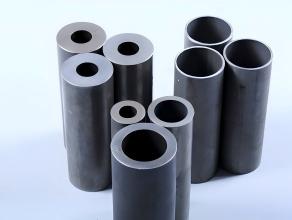
The final tube quality depends on a handful of interdependent variables, and getting them right is where engineering judgment matters most.
Choosing between tube sinking and plug drawing is the first critical decision. It affects not only dimensions but also how the material flows and the residual stress pattern.
| Process | Reduction per pass | OD tolerance | ID surface finish | Typical applications |
|---|---|---|---|---|
| Tube sinking | 15 to 35 percent | ±0.1 mm | Rough, no ID sizing | Non-critical structural tubing |
| Plug drawing | 10 to 25 percent | ±0.05 mm | Smooth, controlled | Hydraulic cylinder tubes, precision shafts |
| DOM tubing | 10 to 20 percent | ±0.05 mm or better | Very smooth, concentric | High-precision mechanical components |
The die angle, bearing length, and lubricant chemistry determine whether the tube emerges with a mirror finish or longitudinal scratches. A die angle too steep increases friction and heat, risking surface tearing. Too shallow, and material flows inefficiently, requiring higher drawing forces. We typically use dies with a 12 to 16 degree approach angle for carbon steels and adjust bearing length to control straightness.
Lubrication is equally critical. Phosphate-based coatings combined with metal soaps work well for carbon steel, while alloy steels often demand oil based lubricants with extreme pressure additives. In one project for a construction machinery OEM, switching from a standard drawing oil to a polymer based lubricant eliminated intermittent chatter marks and cut reject rates by more than half.
Multiple drawing passes harden the material, and without intermediate annealing the tube becomes too brittle to draw further. Annealing between passes recrystallizes the grain structure, restoring ductility. The decision of when to anneal, and whether to use subcritical or full annealing, depends on the steel grade and total reduction. For example, a 1020 steel tube drawn with a 30 percent total reduction can often skip intermediate annealing, while a 4140 alloy may need annealing after only 15 percent reduction to prevent cracking.
Cold drawing does more than shape steel. It modifies the tube’s internal structure, and those changes determine how the tube behaves in service.
Each drawing pass increases dislocation density in the steel’s crystal lattice, raising yield and tensile strength. A hot-rolled 1020 tube with a yield strength around 250 MPa can reach 450 MPa after cold drawing with 20 percent reduction. However, elongation drops, which limits formability. The following table shows typical changes for a low-carbon steel:
| Cold reduction | Yield strength (MPa) | Tensile strength (MPa) | Elongation (%) |
|---|---|---|---|
| 0 percent (hot-rolled) | 250 | 420 | 30 |
| 10 percent | 350 | 480 | 20 |
| 20 percent | 450 | 550 | 12 |
Residual stress is the manufacturing engineer’s invisible headache. When the tube is drawn, the outer surface experiences tensile stress while the inner surface can be in compression. Uneven cooling or varying die pressure leaves these stresses locked in. Later, when a machinist cuts a keyway or bores the ID, the stress releases and the tube bows or twists, sometimes beyond tolerance. Low-temperature stress relieving (typically 450 to 600 degrees Celsius for carbon steel) after drawing substantially reduces these stresses without sacrificing the strength gains.
Grain flow follows the drawing direction, giving the tube anisotropic properties: stronger in the longitudinal direction than transverse. The reduction per pass and die angle influence how elongated the grains become. A heavier reduction per pass produces a more directional grain structure, which benefits fatigue strength in cycling axial loads but may reduce burst resistance. Balancing these effects demands a clear understanding of the loading conditions the tube will see in its final assembly.
When writing procurement specifications, calling out only the standard and dimensions leaves too much to chance. I recommend including minimum requirements for yield strength, elongation, OD ovality (usually within 80 percent of the tolerance band), and, where post-machining is planned, a stress-relief treatment specification.
For automotive steering column shafts, we often specify a cold drawn 1020 tube with a yield strength of at least 400 MPa, a maximum ovality of 0.05 mm, and a surface finish of 1.6 µm Ra after drawing. For hydraulic cylinder bodies, we turn to plug drawn DOM tubes in ST52 or 4140 with strict ID roundness and a guaranteed residual stress level after stress relieving. Each application has its own balance of strength, ductility, and surface integrity, and the cold drawing process must be tuned accordingly.
At Changzhou Tenjan Steel Tube, we control the entire cold drawing process from raw material to finished tube under ISO certified quality management. Whether you need 15 mm OD tubes for fuel injection systems or 108 mm DOM tubing for earthmoving cylinders, we adjust reduction rates, die sets, and post-draw heat treatment to match your functional requirements, not just the dimensional print.
If you have battled post-machining tube distortion or inconsistent mechanical properties, the solution starts with cold drawing parameters tailored to your part. Share your part number and desired performance requirements with us at Sunny@tenjan.com or call +86 51988789990, and we will confirm the process specifications that ensure your tubes perform as designed.
Cold drawing pulls the tube through a die, reducing diameter and wall thickness while aligning grain structure along the tube axis. Cold rolling uses rollers that compress the wall, giving a more uniform reduction but with less surface finish control. In precision tubing, drawing is preferred when tight OD tolerances and good surface finish are critical.
It depends on the steel grade, the degree of cold work, and whether the tube has been annealed or stress relieved after drawing. In programs we have supported, a 1020 tube drawn with 15 percent reduction and then stress relieved bends easily with a radius of 2D. A 4140 tube drawn to high strength without post treatment will likely crack unless preheated.
For tubes under 30 mm OD, commercial cold drawing routinely holds ±0.05 mm. Tighter tolerances as fine as ±0.02 mm are achievable with extra care in die maintenance and drawing speed control. We recommend discussing the functional need rather than defaulting to the tightest tolerance, because over-specifying adds cost without benefit.
Yes, and often positively, provided residual stress is managed. The work hardened surface and oriented grain structure can raise fatigue limits by 20 to 30 percent compared to hot-rolled tubes of the same grade. But if high tensile residual stresses remain on the surface, fatigue life may drop. Stress relieving after drawing becomes essential for cyclically loaded components.
Stress relieving reduces the internal stresses built up during plastic deformation without significantly altering the strength gained from work hardening. Without it, the tube is prone to cracking during subsequent forming, welding, or when exposed to corrosive environments. If your application involves welding or heavy machining, specify that the tube be stress relieved after the final drawing pass. Share your requirements and we will confirm the appropriate stress-relief cycle for your material and application.


Home Product Capabilities Case Studies Blogs About Get a Quote
Pipe & Tube Manufacturing Process Shapes & Profiles Pipes & Tubes Material Standard Steel Pipes & Tube Rebar Couplers Cold Drawn Steel Profiles & Bars
Oil & Petrochemical Industry Automotive & Motorcycle Components Mechanical Engineering Components Mining Construction Support Structures High-Pressure Boiler System Construction Machinery Geological Drilling Agricultural Machinery Parts Industrial Fluid Transfer Systems


© 2024 Changzhou Tenjan Steel Tube Co., Ltd All rights reserved. Privacy StatementTerms-ConditionsSitemap
