Welcome to Changzhou Tenjan Steel Tube Co., Ltd
Sunny@tenjan.com



Choosing between cold drawn and DOM tubing comes down to where each one actually performs better in your specific application. I’ve worked through enough material selection decisions to know that the “best” option depends entirely on what you’re building and what failure modes you’re trying to avoid. Both processes produce precision tubing, but they start from different places and end up with different strengths. The differences matter most when you’re pushing pressure limits, need perfect concentricity, or have to hit a cost target without compromising reliability.
Cold drawn tubing starts with either seamless or welded tubes that get pulled through a die and over a mandrel at room temperature. That cold working does real work on the steel’s microstructure. The material strain hardens, which pushes up yield strength, tensile strength, and hardness in measurable ways.
The drawing process tightens up both outer diameter and inner diameter tolerances while smoothing the surface finish. For applications where you need consistent fits or predictable flow characteristics, that precision matters. Most manufacturers follow up with stress relief annealing to knock down internal stresses and restore some ductility. Without that step, you risk cracking during any subsequent bending or forming.
This process delivers OD/ID precision and solid material integrity. Our Precision Pipe&tube products demonstrate these characteristics with high-precision seamless steel pipes built for dimensional accuracy across diverse industrial applications.
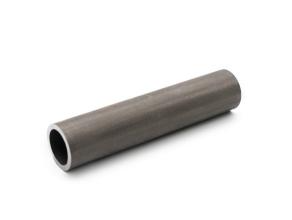
Drawn Over Mandrel tubing takes a different path. It starts as electric resistance welded tubing, formed from flat steel strip that’s cold-rolled into a tube shape and welded along its length. The defining step comes next: drawing that ERW tube through a die and over a mandrel.
This drawing operation reduces the outer diameter and wall thickness while essentially eliminating the internal weld bead. The result is a tube with excellent concentricity and uniform wall thickness around the entire circumference. That uniformity translates directly to better structural integrity and fatigue resistance under cyclic loading.
The cold working improves mechanical properties similar to cold drawn seamless tubes, but DOM’s real advantage is wall consistency. That’s why it shows up so often in hydraulic cylinders, automotive components, and other applications where weld integrity and dimensional consistency drive the design.
The choice between cold drawn and DOM tubing depends on which performance characteristics your application demands most.
Dimensional accuracy in cold drawn seamless tubes runs excellent for OD/ID control. DOM tubing, because of how the drawing process irons out the weld seam, achieves exceptional uniform wall thickness and concentricity. Surface finish differences tend to be subtle in practice, though cold drawn seamless typically has a naturally smoother internal surface.
Both types benefit from cold work hardening, so tensile and yield strengths end up comparable. The absence of any weld seam in seamless cold drawn tubes can provide slightly better fatigue life under certain stress patterns, but modern DOM processes produce welds that often exceed parent material strength.
Cost differences favor DOM tubing for many applications. When you need high precision but don’t strictly require seamless construction, DOM often makes more economic sense. Production efficiency for DOM runs higher for certain size ranges because of the ERW starting point. Both handle high pressure well, but seamless cold drawn tubes remain the default choice for the most critical high-pressure applications where structural uniformity can’t be questioned.
| Feature | Cold Drawn Tubing | DOM Tubing |
|---|---|---|
| Starting Material | Seamless Tube | Electric Resistance Welded (ERW) Tube |
| Weld Seam | None (Seamless) | Present, but virtually eliminated by drawing |
| Dimensional Accuracy | High OD/ID precision, tight tolerances | Excellent uniform wall thickness, concentricity |
| Surface Finish | Smooth, often superior internal finish | Smooth, good overall finish |
| Mechanical Properties | High tensile/yield strength, good fatigue life | High tensile/yield strength, excellent fatigue life |
| Cost | Generally higher | Often more cost-effective |
| Criticality | Preferred for extreme pressure/temperature | Excellent for hydraulic, automotive applications |
The answer depends on how you define strength. Both cold drawn and DOM tubing develop high tensile and yield strength through cold work hardening. Cold drawing increases material hardness and strength in seamless tubes substantially. DOM tubing gains comparable strength from its drawing process, which refines the structure and improves weld integrity.
A seamless tube has no weld by definition, but modern DOM processes produce welds that frequently test stronger than the surrounding parent material. For most applications, tubing strength profiles are similar enough that material grade and heat treatment choices matter more than the manufacturing method.
Cold drawn seamless tubing typically costs more than DOM tubing. The price difference starts with raw materials: seamless billets cost more than the steel strip used for ERW production. Manufacturing complexity adds to the gap, and DOM’s ERW starting process runs more efficiently for high-volume production.
That said, secondary processing requirements or specific dimensional needs can shift the cost-effectiveness calculation. Depending on your project’s budget considerations and technical requirements, either option might end up being the more practical choice.
The right tubing selection matches material characteristics to application demands and relevant industry standards.
Cold drawn seamless tubes fit best in high-pressure boilers, hydraulic systems, and critical structural components where absolute integrity and consistent material properties aren’t negotiable. ASTM A179 Steel Pipe provides seamless cold-drawn low-carbon steel for heat exchangers and condensers. DIN 2391 Steel Pipe delivers precision seamless cold-drawn steel pipes with tight dimensional accuracy.
DOM tubing performs well where superior concentricity and uniform wall thickness matter most: hydraulic cylinders, automotive industry tubing, and construction machinery components. Its fatigue resistance handles dynamic loads effectively. Both types meet stringent ASTM standards, EN standards, DIN standards, and JIS standards for material suitability and performance verification.
We also manufacture custom-shaped steel tubes, including Special-Shaped Alloy Steel Tubes and Special-Shaped Carbon Steel Tubes, for unique OEM specifications.
| Tubing Type | Key Applications | Relevant Standards |
|---|---|---|
| Cold Drawn | Hydraulic lines, high-pressure systems, boiler tubes, structural components | ASTM A179, ASTM A519, DIN 2391, EN10305-1, JIS G3461 |
| DOM | Hydraulic cylinders, automotive shafts, shock absorbers, construction equipment | ASTM A513 Type 5, EN10305-2, JIS G3445, STKM13A |
Precision steel tubing functions as a critical component in systems where failure isn’t acceptable. At Tenjan Steel Tube, ISO-certified quality control runs through every production stage. Full process control from raw material sourcing to finished product means we track every variable that affects final performance.
Advanced inspection methods verify material integrity at multiple points. PMI inspection confirms material composition matches specifications. NDT inspections using eddy current or ultrasonic testing detect internal or surface flaws before tubes ship. This quality assurance approach ensures every tube, whether standard precision steel tubing or custom geometries, meets the specifications our global OEM partners require.
Steel tubing selection involves enough variables that having an experienced partner makes the process more efficient. Tenjan Steel Tube combines manufacturing capability with application knowledge to deliver cold drawn and DOM tubing solutions that fit your actual requirements. Our team can help you specify the right tubing for performance and cost targets. Reach out to start the conversation.
Email: Sunny@tenjan.com
Tel: +86 51988789990
Phone: +86 13401309791


Home Product Capabilities Case Studies Blogs About Get a Quote
Pipe & Tube Manufacturing Process Shapes & Profiles Pipes & Tubes Material Standard Steel Pipes & Tube Rebar Couplers Cold Drawn Steel Profiles & Bars
Oil & Petrochemical Industry Automotive & Motorcycle Components Mechanical Engineering Components Mining Construction Support Structures High-Pressure Boiler System Construction Machinery Geological Drilling Agricultural Machinery Parts Industrial Fluid Transfer Systems


© 2024 Changzhou Tenjan Steel Tube Co., Ltd All rights reserved. Privacy StatementTerms-ConditionsSitemap
