Welcome to Changzhou Tenjan Steel Tube Co., Ltd
Sunny@tenjan.com



The difference between a steel pipe that performs reliably for years and one that fails unexpectedly often comes down to things you cannot see at a glance: a subsurface lamination, a grain-boundary weakness from improper heat treatment, or a wall-thickness drift that crept past the tolerance during cold drawing. I have spent two decades in precision steel pipe manufacturing, and I have yet to meet an experienced quality engineer who believes that defects “just happen.” Most defects are the logical consequence of a process variable that was allowed to drift, and the good news is that if you understand the root cause, prevention becomes a systematic, repeatable task rather than a guessing game.
The defects I encounter most frequently break into a few families, and each has a characteristic signature that tells you something about where the process went wrong. This table captures the ones that cause the most field failures and production-line rejections:
| Defect Category | Typical Appearance | Most Common Root Cause |
|---|---|---|
| Surface cracks & scabs | Longitudinal or transverse fissures, often visible to the naked eye | Inclusions in the billet, excessive cold-drawing reduction per pass, or insufficient lubrication |
| Laminations | Planar separations running parallel to the pipe surface, often subsurface | Non-metallic inclusions rolled into the hollow from the original billet; these tend to open up during cold working |
| Wall thickness variation | Localized thinning or thickening beyond the stated tolerance | Eccentric piercing of the hollow or uneven die clearance during cold drawing |
| Ovality & straightness deviation | Cross-section out-of-round; pipe visibly bows when rolled on a flat surface | Asymmetric cooling after heat treatment or uneven drawing forces from a misaligned die |
| Pits & surface indentations | Shallow, localized depressions, often irregularly spaced | Scale rolled into the surface or mechanical damage from worn dies and tooling |
In practice, you rarely see just one defect in isolation. A billet with heavy inclusion content can produce a tube that shows both laminations and surface cracking after cold drawing, which is why root-cause analysis must look at the full manufacturing chain, not just the final visible symptom.
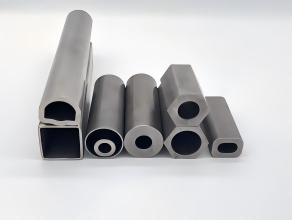
If you only inspect finished pipes, you are already too late to prevent most defects. The problems start in the molten steel. Billet quality governs everything downstream. Macroscopic inclusions—oxides, sulfides, silicates—that survive the ladle and tundish will never fully re-bond to the matrix during rolling, and they turn into the laminations and crack-initiation points I described above. In the grades we work with most—E355, 25CrMo4, SCM440—even a small clustering of nonmetallic particles is enough to cause failure in a hydraulic cylinder tube that cycles at 250 bar several thousand times a day.
The next vulnerability appears during hot rolling or piercing. If the piercer is even slightly eccentric or the billet heating is uneven, the wall thickness will be non-uniform from the start. Cold drawing can subsequently refine dimensions, but it cannot fully correct a seriously off-center hollow. In fact, aggressive cold drawing without intermediate annealing can introduce residual stresses that cause the pipe to bow or develop hairline cracks. I have seen entire lots rejected for straightness because the drawing bench was run at the wrong reduction ratio for the material grade.
A related failure mechanism that deserves more attention is the heat treatment cycle. A pipe that looks dimensionally perfect can still fail in service if the microstructure is wrong. Quenching and tempering parameters that work for a carbon-manganese grade like ST52 may leave an alloy like 41Cr4 excessively brittle if the tempering temperature is not increased to account for the higher hardenability. The result is a pipe with high tensile strength on the mill certificate but no usable elongation in a real bending application. Our team once investigated a batch of 16MnCr5 tubes for an automotive steering component that cracked during cold forming; the root cause was a normalizing furnace that ran 30°C cooler than the setpoint for the first half of the batch, producing an uneven ferrite-pearlite mix that had no visible surface signature.
These are not theoretical failure modes. They play out repeatedly in procurement cycles, and they almost always trace back to one of three things: raw material quality, process control discipline, or heat treatment fidelity.
Prevention is not a single action. It is a chain of interventions that start well before the tube reaches the customer. The three interventions that have made the biggest difference in the production lines I have overseen are die condition monitoring, reduction-per-pass management, and controlled heat treatment.
Die geometry degrades in ways that are hard to see without a profilometer. A worn approach angle on a cold-drawing die can raise the contact stress by 15–20% without a visible increase in the surface roughness of the die itself. That extra stress can be enough to initiate micro-cracks in work-hardened grades where the yield strength has climbed past 600 MPa before the final annealing. We replace or recondition dies not by time-in-service but by dimensional checks every shift, measuring the approach and bearing sections against the original drawing. It is a discipline, not a cost-saving variable.
Reduction per pass has to be set for the specific grade, not copied from a standard table. For a 4130-type alloy with medium carbon content, we limit cold-drawing reduction to no more than 20% area reduction per pass before intermediate annealing; exceeding that can induce shear bands that make the pipe susceptible to longitudinal splitting during subsequent cold bending. For low-carbon grades like 1020, we can push higher, but we increase the frequency of die inspection when we do. The rule is simple: every material has a deformation limit, and that limit shifts depending on the previous heat treatment condition.
Heat treatment is the final safety net that corrects the cumulative damage of cold work. A properly controlled stress-relief anneal—held for at least one hour at temperature for every inch of wall thickness, followed by slow cooling—can remove the residual tensile surface stress that otherwise turns small surface imperfections into full cracks. We have normalized EN10305-1 precision tubes destined for hydraulic cylinders at 920°C precisely, with a tolerance of ±10°C across the whole furnace charge, and verified the uniformity with thermocouples embedded in test pieces. It is not the cheapest way to run a furnace, but it is the only way to guarantee that every tube in the batch emerges with the same microstructure and the same dimensional stability.
If your design calls for welded tubes that must later be cold-drawn, an additional concern is the integrity of the weld zone. Poor weld fusion or excessive oxide entrapment at the seam can create weak points that open up during the cold-drawing pass. Our DIN 2391 cold-drawn welded tubes are produced with a continuous monitoring system that compares weld pool temperature and gas shielding flow rate in real time, and every coil is eddy-current tested before it enters the drawing line. The combination of in-process weld verification and post-draw NDT catches seam defects that a final visual inspection alone would miss.
If your program involves thin-wall tubing with a wall thickness under 2 mm, the interplay between die condition, reduction ratio, and heat treatment becomes even tighter. In those cases, it is worth confirming the supplier’s specific process parameters for your grade before committing to a production run. Feel free to reach out at Sunny@tenjan.com to discuss the details.
A reliable inspection regime detects defects before they hurt your operation, but I have learned that not all inspection methods catch the same problems. The right choice depends on the type of defect you are chasing and the standard your application must meet.
Ultrasonic testing (UT) is the workhorse for internal defects. It detects laminations, non-metallic inclusions, and internal cracks down to a reference notch depth of about 3% of wall thickness when calibrated properly for the material velocity. However, UT is not sensitive to surface-breaking cracks that are shallow and perpendicular to the probe beam, which is why we pair it with eddy current testing. Eddy current probes detect surface and near-surface discontinuities that UT might miss, and they can be configured to trigger an alarm when the local wall thickness deviates by more than a preset limit.
Dimensional checks—OD, wall thickness, straightness, and ovality—should be performed on every piece, not just a statistical sample, if your application is safety-critical. We use laser micrometers and air gauges that feed measurements back into the process control system in real time, so a drift in wall thickness is caught while the batch is still running, not after the order is packed.
For alloy verification, portable PMI (Positive Material Identification) instruments are now standard practice. If a customer’s specification calls for 34MnB5, we confirm every heat lot with PMI at goods-in and again before shipment, matching the readings against the mill certificate’s spectral analysis. A tube that passes all dimensional and NDT checks but is made from the wrong chemistry is still a defect that can lead to catastrophic service failure.
The most common inspection blind spot I see is in the FAQ section below, because it is a question every buyer should ask their supplier but very few actually do.
Selecting a supplier is the final preventive step, and it should be based on verifiable process controls, not promises. There are three areas to probe when you evaluate a manufacturer:
First, ask for the documented process standards they follow during production, not just the final product standard. ASTM A519 and EN10305-1 are product standards that tell you the final mechanical properties and tolerances; they do not tell you whether the billet was inspected ultrasonically before piercing or whether the heat treatment furnace had uniform temperature distribution. A supplier that cannot show you its internal work instructions for billet inspection, drawing die maintenance, and furnace control is one you are gambling on.
Second, confirm the scope of NDT capability. A full suite—UT, eddy current, PMI, dimensional laser measurement—is a sign of investment in quality, not just compliance. At Tenjan, we run PMI and NDT inspections as standard for every alloy pipe order, and we maintain ISO-certified quality control with full traceability from raw material to finished product. When a customer’s engineering team specifies 25CrMo4 for a high-pressure boiler application, we can provide UT reports, PMI verification, and dimensional certificates for each pipe in the shipment, not just a summary certificate for the heat.
Third, investigate traceability. Every tube should be traceable back to its original heat number and, ideally, to the specific billet or coil it was produced from. If a defect is found downstream, traceability allows you to isolate the affected lot, not quarantine an entire shipment. We implement batch-level traceability that links each finished pipe to its heat, its drawing sequence, and its NDT records, and we retain those records for the full warranty period of the contract.
Receiving defective pipe after weeks of lead time is a cost no engineering team wants to absorb. If your next project involves precision tubing where dimensional accuracy and material integrity are non-negotiable, we are available to review your specification and confirm the right manufacturing route. Call us at +86 519 8878 9990 or email Sunny@tenjan.com with your part number, quantity, and tolerance requirements, and we will provide a detailed feasibility assessment.
It depends on the standard and the intended service. ASTM A500 structural tube, for example, allows surface imperfections not exceeding 12.5% of wall thickness in depth, provided they are isolated and not sharp-edged. However, if the same tube is later machined or cold-formed, even subsurface marks can nucleate cracks. In practice, we flag any surface indication deeper than 5% of the nominal wall for review, regardless of what the standard permits, because the cost of a field failure far outweighs the cost of rejecting an individual piece.
Look for objective evidence that is not part of the standard mill certificate package. Ask for sample NDT reports for a recent shipment of the same grade, ask whether they perform billet ultrasonic testing before piercing, and ask what their die-change interval is for cold drawing. A manufacturer that can answer all three in detail—and provide example documentation—has a process, not just a policy. If the answer is “we inspect everything,” without specifics, keep looking.
No. Certain defects, like micro-scale inclusions that form during solidification of the cast billet, are statistically present in every industrial heat of steel. The goal is not zero defects; it is controlled defect severity within the risk tolerance of the application. For a ground-engaging mining tube, a small subsurface inclusion that does not propagate under impact loading is a manageable risk. For a high-pressure boiler tube operating at creep temperatures, the same inclusion could be a site for time-dependent failure. The difference is made by the inspection and acceptance criteria that match the service condition, not by chasing an unattainable perfect pipe.
If a defect is discovered after downstream processing, the investigation needs to start with a root-cause analysis that includes the tube’s process history, the machining parameters, and any subsequent heat treatment. We require the customer to retain the failed piece and, ideally, any mating components, and we send our quality engineer to examine the fracture surface and cross-section under a microscope. In many cases, the defect can be traced back to a known process variable, and we adjust future production accordingly. For any program with post-delivery machining, we recommend setting aside a few reference samples from each heat before machining begins—this gives both parties a baseline for the investigation. If your program involves critical machined components and you need a defect-investigation protocol, share your requirements and we will confirm the documentation package available for your order.


Home Product Capabilities Case Studies Blogs About Get a Quote
Pipe & Tube Manufacturing Process Shapes & Profiles Pipes & Tubes Material Standard Steel Pipes & Tube Rebar Couplers Cold Drawn Steel Profiles & Bars
Oil & Petrochemical Industry Automotive & Motorcycle Components Mechanical Engineering Components Mining Construction Support Structures High-Pressure Boiler System Construction Machinery Geological Drilling Agricultural Machinery Parts Industrial Fluid Transfer Systems


© 2024 Changzhou Tenjan Steel Tube Co., Ltd All rights reserved. Privacy StatementTerms-ConditionsSitemap
