Welcome to Changzhou Tenjan Steel Tube Co., Ltd
Sunny@tenjan.com



When a 50-ton excavator bucket slams into broken rock, the steel tubes inside its boom cylinders have already cycled thousands of times that day—elastic deformation, rebound, repeat. In heavy machinery, the tube isn’t just a conduit; it’s a load-bearing backbone that has to survive shock, vibration, and constant pressure without ever yielding. I’ve spent two decades matching tubing to these punishing conditions, and the common thread is always the same: pick the right grade, the right manufacturing process, and the right standard, or the failure shows up fast. This article walks through that triple combination, drawing on real project experience and international specifications to help you select steel tubes that keep heavy equipment running, not stranded.
Heavy machinery tubes live in a world of abuse. A hydraulic excavator’s boom cylinder not only holds pressurized oil at 30–40 MPa but also absorbs lateral shocks when the bucket hits uneven resistance. A dump truck’s hoist cylinder sees near-static pressure one minute and a sharp load spike the next as the bed tips. In mining drills, tubes inside the feed mechanism experience bending, torsion, and abrasive slurry from the outside.
The real killer, though, is fatigue. Every time a cylinder extends and retracts, the tube wall cycles from zero load to full working stress. Over a typical service life of 10,000 hours or more, that can be millions of cycles. If there’s a microscopic wall thickness variation, a hard spot from inconsistent heat treatment, or a surface defect, a fatigue crack will start there. I once investigated a series of premature failures on a line of roadheader booms: the tube wall had a thickness asymmetry of 0.18 mm, enough to create a local stress riser at each pressure cycle. The crack started after roughly half the design life.
So what does the machinery need? Dimensional uniformity, clean internal surface (for seal life), high yield strength to resist plastic deformation, and enough toughness to contain cracks, not suddenly rupture. That leads naturally to the material grade choice.
Material selection is where most procurement mistakes start. A common error is asking for “a strong tube” and getting quoted plain medium-carbon steel, which then fails when it meets a hard rock. Heavy machinery demands alloy steels in the high-stress zones and cost-effective carbon steels where loads are moderate. Below is a quick comparison of workhorse grades we frequently run for OEMs.
| Grade | Common Standards | Typical Tensile Strength (MPa) | Typical Yield Strength (MPa) | Key Attribute | Common Machinery Application |
|---|---|---|---|---|---|
| 4140 / 42CrMo4 / SCM440 | ASTM A519, EN 10297-1, DIN 17204 | 900–1100 (Q+T) | 700–900 | High fatigue strength, through-hardening | Excavator boom rod, hydraulic piston rod, mining drill shaft |
| 25CrMo4 / 4130 | ASTM A519, EN 10297-1 | 700–850 (Q+T) | 550–700 | Good weldability, high ductility | Loader arm tube, structural pivot pin |
| ST52-3 / E355 | EN 10297-1, DIN 2391 | 520–620 | 355–450 | Balanced strength and toughness, cost-effective | Hydraulic cylinder body, telescopic sleeve |
| 1020 / ST35 | ASTM A519, EN 10297-1 | 350–480 | 200–280 | Excellent formability, low cost | Guide bushing, spacer tube |
The numbers in the table are typical after quenching and tempering (Q+T) or normalizing, depending on the grade. The difference between, say, a 4140 tube and a 1020 tube isn’t incremental—it’s the difference between a component that will outlast the machine and one that will need replacement in a few thousand hours. For the highest stress applications (boom pins, hydraulic rods), I always recommend 4140 or its equivalents. The deep hardening capability means the core of a thick-wall tube still reaches 40+ HRC, which is crucial when you’re dealing with section sizes over 20 mm wall.
You can buy the right alloy, but if the tube was just hot-rolled, it won’t perform the same as a cold-drawn one. Hot rolling leaves a scale surface and a tolerance on wall thickness of typically ±10%. That’s fine for structural posts but not for a piston bore where your seal lip is scraping back and forth 50 times a minute.
Cold drawing changes everything. We take a hot-rolled hollow and pull it through a die with an internal mandrel at room temperature. The steel yields and flows plastically, which does three things simultaneously: it improves dimensional accuracy to ±0.1 mm on wall thickness, it work-hardens the surface (boosting yield strength by 20–40% depending on the grade), and it creates a smooth internal finish that reduces seal wear. After drawing, a stress-relief anneal locks in the dimensional stability without sacrificing strength.
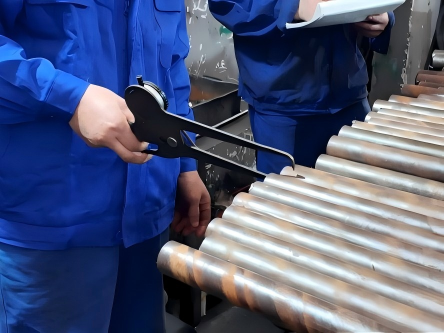
I often tell engineers to think of cold-drawn tube as “pre-fatigued” in a good sense—the material has already been strained uniformly, so any subsequent cyclic stress sees a consistent microstructure. In a recent crawler crane project, switching from hot-rolled ST52 cylinder bodies to cold-drawn and stress-relieved ones eliminated a recurring ovalization problem that was causing piston drift after 500 hours.
Heavy machinery buyers face a wall of acronyms on material certificates: ASTM A519, EN 10297-1, DIN 2391, JIS G3441/3445. They aren’t interchangeable, and picking the wrong one can lead to rejections at incoming inspection.
The key differences are scope and testing requirements. ASTM A519 (U.S.) covers carbon and alloy mechanical tubing but doesn’t prescribe mandatory heat treatment—the condition (cold-worked, annealed, Q+T) must be specified by the purchaser. EN 10297-1 (Europe) is more prescriptive: it defines steel grades, delivery conditions, and mechanical property ranges. DIN 2391 (the old German standard, now largely replaced by EN 10305-1) was the benchmark for precision cold-drawn tubes, and many engineers still reference it. JIS G3441 and G3445 serve the Japanese market for machine structural tubes.
A practical tip: don’t just put “Seamless steel tube” on your purchase order. Write the standard, grade, and condition: for example, “EN 10297-1, grade 25CrMo4, condition +QT, OD 60 mm x ID 40 mm.” If your drawing mentions a superseded standard like DIN 2391 ST52, we can cross-reference it to EN 10305-1 E355, but clarify that at RFQ stage to avoid confusion. I once had a customer insist on DIN 2391 for a new agricultural harvester, only to discover the standard had been withdrawn five years earlier—their internal spec hadn’t been updated.
Standard round tubing covers most hydraulic and structural needs, but heavy machinery often requires profiles you won’t find in a catalog. Engine walk frames, mining drill mast components, and telescopic boom sections frequently use square, rectangular, or hexagonal tubes to resist torsion or fit tight packaging constraints.
Cold drawing can produce these custom shapes while maintaining the same tight tolerances as round tubes. The process is similar: start with a round hollow, then draw through a series of shaped dies. The resulting hex tube has sharp corners and flat sides without the stress concentration of a welded corner. For a recent project involving a surface miner feed mechanism, we drew a hex tube in 5140 alloy with a 28 mm A/F dimension and ±0.15 mm tolerance on the flat, directly substituting a previously machined bar stock part. That cut material waste by over 30% and eliminated multi-axis milling.
If you’re designing a new piece of equipment, it’s worth considering whether a custom-shaped tube could simplify your manufacturing steps—often the die cost pays back in the first production batch.
Selecting the optimal steel tube for heavy machinery always comes down to the same decision path: what is the primary load (tension, compression, bending, pressure), what environment (corrosion, temperature, impact), and what service life. The material grade and process then fall into place.
The challenge is that catalog data online rarely tells the full story. Two 4140 tubes from different mills can behave very differently if one was properly stress-relieved and the other wasn’t. Certification marks on a test certificate don’t always capture the internal soundness that only NDT and PMI (positive material identification) can confirm. That’s where a vertically integrated mill with its own drawing and heat treatment lines has an advantage—the chain of responsibility isn’t split across three subcontractors.
If you’re currently quoting a tube package for a heavy machinery program, send your part number, quantity, and required standard to Sunny@tenjan.com. Our technical team can confirm stock, propose grade equivalents, and if you’re exploring a custom shape, we’ll estimate the die cost and lead time. You can also reach us by phone or WhatsApp at +86 13401309791. No minimum order for standard sizes, and we routinely handle trial lots from 100 meters for new designs.
Seamless or welded—which is better for a hydraulic cylinder tube?
For high-pressure mobile hydraulics (above 25 MPa), seamless cold-drawn tube is the standard. The consistent wall thickness and absence of a weld seam eliminate two common leak paths. Welded DOM (drawn over mandrel) tubes can serve at lower pressures or for return lines, but for a boom or arm cylinder, I would not substitute them without a thorough FEA. Always specify the standard and confirm the supplier’s ultrasonic testing scope.
How do I know if I need 4140 or can use a cheaper carbon steel?
Ask what happens if the part yields once. If it’s a spacer or a guide bushing where slight deformation won’t stop the machine, a plain carbon tube like ST35 or 1020 is fine. If it’s a piston rod that must slide past a seal without scoring, or a pivot pin that could snap and drop the boom, the alloy premium for 4140 or 25CrMo4 is worth it. As a rule of thumb: if the calculated working stress exceeds 60% of the carbon steel’s yield strength, step up to an alloy.
What tolerances should I expect from a cold-drawn tube?
For heavy machinery hydraulic cylinder bodies, we routinely hold wall thickness variation within ±0.1 mm and inner diameter to H8 tolerance. If you need tighter, say for a high-speed pneumatic cylinder, we can hone after drawing to reach H7. Specify concentricity if your design has a thin wall relative to diameter; we guarantee wall thickness eccentricity below 5% as standard. A quick check: for a 60 mm OD / 40 mm ID tube, that means the wall varies by no more than 0.2 mm around the circumference.
Can I get a non-standard outside diameter, something like 57.15 mm?
Yes. Cold drawing uses matched die and mandrel sets, so the OD is only limited by the tooling. We produce many ODs that are not round metric numbers, such as 2.250 inches or other inch fractions for legacy equipment. There’s no minimum order for a new OD within our range, and the lead time for die preparation is typically two to three weeks. If your drawing calls for a diameter that is just slightly off a catalog size, don’t compromise your seal design—email the drawing and we’ll draw it to your exact requirement.


Home Product Capabilities Case Studies Blogs About Get a Quote
Pipe & Tube Manufacturing Process Shapes & Profiles Pipes & Tubes Material Standard Steel Pipes & Tube Rebar Couplers Cold Drawn Steel Profiles & Bars
Oil & Petrochemical Industry Automotive & Motorcycle Components Mechanical Engineering Components Mining Construction Support Structures High-Pressure Boiler System Construction Machinery Geological Drilling Agricultural Machinery Parts Industrial Fluid Transfer Systems


© 2024 Changzhou Tenjan Steel Tube Co., Ltd All rights reserved. Privacy StatementTerms-ConditionsSitemap
