Welcome to Changzhou Tenjan Steel Tube Co., Ltd
Sunny@tenjan.com



Hydraulic cylinders turn fluid pressure into straight-line motion. Simple concept, but getting them to work reliably under real conditions takes more than basic engineering. The tubing that forms the cylinder barrel matters more than most people realize. Get it wrong, and you’re looking at leaks, premature seal failure, or worse. We’ve spent years supplying precision steel tubes for these applications, and the difference between adequate and excellent tubing shows up fast in the field.
The basic mechanics are straightforward. Pressurized oil pushes against a piston inside a cylinder bore, creating linear force. That force scales with pressure and piston area. Nothing complicated there.
What gets tricky is building a cylinder that handles real-world pressures without failing. The barrel needs to contain significant internal pressure while the piston moves smoothly inside it. Surface finish on the bore affects friction and seal life. Dimensional accuracy determines whether seals seat properly or leak from day one.
We produce seamless, cold-drawn tubes including ST52 Steel Pipe and E355 Steel Pipe for these high-pressure systems. The cold-drawing process gives us the tight tolerances and surface quality that hydraulic applications demand.
Construction equipment doesn’t operate in controlled environments. Excavators dig through frozen ground in January and bake in summer heat. Loaders push against loads that shift unexpectedly. Cranes lift at angles that create side loads the original designer probably didn’t anticipate.
The hydraulic cylinders in this equipment take punishment that would destroy lesser components. Boom cylinders on excavators cycle thousands of times per day under heavy load. Bucket cylinders absorb shock loads when the bucket hits rock.
Our 4140 Steel Pipe and SCM440 Steel Pipe handle these conditions. The alloy content gives them the fatigue resistance and toughness that heavy equipment demands. We’ve supplied tubes for boom, arm, and bucket cylinders across multiple excavator manufacturers.
| Cylinder Type | Where You’ll Find It | What the Tubing Needs to Handle |
|---|---|---|
| Double-acting | Excavator Boom | High pressure, constant cycling |
| Telescopic | Crane Extension | Strength without excess weight |
| Single-acting | Loader Lift | Impact loads, debris exposure |
| Tie-rod | Bulldozer Blade | Heavy side loads, field serviceability |
Cars and trucks use hydraulic systems differently than construction equipment. The pressures are often lower, but the precision requirements are higher. A brake system that works perfectly 99.9% of the time isn’t acceptable.
Power steering, ABS, and active suspension systems all depend on hydraulic components that must perform flawlessly for years. The tubing in these systems faces constant pressure cycling, temperature swings, and vibration.
We supply STKM13A Steel Tubes and JIS G3445 Steel Pipe for automotive hydraulic applications. These meet the specifications that automotive manufacturers require, and our process control ensures consistency across production runs. When you’re making components for brake systems, “close enough” doesn’t cut it.
Industrial robots and automated handling systems use hydraulic cylinders for tasks requiring both power and accuracy. A robotic arm might need to position a heavy component within fractions of a millimeter, thousands of times per shift.
These applications demand tubing with exceptional dimensional consistency. Variations in bore diameter or surface finish translate directly into positioning errors or inconsistent force output.
Our Special-Shaped Carbon Steel Tubes and Hexagonal Steel Pipes & Tubes serve specialized automation applications where standard round tubing won’t work. Custom profiles enable more compact cylinder designs and creative mounting solutions.
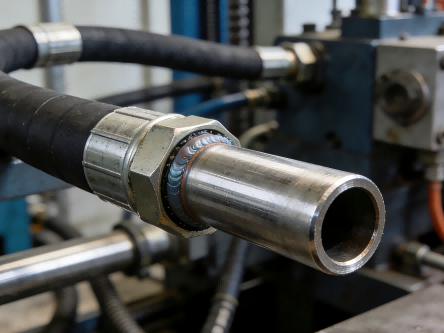
Working offshore or in energy production means dealing with conditions that accelerate every failure mode. Salt water corrodes. Temperature extremes stress materials. Pressure requirements push design limits. And when something fails, fixing it costs a fortune.
Hydraulic systems on drilling platforms, wind turbines, and subsea equipment need to work for years with minimal maintenance. The consequences of failure range from expensive downtime to environmental disaster.
We put our S355JR Steel Pipe and Seamless Alloy Steel Tubes through ISO-certified quality processes and NDT inspections before they ship to these applications. The testing adds cost, but nobody wants to explain why a blow-out preventer failed because they saved money on tubing.
Cylinder longevity comes down to a few factors that all connect back to tubing quality.
Surface finish affects seal wear. A bore that’s too rough chews through seals. Too smooth, and seals can’t maintain the oil film they need for lubrication. There’s a sweet spot, and hitting it consistently requires process control.
Material properties determine pressure capacity and fatigue life. A cylinder might handle its rated pressure fine for the first thousand cycles, then crack at cycle ten thousand because the material couldn’t handle the repeated stress.
We control our process from raw material through cold drawing and finishing. When customers need specific properties, we can work with materials like 1035 Seamless Pipe or 25CrMo4 Steel Pipe to match their requirements. The vertical integration means we’re not hoping our suppliers got it right.
Changzhou Tenjan Steel Tube Co.,Ltd has manufactured precision steel tubing for over twenty years. We produce seamless, cold-drawn, and custom-shaped tubes that meet global standards for hydraulic cylinder applications in automotive, construction, and industrial equipment.
Reach out to discuss what your project needs.
Email: Sunny@tenjan.com | Tel: +86 51988789990 | WhatsApp: +86 13401309791| Tel: +86 51988789990 | WhatsApp: +86 13401309791
Construction equipment leads the list. Excavators, bulldozers, cranes, and loaders all run on hydraulic power. Agriculture follows closely with tractors and harvesters. Material handling equipment like forklifts and industrial automation systems round out the major users. Any application needing controlled linear force in a compact package tends to end up with hydraulic cylinders. We supply the steel tubing that makes these systems work.
The cylinder barrel is where pressure containment happens. Poor dimensional accuracy means seals don’t fit right and leak. Rough surface finish accelerates seal wear. Inconsistent material properties lead to fatigue failures. High-quality tubing with tight tolerances, proper surface finish, and verified material properties prevents these problems. Our ISO-certified manufacturing catches issues before tubing ships.
Regular inspection catches problems early. Check seals for wear, rods for scoring or bending, and fluid for contamination. Use the correct hydraulic fluid and keep it clean. Prevent dirt and debris from entering the system. When components do need replacement, using quality parts matters. Cheap seals or substandard tubing just means you’ll be doing the repair again sooner.


Home Product Capabilities Case Studies Blogs About Get a Quote
Pipe & Tube Manufacturing Process Shapes & Profiles Pipes & Tubes Material Standard Steel Pipes & Tube Rebar Couplers Cold Drawn Steel Profiles & Bars
Oil & Petrochemical Industry Automotive & Motorcycle Components Mechanical Engineering Components Mining Construction Support Structures High-Pressure Boiler System Construction Machinery Geological Drilling Agricultural Machinery Parts Industrial Fluid Transfer Systems


© 2024 Changzhou Tenjan Steel Tube Co., Ltd All rights reserved. Privacy StatementTerms-ConditionsSitemap
