Welcome to Changzhou Tenjan Steel Tube Co., Ltd
Sunny@tenjan.com



Rebar couplers have quietly become one of those details that separate projects that perform well under stress from those that don’t. I’ve watched enough column extensions and beam-column joints go in to know that the connection method matters more than most people realize until something goes wrong. The shift away from traditional lap splices isn’t just about following newer codes—it’s about recognizing that concrete congestion and bond-dependent connections create vulnerabilities that mechanical splices simply eliminate. What follows covers the scenarios where rebar couplers become mandatory, the standards that govern their use, and the practical considerations that determine whether an installation actually delivers on its structural promise.
Rebar couplers aren’t optional equipment in certain construction contexts—they’re specified because the structural demands exceed what lap splices can reliably deliver. High-rise buildings impose load transfer requirements that bond-dependent connections struggle to meet consistently. Seismic zones present dynamic forces that favor positive mechanical connections over friction-based alternatives. Precast concrete elements need splice solutions that work within tight geometric constraints while maintaining full strength continuity.
Column extensions represent one of the clearest cases for mandatory coupler use. The load path through a column needs to remain continuous without the stress concentrations that lap splices introduce. Beam-column joints face similar requirements—moment transfer through these connections determines how well a frame resists lateral loads. Foundation connections complete the picture, transmitting forces into the substructure through splices that can’t afford to be the weak link in the system.
The performance gap between mechanical splices and lap splices comes down to how each transfers load. Lap splices depend entirely on the bond between concrete and rebar, which means their effectiveness varies with concrete quality, cover depth, and how congested the reinforcement layout becomes. Mechanical splices bypass these variables by creating direct metal-to-metal connections that achieve full tensile and compressive strength—often exceeding the rebar’s yield strength rather than approaching it asymptotically.
| Feature | Mechanical Splices (Couplers) | Lap Splices |
|---|---|---|
| Load Transfer | Full strength (100% rebar) | Dependent on bond |
| Space Efficiency | High (compact) | Low (long overlaps) |
| Concrete Congestion | Reduced | High |
| Material Savings | Significant | Minimal |
| Installation Time | Faster | Slower |
The space efficiency difference matters more than it might seem on paper. Reduced splice lengths mean less rebar congestion, which directly affects how well concrete flows during placement and how thoroughly it consolidates around the reinforcement. Poor consolidation creates voids that compromise both strength and durability—problems that don’t show up until the structure is under load.
International standards exist because rebar couplers need to perform predictably across different manufacturers, materials, and installation conditions. ASTM A970 establishes the baseline requirements for mechanical splices in reinforcing bars, specifying both the performance thresholds and the testing protocols that verify compliance. EN 1992-1-1 integrates splicing provisions into broader structural design rules for concrete, while DIN 1045 addresses the specific requirements for German construction practice. JIS G 3112 covers the Japanese approach to steel bars for concrete reinforcement.
| Standard | Region/Scope | Key Focus |
|---|---|---|
| ASTM A970 | International | Mechanical splices for reinforcing bars |
| EN 1992-1-1 | Europe | Design of concrete structures, including splicing |
| DIN 1045 | Germany | Concrete, reinforced, and prestressed concrete |
| JIS G 3112 | Japan | Steel bars for concrete reinforcement |
| ISO 15835 | International | Couplers for mechanical splicing of rebar |
These standards don’t just specify what a coupler should achieve—they define how to verify that it actually does. Testing requirements include tensile strength verification, slip measurement under load, and fatigue performance for applications subject to cyclic loading. Compliance with these frameworks provides the assurance that a coupler will behave as the structural design assumes.
The structural contribution of rebar couplers extends beyond simple load transfer. Maintaining full tensile and compressive strength through a splice means the reinforcement behaves as a continuous element rather than a chain with weak links. This continuity becomes critical when structures face loads that approach design limits—the splice shouldn’t be where failure initiates.
Rebar couplers also reduce concrete cover requirements compared to lap splices, which need additional cover to develop adequate bond strength. Less cover means less material at risk of spalling under fire exposure or corrosion attack. The durability implications compound over the structure’s service life, particularly in aggressive environments where chloride penetration or carbonation threatens the reinforcement.
Seismic performance deserves specific attention. Ductility—the ability to deform without sudden failure—determines how well a structure survives earthquake loading. Mechanical splices maintain ductility through the connection because they don’t depend on concrete bond, which can degrade rapidly under cyclic loading. This characteristic makes rebar couplers the preferred choice in seismic design, where connection performance directly affects life safety.
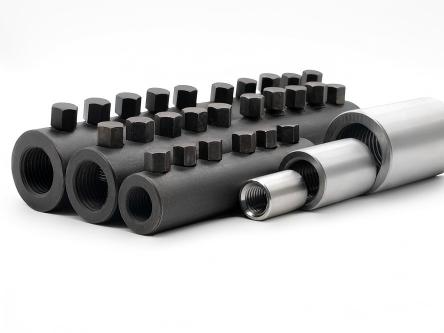
Different rebar coupler designs address different installation constraints and performance requirements. Threaded couplers require rebar ends to be prepared with matching threads, creating connections that achieve full strength through mechanical engagement. Bolted couplers use external fasteners to clamp rebar ends together, offering faster installation when threading isn’t practical. Grout-filled couplers accept rebar ends into a sleeve that gets filled with high-strength grout, accommodating tolerance variations that other types can’t handle.
The choice between types depends on project-specific factors: available space, required installation speed, tolerance conditions, and whether the connection needs to accommodate future disassembly. Precast applications often favor grout-filled couplers because they handle the alignment variations inherent in connecting prefabricated elements. Cast-in-place construction might lean toward threaded or bolted options where tighter tolerances are achievable.
Even the best-designed rebar coupler fails if installation doesn’t meet specifications. The connection between design intent and field performance runs through installation quality, which means best practices aren’t optional refinements—they’re requirements.
Surface Preparation: Rebar ends need to be clean and free from rust, mill scale, or debris that would interfere with thread engagement or grout bond.
Thread Engagement: Threaded couplers require full thread engagement as specified by the manufacturer—partial engagement reduces capacity proportionally.
Torque Application: Bolted couplers need correct torque applied with calibrated wrenches, not estimated with uncalibrated tools.
Grout Filling: Grout-filled couplers must achieve complete filling without voids, followed by proper curing before load application.
Visual Inspection: Every installed coupler should receive visual verification of alignment, engagement, and absence of damage.
Load Testing: Random load tests on installed couplers verify that field conditions match laboratory performance.
Quality assurance programs that skip these steps create uncertainty about whether the installed connections actually achieve their rated capacity. The cost of verification is trivial compared to the cost of structural inadequacy discovered after the concrete has cured.
The business case for rebar couplers doesn’t rest solely on structural requirements—economic advantages make them attractive even where lap splices would technically suffice. Material savings accumulate from eliminating the long overlap lengths that lap splices demand. A 40-diameter lap splice on large-diameter bars consumes substantial rebar that serves no purpose except developing bond strength.
Construction speed improves because coupler installation is faster than positioning, tying, and verifying lap splices. The time savings compound when reduced congestion makes concrete placement and vibration more efficient. Formwork becomes simpler when splice zones don’t require accommodation for protruding rebar lengths.
Site safety benefits from less rebar handling and fewer tripping hazards. Protruding rebar ends from lap splices create injury risks that mechanical splices eliminate. These operational improvements translate into schedule reliability and reduced incident rates—factors that affect project profitability beyond direct material and labor costs.
Rebar couplers represent a mature technology with well-established performance characteristics and clear application guidelines. Their role in modern construction reflects both structural necessity in demanding applications and practical advantages in routine ones. The standards framework ensures predictable performance when manufacturers and installers follow established protocols. What remains is execution—selecting appropriate coupler types, following installation best practices, and maintaining quality control that verifies field performance matches design assumptions.
Looking for reliable, high-precision steel tubing and rebar coupler solutions? At Changzhou Tenjan Steel Tube Co.,Ltd, we specialize in custom-shaped steel tubes and precision components compliant with ASTM, EN, DIN, and JIS standards. Our ISO-certified quality control, including PMI and NDT inspections, ensures material integrity for your critical applications. Contact us today for expert consultation and tailored solutions. Email: Sunny@tenjan.com, Tel: +86 51988789990, Phone/WhatsApp: +86 13401309791.
Rebar couplers provide full-strength mechanical connections that don’t depend on concrete bond development. This means reduced rebar congestion, shorter splice lengths, and faster installation. The practical result is better concrete consolidation, improved structural performance in seismic events, and connections that maintain capacity even when concrete quality varies. Cost savings follow from reduced material use and accelerated schedules.
The efficiency gains come from multiple sources. Eliminating long overlap lengths reduces rebar quantities directly. Faster installation cuts labor hours for rebar work. Reduced congestion simplifies concrete placement and formwork, which affects trades beyond just reinforcement installation. These efficiencies compound across a project schedule, often making rebar couplers cost-effective even when structural requirements don’t mandate them.
Rebar couplers must comply with applicable standards for the project jurisdiction—typically ASTM A970 in North America, EN 1992-1-1 in Europe, or equivalent national standards elsewhere. These standards specify performance requirements and testing protocols that manufacturers must satisfy. ISO 15835 provides international guidance specifically for mechanical splicing couplers. Verification through manufacturer certifications and project-specific testing confirms that installed couplers meet design assumptions.


Home Product Capabilities Case Studies Blogs About Get a Quote
Pipe & Tube Manufacturing Process Shapes & Profiles Pipes & Tubes Material Standard Steel Pipes & Tube Rebar Couplers Cold Drawn Steel Profiles & Bars
Oil & Petrochemical Industry Automotive & Motorcycle Components Mechanical Engineering Components Mining Construction Support Structures High-Pressure Boiler System Construction Machinery Geological Drilling Agricultural Machinery Parts Industrial Fluid Transfer Systems


© 2024 Changzhou Tenjan Steel Tube Co., Ltd All rights reserved. Privacy StatementTerms-ConditionsSitemap
