Welcome to Changzhou Tenjan Steel Tube Co., Ltd
Sunny@tenjan.com



Buying steel pipe well means getting the balance right between what the material needs to do, how you verify it actually performs, and how efficiently you can get it where it needs to go. That sounds straightforward enough, but the details matter more than most procurement teams expect until something goes wrong. The difference between a pipe that holds up under pressure for fifteen years and one that fails in three often comes down to decisions made during sourcing, not during installation.
The factors that determine whether a steel pipe works for your application start with basics that get overlooked surprisingly often. Manufacturing method shapes everything downstream. Seamless steel tubing gets formed from a solid billet that’s heated and pushed through a die to create the hollow center. No weld seam means no weak point where the material properties change, which is why high-pressure boilers and hydraulic systems almost always specify seamless.
Cold drawn profiles take this further by pulling the tube through dies at room temperature. The result is tighter dimensional tolerances and better surface finish. For automotive hydraulics or construction machinery where components need to fit precisely and cycle repeatedly under load, that extra processing step pays for itself.
The steel grade matters just as much as the manufacturing process. ST52 steel pipe handles structural loads where moderate strength and good weldability are needed. 25CrMo4 steel pipe brings chromium and molybdenum into the alloy for applications where heat resistance and fatigue strength become critical. Picking the wrong grade for the environment means either overpaying for properties you don’t need or watching the pipe degrade faster than your maintenance schedule can handle.
Welded pipes start as flat steel strips or plates rolled into cylinders and joined along the seam. The process costs less because it uses simpler equipment and runs faster. For structural applications or low-pressure fluid transfer, welded pipe works fine and saves money.
The tradeoff shows up when pressure increases or the pipe faces cyclic loading. That weld seam represents a metallurgical discontinuity. The heat-affected zone next to the weld has different grain structure and potentially different mechanical properties than the parent material. Under high stress, cracks tend to initiate there first.
| Feature | Seamless Steel Pipe | Welded Steel Pipe |
|---|---|---|
| Manufacturing | Extruded or drawn from solid billet | Formed from rolled plate/strip, then welded |
| Strength | Higher, no weld seam weakness | Generally lower due to weld seam |
| Pressure Rating | Superior for high-pressure applications | Lower pressure tolerance, depends on weld quality |
| Cost | Higher production cost | More cost-efficient to produce |
| Applications | High-pressure boilers, hydraulics, oil & gas | Structural, low-pressure fluid transfer |
| Uniformity | Excellent, consistent wall thickness | Can have variations near weld seam |
Seamless steel tubing advantages become most apparent in applications where failure consequences are severe. A burst hydraulic line on a construction crane or a failed boiler tube in a power plant creates problems that dwarf any savings from cheaper pipe.
Steel pipe certifications exist because buyers learned the hard way that trusting suppliers without verification leads to expensive failures. ASTM, EN, DIN, and JIS standards specify chemical composition, mechanical properties, dimensional tolerances, and testing requirements. When a pipe carries a DIN 17175 designation, that tells you it meets specific criteria for high-temperature boiler service. ASTM A179 steel pipe has been tested and verified for heat exchanger applications.
The paperwork matters, but so does knowing what the paperwork actually proves. Material test reports show chemical analysis and mechanical test results for the specific heat of steel your pipe came from. Positive Material Identification uses handheld spectrometers to verify the alloy composition matches what the documentation claims. Non-destructive testing catches internal flaws, inclusions, or surface defects that would compromise performance.
Quality assurance steel pipe programs integrate these checks throughout manufacturing rather than just at final inspection. Catching a problem after the pipe is cut to length and ready to ship costs more than catching it when the tube first comes off the mill.
New supplier relationships carry risk that established ones don’t. The verification process needs to be thorough enough to catch problems before they become your problems.
Start with documentation. Request material test reports and certifications for the specific standards your application requires. A supplier who can’t produce these promptly probably doesn’t have robust quality systems.
Factory audits reveal what documentation can’t. Walk the production floor. Look at how they handle material traceability, what inspection equipment they use, and whether operators actually follow the procedures posted on the walls. The gap between written procedures and actual practice tells you a lot about quality culture.
Sample testing adds another layer. Send samples to an independent lab for chemical analysis, mechanical testing, and whatever non-destructive examination makes sense for your application. Ultrasonic testing finds internal voids and inclusions. Eddy current testing catches surface and near-surface defects.
Third party inspection agencies provide independent verification when the stakes justify the cost. They have no incentive to overlook problems, and their reports carry weight if disputes arise later.
Logistics complexity increases with international sourcing. Lead times for standard seamless pipe and tube products typically run four to six weeks from order to delivery. Precision pipe and tube with tighter tolerances or custom dimensions extends that to eight weeks or more. Custom shaped steel tubes with hexagonal, oval, or other non-standard profiles can push lead times past twelve weeks depending on tooling requirements.
Vertically integrated manufacturers offer advantages that become apparent when problems arise. When the same company controls raw material sourcing, tube production, heat treatment, and finishing, accountability stays clear and communication stays simple. Coordinating between separate suppliers for each step introduces delays and finger-pointing when something goes wrong.
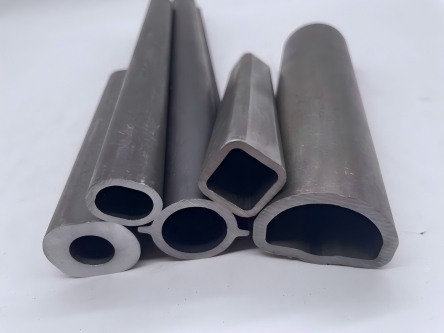
Special-shaped alloy steel tubes and special-shaped carbon steel tubes serve applications where round pipe won’t fit the design constraints. Shaped steel pipes and tubes require specialized tooling and expertise, but they eliminate secondary machining operations that would otherwise be needed to create the required geometry from round stock.
Shipping steel pipe internationally involves variables that domestic orders don’t. Customs clearance requires accurate documentation. Harmonized tariff codes need to be correct. Country of origin certificates, material test reports, and commercial invoices all need to align.
Sea freight handles bulk orders economically but adds transit time. Container shipping from Asia to North America typically takes three to four weeks on the water, plus time at both ends for loading, unloading, and customs processing. Air freight makes sense for urgent smaller quantities where the premium justifies faster delivery.
Port congestion creates unpredictable delays. Weather disrupts schedules. Customs inspections can hold shipments for days or weeks if documentation problems surface. Building buffer time into project schedules and maintaining relationships with experienced freight forwarding partners reduces the impact when these disruptions occur.
Treating steel pipe procurement as a series of one-off transactions leaves value on the table. Strategic partnerships with manufacturers who understand your applications create advantages that accumulate over time.
Consistent pricing becomes possible when suppliers can plan production around your forecasted needs rather than scrambling to fit rush orders into their schedule. Access to technical expertise helps when new applications arise or problems need troubleshooting. Priority allocation during supply constraints goes to customers who represent ongoing business rather than occasional buyers.
Vendor selection criteria should weight manufacturing capability and quality systems heavily. Full process control from raw material through finished product indicates a supplier who can maintain consistency. Certifications to relevant standards demonstrate commitment to quality that goes beyond marketing claims.
The relationship works both ways. Suppliers invest more in customers who provide reliable volume, clear specifications, and reasonable lead times. Treating procurement as a partnership rather than an adversarial negotiation creates incentives for both sides to solve problems together.
Changzhou Tenjan Steel Tube Co.,Ltd brings nearly two decades of experience to precision steel tubing applications. The vertical integration from raw material through finished product means quality control stays consistent throughout the process. Automotive, boiler, and hydraulic applications all require different combinations of properties, and the manufacturing flexibility to address each of them comes from understanding what the end use actually demands.
Reach out at Sunny@tenjan.com or +86 13401309791 to discuss specific requirements. Whether the application calls for standard seamless tubing or custom profiles with tight tolerances, the conversation starts with understanding what the pipe actually needs to do.
ASTM A106 Grade B and Grade C see wide use in high-temperature fluid transport because they balance strength with weldability. ASTM A335 P11 and P22 add chromium and molybdenum for better creep resistance at elevated temperatures, making them standard choices for power plant piping. EN standards for boiler and pressure vessel steels cover similar territory with different testing and certification frameworks. ASTM A106 Gr.B steel pipe specifically handles the combination of pressure and temperature that makes high-pressure boiler service demanding.
The cold drawing process works the metal below its recrystallization temperature, which strain-hardens the material and increases tensile strength. Surface finish improves because the die polishes the outer surface during drawing. Dimensional tolerances tighten significantly compared to hot-finished tube. The grain structure refines, which can improve fatigue resistance. DIN 2391 steel pipe and EN10305-1 steel pipe both specify cold-drawn production for applications where these enhanced properties justify the additional processing cost.
Custom shaped steel tubes in square, rectangular, hexagonal, and more complex geometries get produced to match specific design requirements. The tooling investment makes sense when the alternative would be extensive secondary machining of round tube or when the shape provides functional advantages in the final assembly. Full process control from raw material through finishing ensures the custom profiles meet the dimensional and mechanical specifications the application requires.


Home Product Capabilities Case Studies Blogs About Get a Quote
Pipe & Tube Manufacturing Process Shapes & Profiles Pipes & Tubes Material Standard Steel Pipes & Tube Rebar Couplers Cold Drawn Steel Profiles & Bars
Oil & Petrochemical Industry Automotive & Motorcycle Components Mechanical Engineering Components Mining Construction Support Structures High-Pressure Boiler System Construction Machinery Geological Drilling Agricultural Machinery Parts Industrial Fluid Transfer Systems


© 2024 Changzhou Tenjan Steel Tube Co., Ltd All rights reserved. Privacy StatementTerms-ConditionsSitemap
