Welcome to Changzhou Tenjan Steel Tube Co., Ltd
Sunny@tenjan.com



Precision steel tubing leaves very little room for error, and concentricity is the one dimension I refuse to gamble with. I have watched a cylinder bind because a tube was a fraction off-center, and the downtime bill still stings. Even tiny deviations ripple into failures and cost, so we treat concentricity as a thread that runs from raw material through tooling to inspection. Here, we walk through the techniques that actually move the needle, the controls we use in production, and the checks that lock in integrity and reliable function.
Understanding the Criticality of Tube Concentricity in Manufacturing
1. Defining Tube Concentricity and Its Importance
Tube concentricity describes how well the center of the inner diameter aligns with the center of the outer diameter along the tube length. In a perfectly concentric tube, wall thickness stays uniform around the entire circumference. Any deviation introduces eccentricity, which means varying wall thickness. This geometric accuracy underpins the structural integrity and performance of precision steel tubing. High concentricity delivers even stress distribution, predictable material response, and efficient fluid flow in hydraulic systems.
2. The Impact of Poor Concentricity on Product Performance and Quality
Poor concentricity creates problems across applications. Uneven walls concentrate stress, which accelerates fatigue under cyclic loading. In hydraulic cylinders, eccentric tubes trigger piston binding, seal wear, and inefficient operation. Rotating parts pick up imbalance, which drives vibration and noise. That drag on system performance shortens service life. It also complicates downstream machining, which lifts scrap and total cost. For instance, a tube with notable eccentricity needs extra material removal to obtain a uniform inner or outer diameter, burning both time and resources.
3. Industries Reliant on High-Concentricity Tubing
Several sectors rely on high-concentricity tubing for mission-critical work. Automotive uses precision tubes in fuel lines, braking systems, and suspension components, where consistency matters every day. Construction machinery depends on hydraulic cylinders and structural components with tight concentricity tolerances for rugged, dependable operation. In energy, high-pressure boilers and heat exchangers require uniform walls for safe, efficient heat transfer. Aerospace taps precision tubing in structural and fluid transfer systems, where failure is off the table. Other key users include medical devices, oil and gas, and general mechanical engineering.
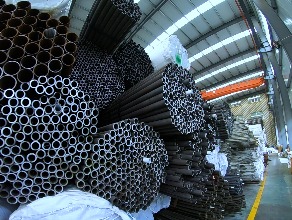
Advanced Manufacturing Processes for Enhancing Tube Concentricity
Achieving superior tube concentricity means tight control at every step. We deploy targeted techniques to curb eccentricity and hold dimensional precision.
1. The Role of Cold Drawing in Precision Tube Production
Cold drawing is a core method for high-precision steel tubing with excellent concentricity. A tube is pulled through a die to reduce outer diameter and wall thickness at the same time. This controlled deformation refines the grain structure and elevates mechanical properties. Critically, cold drawing sharpens dimensional accuracy, including concentricity. We use advanced drawing benches with precise tooling and well-managed lubrication to hit tight tolerances. Multiple drawing passes, often with intermediate annealing, stepwise improve concentricity. Our Cold Drawn Pipe&Tube products exemplify this precision.
2. Optimizing Cold Rolling Techniques for Dimensional Accuracy
Cold rolling also boosts tube concentricity and surface finish. Rollers compress the tube wall, reducing diameter and thickness. Unlike drawing, cold rolling applies compressive forces, which suit certain materials and surface targets. Pilger mills or multi-roll cold reduction mills are common choices. We control roll gap, feed rate, and tension with care to keep wall thickness uniform. The result is high dimensional accuracy and smoother internal and external surfaces. Our Cold Rolled Pipe&Tube offerings benefit directly from optimized cold rolling.
3. Specialized Equipment and Tooling for Concentricity Control
Equipment quality and tooling directly shape final concentricity. We invest in state-of-the-art cold drawing dies, mandrels, and rolling mills engineered for precision. Dies are built from high-grade tool steels or carbides for wear resistance and consistent dimensions. Mandrels, which govern the inner diameter, are precisely ground and polished to prevent scoring and protect internal concentricity. Modern machinery integrates advanced sensors and control systems that enable real-time adjustments. This reduces deviations and keeps product quality stable across batches.
Key Factors Influencing and Controlling Tube Concentricity
Multiple variables affect tube concentricity during manufacturing. Managing these inputs is how we hold the line on quality.
1. Material Selection and Its Effect on Concentricity
Raw material choice strongly impacts achievable concentricity. Uniform microstructure and steady mechanical properties yield more predictable deformation during cold work. Variations in hardness or inclusions can divert metal flow during drawing or rolling, causing eccentricity. We select high-quality carbon and alloy steels known for strong cold workability. For example, choosing specific grades of Seamless Carbon Steel Tubes or Seamless Alloy Steel Tubes with controlled chemistries stabilizes processing. This lowers internal stresses and supports uniform deformation.
2. Process Parameters and Their Adjustment for Precision
Tight control of process parameters is vital for maintaining concentricity. For drawing, we tune drawing speed, reduction ratio, die angle, and lubrication. In cold rolling, roll force, roll gap, and feed rate are critical. Any drift in these values can introduce or amplify eccentricity. We use sophisticated control systems to monitor and adjust these variables in real time. That keeps material flow steady and deformation uniform, which improves concentricity. We also calibrate machinery and tooling regularly to preserve optimal conditions.
3. In-Process Measurement and Real-Time Monitoring Systems
Continuous monitoring during production enables fast detection and correction of concentricity drift. We integrate ultrasonic sensors and laser gauges into our lines for in-process measurement. These systems deliver real-time readings of wall thickness and diameter variation. Operators can adjust process parameters immediately, avoiding non-conforming output. This proactive stance cuts scrap and elevates overall product quality. These systems are part of our precision-first approach.
Quality Assurance and Inspection for Verifying Concentricity
Robust quality assurance is non-negotiable when verifying concentricity in finished tubes. We rely on stringent inspection methods to protect product integrity.
1. Non-Destructive Testing (NDT) Methods for Tube Inspection
Non-destructive testing methods allow us to evaluate concentricity without harming the material. Ultrasonic testing measures wall thickness variation around the circumference. Eddy current testing flags surface and subsurface flaws that can track with concentricity issues. We also use magnetic particle inspection for ferromagnetic materials to reveal surface discontinuities. These NDT methods provide a wide-ranging view of internal and external integrity, confirming that tubes meet specified concentricity requirements.
2. Precision Measurement Tools and Techniques for Concentricity
Beyond NDT, we apply precision measurement tools for direct verification. Coordinate Measuring Machines deliver highly accurate dimensions for both inner and outer diameters. Digital micrometers and calipers capture precise wall thickness at multiple points along the tube. Specialized concentricity gauges and run-out indicators quantify the deviation of the inner bore relative


Home Product Capabilities Case Studies Blogs About Get a Quote
Pipe & Tube Manufacturing Process Shapes & Profiles Pipes & Tubes Material Standard Steel Pipes & Tube Rebar Couplers Cold Drawn Steel Profiles & Bars
Oil & Petrochemical Industry Automotive & Motorcycle Components Mechanical Engineering Components Mining Construction Support Structures High-Pressure Boiler System Construction Machinery Geological Drilling Agricultural Machinery Parts Industrial Fluid Transfer Systems


© 2024 Changzhou Tenjan Steel Tube Co., Ltd All rights reserved. Privacy StatementTerms-ConditionsSitemap
