Welcome to Changzhou Tenjan Steel Tube Co., Ltd
Sunny@tenjan.com



After two decades of making cold-drawn tubes, I’m still surprised how many procurement teams treat a mill test certificate like a birth certificate for their boiler tubes. You see chemistry within ASTM A210 limits, you nod at the tensile numbers, and you assume the tube will last. In practice, I’ve watched tubes that sailed through material tests fail within a year because of manufacturing shortcuts that no standard MTC captures. If you’re sourcing A210 boiler tubes, what you know about the production path and the verification steps that follow the paperwork determines whether that tube survives years of thermal cycling or develops a leak just when you don’t need one. Here’s what to look for beyond the paper trail.
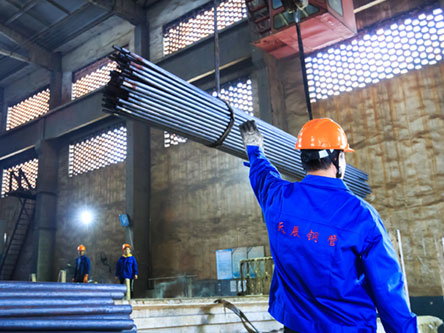
ASTM A210 specifies seamless medium-carbon steel tubes for boiler and superheater flues, waterwall panels, economizers, and similar high-temperature applications. The standard covers two common grades. The table below summarizes the main requirements per ASTM A210/A210M.
| Grade | C max (%) | Mn (%) | P max (%) | S max (%) | Tensile Strength (MPa, min) | Yield Strength (MPa, min) | Elongation in 2 in. (min 30%) |
|---|---|---|---|---|---|---|---|
| A-1 | 0.27 | 0.93 max | 0.035 | 0.035 | 415 | 255 | 30 |
| C | 0.35 | 0.29–1.06 | 0.035 | 0.035 | 485 | 275 | 30 |
The key split between A-1 and C boils down to strength versus ductility. Grade C buys you a higher tensile margin, which matters when your boiler runs at the upper end of its design pressure, but the carbon bump pushes the material closer to the hardenability limit. If your tube supplier neglects precise heat control during the rolling and cold-drawing steps, a Grade C tube can develop inconsistent hardness bands that cause premature cracking at rolled joints. That’s something no chemical certificate will flag—you need to know how the tube was made, not just what it’s made of.
I sometimes joke that mill test certificates are like restaurant menus: they tell you what’s supposed to be in the dish, but they don’t prove the chef washed the vegetables. In tube manufacturing, the “vegetable washing” is the processing route—cold-drawn versus hot-finished, the reduction ratio, the heat treatment soak times. These choices heavily influence grain structure, residual stress, and surface condition, all of which affect boiler tube life far more than a one-time tensile result.
Cold-drawn A210 tubes go through a sequence of drawing passes that reduce diameter and wall thickness, typically with an intermediate anneal. Each pass refines the grain, raises hardness uniformly, and produces a smooth ID that limits scale buildup. A hot-finished tube, while cheaper and perfectly legitimate under the standard, often carries a heavier oxide scale and a less homogeneous microstructure. I’ve seen hot-finished A210 tubes with yield strength that barely cleared the 255 MPa threshold on the MTC, but then dropped below that mark after the boiler’s first heat cycle because residual stress relaxed. In our shop, we prefer cold-drawing for A210 because it gives you a tube that stays dimensionally stable when you push it to 400 °C, not just on a test bench at 20 °C.
The real gain isn’t just a better surface roughness number; it’s the uniformity of wall thickness around the circumference. A hot-rolled tube can carry a 5% wall variation without anyone blinking. That unevenness, when exposed to high-pressure steam flow, turns into hot spots and eventual tube rupture. Cold drawing through precision dies keeps our A210 tube walls within ±0.1mm, and that sort of consistency directly adds thousands of hours to a boiler’s runs between inspections.
If you’re responsible for purchasing A210 tubes, I’d recommend these three actions that most buyers skip—and then regret.
1. Request the eddy current chart, not just the pass/fail statement.
Eddy current testing sounds automatic: run the tube through the coil, if it doesn’t beep, ship it. But sensitivity settings vary. A supplier who calibrates the ET instrument to a 6 mm through-drilled hole as the reference defect will catch macro-laminations but might miss tight, longitudinal seams that open up under thermal stress. Ask for the actual strip chart or digital record. When I see an ET chart with a clean baseline and no excitation noise, I know the tube wall is genuinely homogeneous. When the supplier won’t share the chart, I assume they had something to hide.
2. Spot-check wall thickness and straightness on delivery.
I’m not talking about the mill’s own QC records. After the tube arrives at your warehouse or the boiler fabricator, pull 5% of the bundle and ultrasonic thickness-gauges them in four quadrants. If the wall variation exceeds 1% of nominal, the tube may have been drawn with worn mandrels or insufficient die support. Straightness matters too: a 3 mm per meter bow might be within ASTM A210’s tolerance, but it creates fit-up problems in tight tube panels. In one case, our team caught a batch where the supplier had swapped a few hot-finished lengths into a cold-drawn order, and the bow jammed the panel assembly jig.
3. Correlate the chemistry with an independent sample, and look for elements not listed on the cert.
A spectrographic spark test on a random tube from the lot—checked against the ladle analysis on the MTC—confirms the material origin didn’t change mid-batch. I’ve spotted extra copper or nickel traces that indicated the mill used a diluted alloy heat, which can shift the creep properties over time. You can’t control what you don’t measure, and a second opinion from an outside lab costs far less than a tube failure during commissioning.
If your program involves prolonged high-temperature exposure, confirming eddy current sensitivity and wall thickness uniformity before finalizing the BOM can prevent costly downtime—reach out at Sunny@tenjan.com for a specification review.
Sourcing ASTM A210 tubes from China often makes commercial sense, but the audit criteria cannot be limited to an ISO 9001 badge and a tasting-menu lunch. The following four items cut through the sales brochure.
Full in-house processing from billet to finished tube: A supplier who cold-draws from its own continuous cast blooms has material traceability that a trader sourcing from multiple mills can’t match. Ask to walk the production flow, from ladle sample storage to the finished goods yard.
NDT capability: The line should include a wet hydrostatic test unit capable of exceeding 1.5× design pressure, in-line eddy current testing with real-time rejection, and a handheld ultrasonic thickness gauge for final spot checks. Hydraulic test alone is not enough for boiler tube; you need the electromagnetic scan to catch subsurface defects.
Documentation discipline: At Tenjan, we attach a unique heat number to each bundle that links back to the chemical melt analysis, the intermediate anneal temperatures, the ET strip chart, and the final dimensional report. If a supplier can’t produce that data spine within hours of your request, walk away.
Engineer-to-engineer communication: A salesperson who forwards your drawing to an anonymous “technical team” adds three days of telephone-game confusion. Work with a supplier where you can discuss wall reduction ratios and bend test specifications directly with the metallurgical engineer who signs the certificates.
Relying solely on composition. Chemistry gets you through the door. Process control and NDT are what keep the boiler running. If your purchase order only references the ASTM A210 number with no further quality riders, you’re accepting the minimum.
Chasing the lowest MOQ without understanding the mixing risk. Small orders often end up as “runner lots” where the mill bundles leftover tubes from several heats into one shipment. That mixing hurts traceability and can put heat numbers with different grain growth behavior into the same boiler panel.
Accepting standard eddy current sensitivity. The standard reference defect in ASTM E570 is a 0.031″ diameter hole, but for high-pressure boilers, we set our ET instruments 30% tighter to catch incipient defects. Specify your required sensitivity in the PO.
Signing off on an MTC without physical correlation. A digital copy of the certificate means nothing if you haven’t touched the tube. Always pull samples, always compare.
Not establishing a direct technical contact before the order. When a problem arises later—a delayed shipment, a borderline hardness result—you don’t want to be three email layers away from the person who can make a decision. Get the production engineer’s name and phone number during the audit.
Sourcing ASTM A210 boiler tubes that hold up under years of high-pressure cycling takes more than matching a spec line to a price sheet. At Tenjan Steel Tube, we produce cold-drawn seamless tubes with documented process control from ladle analysis to final hydrostatic test, so you receive material with verifiable integrity. Send your required dimensions, grade, and quantity to Sunny@tenjan.com or reach us at +86 13401309791 (WhatsApp). We’ll respond with a detailed material proposal and available delivery timeline.
Material-wise, yes. ASME SA210 is essentially the identical specification adopted for ASME Boiler and Pressure Vessel Code construction. The difference is procedural: if your boiler must be code-stamped, you’ll need SA210 tubes with the appropriate marking and certified by an authorized manufacturer. From a production standpoint, the same tube can often serve both, but the documentation trail changes slightly. Always clarify with your third-party inspector which designation applies.
It depends on the operating temperature and pressure margin. If your design leaves plenty of headroom below the tube’s yield strength at temperature, A-1’s slightly better ductility makes flaring and rolling easier. When you’re pushing right up against the allowed stress limits, Grade C’s extra 70 MPa buys you a safety cushion, provided the fabricator can handle the reduced elongation. In retrofits where existing tubes failed early, I’ve often seen Grade C replace A-1 simply because the root cause was creep, not corrosion.
Beyond the three verification steps described earlier, ask for a live video inspection of your lot during the final hydrostatic test, with the tube markings visible. A serious manufacturer will cooperate; one that makes excuses about “confidential processes” usually has something to hide. Also, insist that the MTC carries the heat number, all required mechanical values, and a statement of compliance to ASTM A210, and cross-check it against independent spot analyses on arrival.
This varies with tooling. Standard OD sizes like 2″ or 2.5″ with common wall thicknesses often require 10 tons or more to run economically. However, if your dimensions fall within an existing die set, some mills will agree to a smaller trial lot. For non-standard sizes, the minimum may drop because the setup cost is amortized. Always ask the supplier what tooling they already have in house; if they don’t need to build new drawing plugs, your MOQ could be as low as 3 tons.
Yes, Tenjan regularly cold-draws A210-equivalent tubes up to 12 meters, depending on diameter and wall combination, with full eddy current and hydrostatic test coverage over the entire length. Longer lengths reduce circumferential joint welds in your boiler panel, which cuts potential leak paths and fabrication time. Share your target length, OD, and wall spec at Sunny@tenjan.com, and we’ll confirm whether it fits within our production capabilities without requiring an intermediary weld splice.


Home Product Capabilities Case Studies Blogs About Get a Quote
Pipe & Tube Manufacturing Process Shapes & Profiles Pipes & Tubes Material Standard Steel Pipes & Tube Rebar Couplers Cold Drawn Steel Profiles & Bars
Oil & Petrochemical Industry Automotive & Motorcycle Components Mechanical Engineering Components Mining Construction Support Structures High-Pressure Boiler System Construction Machinery Geological Drilling Agricultural Machinery Parts Industrial Fluid Transfer Systems


© 2024 Changzhou Tenjan Steel Tube Co., Ltd All rights reserved. Privacy StatementTerms-ConditionsSitemap
