Welcome to Changzhou Tenjan Steel Tube Co., Ltd
Sunny@tenjan.com



Seamless steel pipes carry fluid under pressure, hold up structures, and handle conditions that would split a welded joint wide open. The reason comes down to how they’re made: no weld seam means no built-in weak spot. Every millimeter of wall thickness does the same job as the next. Getting there takes more than heating steel and pushing it through a die. It takes control at every stage—material selection, piercing, rolling, drawing, and inspection—each one setting up the next. At Changzhou Tenjan Steel Tube Co., Ltd, we’ve spent two decades refining that sequence, and the details still matter as much as they did on day one.
A seamless steel pipe starts as a solid billet. Heat it, pierce it, roll it out, and you have a tube with no longitudinal weld. That single fact changes everything about how the pipe performs under stress.
Welded pipes have a seam running their full length. Under high internal pressure or cyclic loading, that seam becomes the failure point. Seamless pipes distribute stress uniformly around the circumference. The wall thickness stays consistent, and so does the strength.
This matters most in high-pressure fluid transport, extreme temperature service, and corrosive environments. A pipeline carrying superheated steam or a hydraulic cylinder cycling thousands of times per hour cannot tolerate weak spots. Seamless construction removes that variable from the equation.
We produce seamless carbon steel tubes and alloy options specifically for these demanding scenarios. The performance advantage over welded alternatives isn’t theoretical—it shows up in pressure ratings, fatigue life, and long-term reliability.
The quality of a seamless steel pipe is locked in before the first heating cycle. Billet selection determines what the finished tube can and cannot do.
We source carbon steel and alloy steel billets matched to specific application requirements. The chemical composition—carbon content, chromium, molybdenum, manganese, and other alloying elements—directly controls mechanical properties. A tube destined for high-temperature boiler service needs different chemistry than one going into a hydraulic cylinder.
Every billet undergoes verification against international material specifications. We work with ASTM, EN, DIN, and JIS standards depending on the end application. For high-strength wear-resistant applications, we might select 4140 Steel Pipe. For high-temperature service lines, ASTM A106 Gr.B Steel Pipe is a common choice.
Billet preparation includes cleaning and cutting to precise lengths. Surface defects or dimensional inconsistencies at this stage propagate through the entire manufacturing process. Catching them early prevents scrap and rework downstream.
Steel grade selection is an engineering decision, not a catalog exercise. The wrong grade in the right dimensions still fails.
Carbon content determines hardness and strength but reduces ductility and weldability at higher levels. Alloying elements modify these tradeoffs. Chromium adds corrosion resistance and high-temperature strength. Molybdenum improves creep resistance. Manganese enhances hardenability and tensile strength.
16MnCr5 Steel Pipe works well for case-hardening applications where you need a tough core with a hard, wear-resistant surface. E355 Steel Pipe provides solid mechanical properties with good weldability for general structural uses.
We work with clients to understand their actual operating conditions—not just the specification sheet, but the real-world stresses, temperatures, and environments the tube will face. That conversation shapes grade selection and ensures the finished product performs as expected.
The hot rolling process is where a solid billet becomes a hollow pipe. Everything that happens here determines the tube’s basic dimensions and metallurgical structure.
We heat billets above 1,200°C (2,200°F), well into the austenitic range where steel becomes pliable enough to deform without cracking. At these temperatures, the crystal structure allows significant plastic flow.
The mandrel mill process handles most of our production. It’s efficient for producing long lengths of seamless tubing with consistent wall thickness. Extrusion serves specific applications, particularly larger diameters or complex alloy compositions that don’t roll well.
Temperature control during hot working is critical. Too cold, and the steel cracks. Too hot, and grain growth degrades mechanical properties. The deformation sequence must maintain consistent temperature throughout the tube cross-section to prevent internal stresses.
The first transformation happens in the piercing mill. A solid billet enters; a hollow shell exits.
The process works through what’s called the Mannesmann effect. Two barrel-shaped rolls rotate in opposite directions, gripping the heated billet and drawing it forward while simultaneously rotating it. This creates tensile stresses at the billet’s center.
A pointed piercing mandrel sits between the rolls, aligned with the billet’s axis. As the rolls squeeze and rotate the billet, those internal tensile stresses cause the center to separate. The mandrel expands this separation into a defined hollow cavity.
The resulting “hollow bloom” has rough dimensions—approximate outer diameter and wall thickness. It’s not a finished product, but it’s the starting point for all subsequent shaping. The quality of this initial piercing affects everything downstream.
After piercing, the hollow bloom moves to the mandrel mill for progressive shaping.
A long cylindrical mandrel slides inside the hollow bloom. The assembly then passes through a series of rolling stands, each one reducing the wall thickness and outer diameter while elongating the tube.
The mandrel controls internal diameter consistency. Without it, the tube would collapse unevenly under the rolling pressure. The external rolls control outer dimensions and wall thickness.
Each stand in the sequence makes incremental reductions. Trying to take too much material in a single pass risks surface defects and dimensional inconsistencies. The gradual approach maintains uniform wall thickness and concentricity.
Hot-finished seamless pipes from this stage have good mechanical properties and are ready for applications where tight tolerances aren’t critical. For precision work, they move to cold drawing.
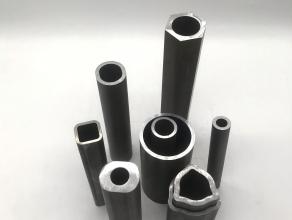
Hot rolling gets the basic tube shape. Cold drawing refines it into something suitable for precision applications.
The process involves pulling a hot-rolled or normalized pipe through a die at room temperature. The die is smaller than the tube’s original diameter, so the tube compresses as it passes through. Wall thickness decreases, length increases, and the surface smooths out.
Cold working hardens the steel. The deformation at room temperature creates dislocations in the crystal structure that impede further deformation. Tensile strength and yield strength both increase significantly.
For applications like hydraulic cylinders, automotive components, and precision machinery, cold drawing is essential. These applications demand tight tolerances and smooth surfaces that hot rolling alone cannot achieve. Our Precision Pipe&Tube products rely on these cold drawing techniques.
Cold drawing follows a controlled sequence that builds precision incrementally.
First, hot-rolled tubes go through pickling to remove the oxide scale that forms during hot working. Acid baths dissolve the scale, leaving clean metal. Then the tubes receive lubrication—typically a phosphate coating followed by soap or oil—to reduce friction during drawing.
The tube end gets pointed so it can feed through the die and grip the draw bench. The bench pulls the tube through the die, reducing diameter and wall thickness in a single pass.
For internal diameter control, a mandrel rides inside the tube during drawing. The die controls the outside; the mandrel controls the inside. Together, they produce concentricity that hot rolling cannot match.
Multiple drawing passes may be necessary for significant size reductions. Between passes, annealing heat treatment restores ductility that cold working removes. Without annealing, the tube would crack during subsequent draws.
This process produces cold drawn profiles and custom-shaped steel tubes with tolerances as tight as ±0.1mm on outer diameter and wall thickness. Surface finish comes out smooth and bright, ready for demanding applications.
The choice between hot-rolled and cold-drawn seamless pipes depends on what the application actually requires.
| Feature | Hot Rolled Seamless Pipes | Cold Drawn Seamless Pipes |
|---|---|---|
| Process Temperature | Above recrystallization (>1,200°C) | Room temperature |
| Dimensional Accuracy | Moderate, wider tolerances | High, tight tolerances (±0.1mm typical) |
| Surface Finish | Rougher, scaled surface | Smooth, bright, scale-free |
| Mechanical Properties | Good strength, ductility, toughness | Enhanced tensile and yield strength |
| Wall Thickness Range | Generally thicker | Can achieve thinner walls precisely |
| Typical Applications | Structural, pressure piping, oil & gas | Hydraulic cylinders, automotive, precision components |
Cold-drawn pipes like our ST35 Seamless Pipe or EN10305-1 Steel Pipe deliver the dimensional stability and surface quality that precision engineering demands. Hot-rolled pipes such as S355JR Steel Pipe make economic sense for structural applications where tight tolerances aren’t the primary concern.
Quality control at Changzhou Tenjan isn’t a final inspection step. It’s integrated into every stage of manufacturing, from billet receipt to shipping.
Since 2004, we’ve maintained ISO-certified quality management systems. The certification matters less than what it represents: documented procedures, traceable materials, calibrated equipment, and trained personnel at every station.
Raw material verification starts the process. We confirm chemical composition and mechanical properties before billets enter production. Dimensional checks occur after each major forming operation. Final inspection covers everything—dimensions, surface condition, mechanical properties, and internal integrity.
The tubes we produce often operate in critical environments. A failure in a hydraulic system can halt a production line. A failure in a boiler tube can cause serious injury. Our quality systems exist to prevent those failures.
Some defects hide inside the tube wall or just below the surface. Visual inspection cannot find them. Non-destructive testing (NDT) can.
Ultrasonic testing sends high-frequency sound waves through the tube wall. Defects—cracks, voids, inclusions—reflect sound differently than solid metal. The reflections map the tube’s internal structure without cutting it open.
Eddy current testing applies electromagnetic fields to the tube surface. Defects disrupt the field in characteristic ways. This method excels at finding surface and near-surface flaws that ultrasonic testing might miss.
Hydrostatic testing pressurizes the tube with water to a specified level above its rated working pressure. If it holds without leaking or deforming, the tube passes. This test proves structural soundness under actual pressure conditions.
Positive Material Identification (PMI) uses X-ray fluorescence or optical emission spectroscopy to verify chemical composition. It confirms that the tube is actually made from the specified grade, not something that looks similar but performs differently.
Every tube we ship—whether it’s 41Cr4 Alloy Pipe or 1020 Steel Pipe—passes through appropriate NDT methods based on its application requirements.
International standards exist so that buyers and sellers share a common understanding of what a product should be. We manufacture to these standards because they represent accumulated engineering knowledge about what works.
Our production covers ASTM standards including ASTM A179 Steel Pipe and ASTM A519 Steel Pipe. European EN standards like EN 10297-1 Steel Pipe define requirements for mechanical and general engineering applications. German DIN standards such as DIN 2391 Steel Pipe specify precision steel tubes. Japanese JIS standards including JIS G3441 Steel Pipe, JIS G3445 Steel Pipe, JIS G3461 Steel Pipe, STKM11A Steel Pipes, and STKM13A Steel Tubes cover various applications from boiler tubes to machine structural use.
ISO 9001 certification validates our quality management system. It means our processes are documented, controlled, and subject to regular audit. For procurement specialists sourcing globally, this certification provides assurance that our operations meet internationally recognized standards.
Precision seamless steel tubing serves industries where failure is expensive, dangerous, or both.
Automotive applications include chassis components, suspension systems, and hydraulic lines. These tubes handle cyclic loading, vibration, and exposure to road conditions. Dimensional consistency matters because these parts must fit precisely into assemblies designed around specific tolerances.
Construction machinery relies on seamless tubes for hydraulic cylinders and structural frames. Excavators, loaders, and cranes subject these tubes to enormous loads and harsh operating conditions. The tubes must maintain integrity through thousands of pressure cycles.
High-pressure boiler tubes operate at extreme temperatures and pressures. Standards like DIN 17175 Steel Pipe and ASTM A192 Steel Pipe specify requirements for these critical applications. A tube failure in a boiler system can cause catastrophic damage.
We also produce specialized tubing for fluid transport, geological drilling, and agricultural machinery. Our capability extends to Special-Shaped Alloy Steel Tubes and Special-Shaped Carbon Steel Tubes in profiles including Oval Steel Pipes&Tubes, Hexagonal Steel Pipes&Tubes, and Octagonal Steel Pipes&Tubes.
| Product Example | Material | Process | Key Application | Specific Properties |
|---|---|---|---|---|
| 4130 Seamless Pipe | Chromium-Molybdenum Alloy | Cold Drawn & Cold Rolled | Automotive, Hydraulics | High strength, good weldability |
| Q355B Steel Pipe | High-Strength Low-Alloy | Cold Drawn & Cold Rolled | Construction Machinery | Excellent weldability, strong mechanical properties |
| ST52 Steel Pipe | Structural Steel | Cold Drawn & Cold Rolled | Engineering Support | High strength, good weldability |
| S235JR Seamless Pipe | Non-alloy Structural | Cold Drawn & Cold Rolled | General Structural | Good weldability, European standard |
| 11SMn30 Steel Pipe | Free-cutting Steel | Cold Drawn & Cold Rolled | Precision Components | Excellent machinability |
This range, combined with our vertically integrated manufacturing approach, positions us as an OEM solution provider for complex engineering projects across global markets.
The weld seam in a welded pipe creates a metallurgical discontinuity. Even a properly made weld has a heat-affected zone with different grain structure than the base metal. Under internal pressure, stress concentrates at this discontinuity. Seamless pipes have uniform microstructure around their entire circumference, so stress distributes evenly. This allows higher working pressures for the same wall thickness, or thinner walls for the same pressure rating.
Ultrasonic testing is the primary method for internal defect detection. Sound waves travel through the steel and reflect off any discontinuity—cracks, voids, or inclusions. The reflection pattern reveals defect location and size. Hydrostatic testing complements this by proving the tube holds pressure without leaking. For surface and near-surface defects, eddy current testing provides additional verification. We apply these methods based on application requirements and customer specifications.
Customization starts with understanding the actual operating conditions—loads, temperatures, environments, and dimensional constraints. From there, we select appropriate steel grades and determine whether hot-rolled or cold-drawn processing best meets the requirements. For non-standard geometries, we can produce custom profiles. Our engineering team works directly with OEM customers to develop specifications that optimize performance for their specific applications, then maintains those specifications through production.
For unparalleled precision and reliability in seamless steel tubing, partner with Changzhou Tenjan Steel Tube Co.,Ltd. As a vertically integrated manufacturer since 2004, we offer full process control, ISO-certified quality, and custom solutions for your most demanding applications. Discover how our high-performance steel tubes can elevate your engineering success. Contact our experts today to discuss your project requirements. Email: Sunny@tenjan.com | Tel:+86 51988789990.| Tel:+86 51988789990.


Home Product Capabilities Case Studies Blogs About Get a Quote
Pipe & Tube Manufacturing Process Shapes & Profiles Pipes & Tubes Material Standard Steel Pipes & Tube Rebar Couplers Cold Drawn Steel Profiles & Bars
Oil & Petrochemical Industry Automotive & Motorcycle Components Mechanical Engineering Components Mining Construction Support Structures High-Pressure Boiler System Construction Machinery Geological Drilling Agricultural Machinery Parts Industrial Fluid Transfer Systems


© 2024 Changzhou Tenjan Steel Tube Co., Ltd All rights reserved. Privacy StatementTerms-ConditionsSitemap
