Welcome to Changzhou Tenjan Steel Tube Co., Ltd
Sunny@tenjan.com



When a hydraulic cylinder fails prematurely or a boiler tube ruptures under pressure, the root cause often traces back to the steel pipe chemical composition. Even minor deviations in carbon, manganese, or impurity levels can dramatically change strength, weldability, or corrosion resistance. Over two decades of working with precision steel tubing for automotive, construction machinery, and high-pressure systems have taught me that understanding the chemistry isn’t just about reading a mill certificate. It’s about predicting how the pipe will perform in service. This article explains what those alloying elements do, how standards control them, and why material selection decisions should never rest on a single number alone.
Every steel pipe starts with iron, but its behavior is defined by a handful of other elements—some deliberate, some residual. In carbon and alloy steel pipes, the five elements that dominate the chemistry are carbon (C), manganese (Mn), silicon (Si), sulfur (S), and phosphorus (P). Carbon gives strength and hardness but reduces ductility. Manganese improves hardenability and counters the brittleness caused by sulfur. Silicon acts as a deoxidizer and slightly boosts strength. Sulfur and phosphorus are usually considered impurities; most standards cap them at 0.035% or lower because sulfur causes hot shortness and phosphorus embrittles the steel, especially at low temperatures.
In alloy steel pipes, we add chromium (Cr), molybdenum (Mo), nickel (Ni), vanadium (V), or titanium (Ti) to achieve specific property profiles. Adding just 1% Cr and 0.5% Mo—the classic 4130 combination—can double high-temperature strength compared to plain carbon steel. The table below shows typical composition ranges for a few common grades:
| Grade | C (%) | Mn (%) | Si (%) | Cr (%) | Mo (%) | Other |
|---|---|---|---|---|---|---|
| A106 Gr.B | 0.30 max | 0.29-1.06 | 0.10 min | – | – | S ≤0.035, P ≤0.035 |
| 4130 | 0.28-0.33 | 0.40-0.60 | 0.15-0.35 | 0.80-1.10 | 0.15-0.25 | – |
| ST52 | 0.22 max | 1.60 max | 0.55 max | – | – | V 0.02-0.15 |
| 25CrMo4 | 0.22-0.29 | 0.60-0.90 | ≤0.40 | 0.90-1.20 | 0.15-0.30 | – |
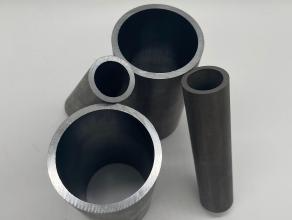
These numbers dictate whether a pipe can withstand 600°C in a superheater or survive subzero impacts in an Arctic pipeline. And they’re not just data points—they’re the first thing an experienced engineer checks on a mill certificate.
Sulfur forms iron sulfide inclusions that melt at hot-working temperatures, leading to cracks during forging or rolling. Phosphorus segregates to grain boundaries and drastically reduces toughness at low temperatures. Even small amounts can turn a ductile steel brittle, so reputable mills keep both elements below 0.020% for critical applications.
Carbon content alone can shift a pipe from soft and easily bent to hard enough to shatter under impact. In carbon steel pipes for mechanical tubing, carbon typically ranges from 0.10% to 0.50%. A 1020 steel (0.20% C) offers a good balance of strength and formability, making it common for general structural parts. Move up to 1045 (0.45% C) and you get higher hardness but need to worry about cracking during welding. I’ve seen hydraulic cylinder rods made from 1045 perform well when properly heat treated, but if the carbon is on the high side of the tolerance and normalizing is skipped, the tube can become brittle and snap under cyclic loading.
Manganese does double duty: it combines with sulfur to form harmless manganese sulfide globules instead of brittle iron sulfide, and it increases the hardenability of steel, meaning thicker sections can be hardened more uniformly. Most structural and mechanical steel pipes contain 0.50% to 1.50% Mn. In grades like ST52, manganese sits near 1.6%, contributing to its high yield strength (≥355 MPa). Without enough manganese, the steel would be weak and prone to hot cracking.
When plain carbon steel can’t handle the application, alloying elements transform the microstructure. Chromium is the most common addition. Even 0.5% Cr delays pearlite transformation and increases hardenability; at 1% and above, it forms stable carbides that resist softening at elevated temperatures. That’s why 25CrMo4 (0.9–1.2% Cr, 0.15–0.3% Mo) is specified for high-pressure boiler tubes and oil refinery piping. Molybdenum works synergistically with chromium, stopping temper embrittlement and maintaining strength where carbon steel would creep. A 4140 pipe (0.95% Cr, 0.20% Mo) retains good toughness after quenching and tempering, making it a favorite for heavy-duty shafts inside construction machinery. In our production, we’ve found that 4140 tubes with a fine tempered martensite structure can withstand shock loads that would fracture a lower-alloy steel.
Vanadium, niobium, and titanium are microalloying additions that form nanoscale carbonitrides, refining the grain and raising yield strength without a big loss in ductility. The vanadium in ST52 (0.02–0.15%) pushes the yield strength to 355 MPa while keeping carbon below 0.22%, so the pipe remains weldable. I often recommend vanadium-containing grades for structural tubing where welding is unavoidable.
If your design involves sustained exposure above 400°C, selecting the right Cr-Mo combination isn’t trivial—the wrong ratio can lead to graphitization or sigma phase formation. Send your operating conditions to sunny@tenjan.com and we’ll verify the grade before ordering.
Welding a high-carbon or high-alloy steel pipe without understanding its chemistry is like baking a cake blindfolded: you might get lucky, but more often you’ll get a mess. The carbon equivalent (CEV) formula combines the effects of carbon, manganese, chromium, molybdenum, and other elements to predict hardenability in the heat-affected zone. Generally, a CEV above 0.45 indicates that preheat and possibly post-weld heat treatment will be needed to avoid cracking.
For field welding of A106 Gr.B pipes (CEV typically 0.35–0.42), a 100°C preheat is often sufficient. But for alloy steels like 25CrMo4 (CEV around 0.55–0.65), I wouldn’t strike an arc without 200°C minimum preheat and controlled cooling. Skipping these steps can create martensitic zones that crack within days. I recall a hydraulic system where a contractor welded a 25CrMo4 tube without preheat. The joint looked fine, but the first pressure test produced a four-inch crack right along the fusion line. The mill certificate was correct. The fabrication practice was not.
Silicon and residual elements also play a role. Too much silicon can promote slag inclusions that weaken the weld. Sulfur, if not controlled with enough manganese, can cause hot cracking. This is why fabricators care about the full heat analysis, not just the tensile report.
International standards like ASTM A106, EN10216, and JIS G3441 don’t just give a range of numbers—they define the acceptable chemistry for a specific application, based on decades of service experience. For seamless carbon steel pipes for high-temperature service, ASTM A106 Grade B caps carbon at 0.30% and sulfur/phosphorus at 0.035%. That seems generous, but high-quality mills routinely achieve 0.20% C and ≤0.010% S and P, which improves toughness and reduces hydrogen-induced cracking risk.
When you compare standards, you’ll notice that chemical requirements are often more restrictive than mechanical ones because composition directly influences weldability, heat treatment response, and long-term stability. For example, EN10297-1 for mechanical steel tubes specifies different carbon equivalents for different delivery conditions—cold finished, normalized, or quenched and tempered. A pipe that meets the tensile test might still fail in service if its carbon equivalent is too high for the welding procedure used on site.
We use positive material identification (PMI) handheld analyzers to verify every heat before cutting. It’s a step that catches mix-ups before they become field failures. In a recent batch of 4130 tubes destined for an automotive steering component, PMI flagged a heat with nickel content slightly above spec—probably from ladle contamination. A certificate might have missed it, but the analyzer didn’t.
ASTM A106 covers pipes for high-temperature fluid transport and focuses on elevated-temperature strength; it allows higher carbon and manganese levels. ASTM A519 is for mechanical tubing where cold forming and machining are common, so it often has tighter carbon ranges and lower sulfur content to improve surface finish and machinability.
Once you understand what the elements do, the challenge becomes translating a set of application requirements—pressure, temperature, cyclic loads, corrosion—into a specific grade and chemistry. Many engineers default to a familiar grade like A106 or 4130 without considering whether a more cost-effective or better-performing alternative exists. For a hydraulic cylinder tube that needs high yield strength and good weldability, ST52 often outperforms 1020 in both respects and costs less than 4140. The manganese up to 1.6% and the microalloying vanadium give it a strength advantage without a big hike in carbon.
This is where working directly with a manufacturer who understands the metallurgy can save you from over-specifying or under-specifying. At Tenjan, we don’t just stock standard sizes; we adjust chemistries within the standard limits to optimize for cold drawing behavior, weldability, or specific end-use conditions. If your project involves a non-standard combination of pressure, vibration, and corrosive media, let’s look at the options together. Contact us at sunny@tenjan.com or call +86 51988789990 with your requirements and we’ll propose a composition that fits, not one that might.
There isn’t one—it’s the combination. Carbon sets the baseline strength, but without manganese for toughness and sulfur control, the pipe would fail in processing. In most structural and mechanical applications, carbon content gets the most attention because it’s the biggest lever on hardenability and weldability. For high-temperature service, chromium and molybdenum often matter more than carbon.
Yes, if the mill has the flexibility. Many manufacturers, including Tenjan, can tailor heats to meet tighter ranges or add specific elements, provided the order quantity justifies a dedicated heat. We’ve produced 34MnB5 tubes with a narrow boron range for a client making lightweight automotive components. The key is discussing your exact needs early in the design phase so the mill can plan the melt.
Demand a 3.1 or 3.2 material certificate per EN 10204, and if the application is critical, arrange third-party testing or PMI spot checks. Many importers rely solely on mill certificates, but contamination and mix-ups happen. We’ve worked with buyers who bring a handheld PMI gun to our warehouse before shipment, a practice I encourage for high-value orders.
The heat analysis represents the composition of the molten steel sampled at the furnace or ladle. The product analysis is performed on a sample from the finished pipe. Differences arise because of segregation during solidification and processing. Standards allow a small deviation between the two, but if the product analysis falls outside the standard’s tolerance, the lot can be rejected. Always clarify which analysis your supplier is reporting.
If you’re unsure which grade meets your application’s mechanical, welding, and corrosion requirements, the fastest path is to discuss your operating conditions with a manufacturer that can provide both the steelmaking know-how and the product. Share your requirements at sunny@tenjan.com or call +86 51988789990, and we’ll confirm whether an existing grade fits or if a custom adjustment is warranted.


Home Product Capabilities Case Studies Blogs About Get a Quote
Pipe & Tube Manufacturing Process Shapes & Profiles Pipes & Tubes Material Standard Steel Pipes & Tube Rebar Couplers Cold Drawn Steel Profiles & Bars
Oil & Petrochemical Industry Automotive & Motorcycle Components Mechanical Engineering Components Mining Construction Support Structures High-Pressure Boiler System Construction Machinery Geological Drilling Agricultural Machinery Parts Industrial Fluid Transfer Systems


© 2024 Changzhou Tenjan Steel Tube Co., Ltd All rights reserved. Privacy StatementTerms-ConditionsSitemap
