Welcome to Changzhou Tenjan Steel Tube Co., Ltd
Sunny@tenjan.com



Precision pipe tubes show up in places where tolerances matter and failure costs more than anyone wants to pay. High-pressure fluid lines, structural frames in heavy equipment, hydraulic cylinders that need to move smoothly for years—these applications don’t forgive sloppy manufacturing. The tubes we produce go through processes designed to hit tight dimensional specs and deliver consistent mechanical properties, because that’s what the work demands.
Two manufacturing routes dominate precision pipe tube production, and each leaves its mark on the final product. Seamless tubes start as solid billets that get pierced and rolled into hollow form. No weld seam means no weak point along the length, which matters when pressure climbs or cyclic loading comes into play. Seamless Pipe&Tube handle these conditions because the material structure stays uniform throughout.
Cold-drawn welded tubes take a different path. A flat strip gets formed into a tube shape, welded along the seam, then pulled through dies that refine everything—grain structure tightens up, dimensions sharpen, and the surface comes out cleaner. The cold-drawing step does real work on the metal, not just shaping it but actually improving its properties. Hydraulic cylinder applications and automotive components often call for this combination of precision and surface quality. We run both seamless tubes manufacturing and cold-drawn profiles operations, which means we can match the process to what the application actually needs.
| Feature | Seamless Tubes | Cold-Drawn Welded Tubes |
|---|---|---|
| Manufacturing | Pierced from solid billet | Formed from strip, welded, then cold-drawn |
| Strength | Uniform, high-pressure resistance | Enhanced by cold drawing, excellent integrity |
| Dimensional Acc. | Good | Superior |
| Surface Finish | Good | Excellent |
| Applications | High-pressure, critical structural | Precision components, aesthetic applications |
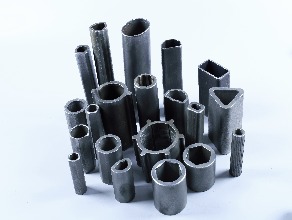
Round tubes work for most situations, but not all of them. Some designs need corners. Others need flat sides that bolt against mounting surfaces or fit into tight spaces where round profiles waste room. We produce square, rectangular, hexagonal, and more complex shapes through cold-drawing processes that maintain the precision these applications require.
Material selection runs parallel to geometry choices. Different alloy and carbon steel grades bring different properties to the table—higher strength, better corrosion resistance, specific responses to heat treatment. Special-Shaped Alloy Steel Tubes let engineers optimize for conditions that standard products can’t address. When a project needs Hexagonal Steel Pipes&Tubes or Oval Steel Pipes&Tubes, we can deliver those shapes with the material properties the application demands. This flexibility cuts down on secondary machining and simplifies assembly.
International standards exist because global supply chains need common reference points. When a specification calls for ASTM, EN, DIN, or JIS compliance, everyone involved knows what material properties, testing methods, and dimensional tolerances to expect. Our precision pipe tubes meet these standards because our customers ship products worldwide and need tubes that work with components from other suppliers.
ISO-certified quality control systems back up this compliance. Every production run gets checked against the relevant specifications, and documentation follows the product through delivery. This matters most when tubes go into applications where regulatory approval depends on traceable, certified materials.
Standards like ASTM A179 Steel Pipe define exactly what a heat exchanger tube needs to deliver—wall thickness tolerances, tensile strength ranges, testing requirements. DIN 17175 Steel Pipe does the same for high-temperature service. Project engineers use these specifications to match materials to operating conditions without guessing. The standards also simplify procurement across borders, since a DIN-compliant tube from one supplier should perform like a DIN-compliant tube from another. That consistency reduces risk when projects involve multiple vendors and tight schedules.
Automotive manufacturing puts our tubes into structural members, exhaust systems, and fluid lines where weight matters and dimensions can’t drift. The tubes need to fit precisely into automated assembly processes and perform reliably for the vehicle’s service life.
Boiler applications push different requirements. Tubes meeting ASTM A192 Steel Pipe specifications handle the combination of high temperature and pressure that boiler service demands. The material needs to resist creep and oxidation while maintaining strength over years of continuous operation.
Hydraulic systems depend on surface finish as much as dimensional accuracy. Any roughness inside a cylinder bore creates friction and wear. Our cold-drawn precision pipe tubes deliver the smooth internal surfaces that hydraulic applications need. Construction equipment and industrial machinery use these tubes in cylinders, valve bodies, and fluid transfer lines where leaks mean downtime. Materials like ST52 Steel Pipe and E355 Steel Pipe provide the strength these applications require.
Vertical integration gives us control over every production stage, from raw material through finished tube. That control matters because quality problems in steel tubing often trace back to earlier process steps—wrong alloy composition, improper heat treatment, contamination during forming. Catching these issues requires inspection methods that look beyond surface appearance.
Positive Material Identification confirms that the alloy in a tube matches what the paperwork says. Mix-ups happen in any manufacturing environment, and PMI testing catches them before tubes ship to applications where the wrong material could fail. Non-Destructive Testing methods—ultrasonic and eddy current techniques—find internal flaws and surface defects without cutting into the product. These inspections verify that our precision pipe tubes meet mechanical property requirements and contain no hidden defects that could cause problems in service.
PMI testing uses X-ray fluorescence or optical emission spectroscopy to read the elemental composition of steel directly. The test takes seconds and confirms whether a tube contains the right amounts of carbon, chromium, molybdenum, and other alloying elements. Ultrasonic testing sends sound waves through the tube wall and listens for reflections from internal discontinuities—voids, inclusions, or laminations that weaken the material. Eddy current testing detects surface and near-surface flaws by measuring changes in electromagnetic response. Together, these methods verify that our steel pipe tubes will perform as specified.
We’ve been manufacturing precision pipe tubes since 2004, long enough to understand what makes projects succeed or fail. The technical side matters—material selection, dimensional tolerances, surface finish requirements—but so does communication. We work with clients from early design stages through delivery, making sure the tubes we produce actually fit the application.
Our capabilities span Seamless Carbon Steel Tubes and custom alloy specifications, with the manufacturing flexibility to handle standard orders and specialized projects. OEMs and engineering firms come to us when they need a supplier who can deliver consistent quality and solve problems when specifications get complicated.
Seamless pipe tubes come from solid billets with no weld seam, giving them uniform strength that handles high-pressure and cyclic loading well. Cold-drawn welded tubes start as welded strip but gain excellent dimensional accuracy and surface finish through the drawing process. The choice depends on whether the application prioritizes pressure resistance or precision and surface quality. We manufacture both types and can recommend the better fit for specific requirements.
Our quality system combines ISO-certified process control with specific inspection technologies. PMI testing confirms alloy composition matches specifications. NDT methods including ultrasonic and eddy current testing detect internal and surface defects. Full process oversight from raw material through finished product ensures traceability and consistent quality across production runs.
Yes. Our cold-drawing capabilities produce square, rectangular, hexagonal, and other complex geometries with the dimensional precision that OEM applications require. Custom-shaped steel tubes reduce secondary machining and simplify integration into assemblies where standard round profiles don’t fit the design.
As a vertically integrated manufacturer since 2004, Changzhou Tenjan Steel Tube Co.,Ltd offers unparalleled expertise in precision steel tubing. For tailored solutions that meet the most demanding industrial specifications and international standards, contact our team today to discuss your project requirements. Email: Sunny@tenjan.com | Tel:+86 51988789990 | WhatsApp:+86 13401309791| Tel:+86 51988789990 | WhatsApp:+86 13401309791


Home Product Capabilities Case Studies Blogs About Get a Quote
Pipe & Tube Manufacturing Process Shapes & Profiles Pipes & Tubes Material Standard Steel Pipes & Tube Rebar Couplers Cold Drawn Steel Profiles & Bars
Oil & Petrochemical Industry Automotive & Motorcycle Components Mechanical Engineering Components Mining Construction Support Structures High-Pressure Boiler System Construction Machinery Geological Drilling Agricultural Machinery Parts Industrial Fluid Transfer Systems


© 2024 Changzhou Tenjan Steel Tube Co., Ltd All rights reserved. Privacy StatementTerms-ConditionsSitemap
