Welcome to Changzhou Tenjan Steel Tube Co., Ltd
Sunny@tenjan.com



Modern construction needs structural connections that actually hold up. Rebar couplers have become the go-to solution for ensuring continuity and strength in reinforced concrete, and for good reason. The shift from traditional lapping to mechanical splicing makes a real difference in how loads transfer through a structure. We’ve seen this play out across countless projects where congestion issues and compromised concrete cover were creating headaches that mechanical splices simply eliminated.
Rebar couplers create mechanical splices between reinforcement bars, establishing a continuous load path that transfers both tensile and compressive forces across joints. The structural integrity of concrete elements stays intact because these connections don’t rely on the inconsistent bond strength that lapping depends on.
The old approach of overlapping rebar sections and tying them together created problems. Congestion made concrete placement difficult, and reduced cover left structures vulnerable. Mechanical splices changed the game by delivering full-strength connections that often exceed the yield strength of the rebar itself. This matters most in high-stress applications where failure isn’t an option.
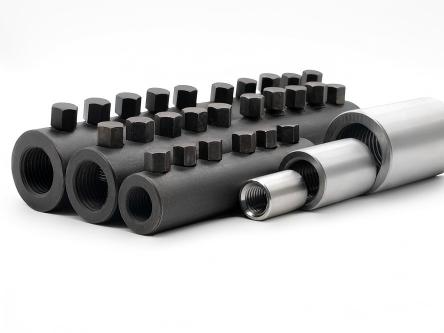
Manufacturing these components requires precision. Materials like ASTM 1045 (45#) Carbon Steel and ASTM 5140 (40Cr) Alloy Steel form the foundation, and the tolerances have to be tight. The available types include rolling straight thread, upsetting parallel thread, cold extrusion press, taper thread, customized special shapes, and bolted configurations. These accommodate rebar sizes from 16mm to 32mm with thread angles typically at 60° or 75°, meeting standards including JG/T 163-2013, ACI318, ACI349, BS8110, NF35-20-1, DIN1045, and ISO 15835.
Different mechanical mechanisms suit different construction demands. Getting this match right determines whether a project runs smoothly or hits unnecessary complications.
Threaded rebar couplers like the rolling straight thread type work by threading rebar ends and screwing them into a coupler sleeve. The strength is excellent and inspection is straightforward, which makes them natural fits for precast concrete elements and column splices where verification matters.
Grout-filled couplers take a different approach. A sleeve filled with high-strength grout connects plain or deformed rebars with minimal preparation. Repair work and connecting pre-existing rebar benefit from this flexibility.
Swaged connectors use hydraulic pressure to deform a metal sleeve onto rebar ends, creating permanent connections with the strength needed for high-rise buildings and bridges. The permanence is the point here.
Bolted configurations skip threading entirely, enabling rapid assembly when speed drives the schedule. This trades some of the permanence for installation efficiency.
| Coupler Type | Mechanism | Typical Applications | Key Advantages | Standards Compliance |
|---|---|---|---|---|
| Rolling Straight Thread | Threaded rebar ends screw into sleeve | Precast concrete, column splicing | High strength, easy inspection | JG/T 163-2013, ACI318, ISO 15835 |
| Grout-Filled | Sleeve filled with high-strength grout | Repair work, connecting existing rebar | Minimal rebar preparation | Various international standards |
| Swaged | Metal sleeve deformed onto rebar ends | High-rise buildings, bridges | Strong, permanent connection | ASTM A970, ISO 15835 |
| Bolted | Bolts secure rebar ends within a sleeve | Rapid assembly, temporary connections | Quick installation, no threading required | ACI318, BS8110 |
| Upsetting Parallel Thread | Rebar ends upset and threaded into sleeve | High-stress applications, seismic zones | Full strength, robust connection | ACI349, NF35-20-1 |
The engineering advantages show up most clearly in demanding structural applications. Mechanical splices distribute forces more uniformly across connections, while lapping relies on bond strength that varies with concrete quality, placement conditions, and curing.
Reduced congestion translates directly to better concrete placement and consolidation. Fewer voids mean a denser, stronger matrix. This isn’t theoretical; it shows up in core samples and load tests.
Seismic applications reveal another advantage. Couplers provide enhanced ductility and energy dissipation that structures in earthquake-prone regions need. The connection doesn’t just hold; it performs predictably under cyclic loading.
Precision manufacturing of steel tubes feeds directly into coupler reliability. Custom-shaped steel tubes with tight tolerances ensure components meet exact specifications. This consistency in the load transfer mechanism produces durable reinforcement that performs as designed.
International standards from ISO, ASTM, and BS establish the guidelines for design, manufacturing, and testing. ASTM A970 specifies requirements for mechanical splices to achieve full strength. ISO 15835 covers couplers used in reinforced concrete applications.
Quality control during manufacturing catches problems before they reach the field. Positive Material Identification confirms correct alloy compositions. Non-Destructive Testing methods like ultrasonic examination detect internal flaws without destroying the product.
These protocols mirror the approach used in precision tubing manufacturing for seamless alloy steel tubes and seamless carbon steel tubes. Material integrity testing ensures every component contributes to structural reliability.
| Standard | Description | Key Focus |
|---|---|---|
| ASTM A970 | Standard Specification for Steel Bar Couplers for Concrete Reinforcement | Performance requirements for mechanical splices |
| ISO 15835 | Steels for the reinforcement of concrete – Reinforcement couplers for mechanical splices of bars | Design, performance, and testing of couplers |
| Eurocode 2 | Design of concrete structures | Guidance on the use and design of rebar couplers |
| BS 8110 | Structural use of concrete | Specifications for reinforcement and connections |
| DIN 1045 | Concrete, reinforced and prestressed concrete structures | Design and construction of concrete structures |
| JIS G3112 | Steel bars for concrete reinforcement | Material properties of rebar and related connections |
Project requirements drive coupler selection. Rebar size, concrete cover, and environmental conditions all factor into the decision. Corrosive environments demand specific alloy steels or protective coatings that standard options won’t provide.
Installation practices determine whether the selected coupler performs as intended. Proper rebar preparation and correct torque application for threaded couplers aren’t optional steps. Regular inspection during and after installation catches issues before they become problems.
This proactive approach extends structure lifespan and minimizes risk. Engineering solutions tailored to specific project needs produce reliable, durable concrete structures that perform over decades of service.
Leverage over two decades of expertise in high-precision steel tubing. Changzhou Tenjan Steel Tube Co.,Ltd, a vertically integrated manufacturer, provides the foundational components for robust and reliable construction. Our custom-shaped steel tubes and stringent quality control, including PMI and NDT inspections, ensure material integrity for critical applications. For tailored solutions that meet ASTM, EN, DIN, and JIS standards, contact us today. Email: Sunny@tenjan.com | Tel:+86 51988789990 | Phone/WhatsApp:+86 13401309791| Tel:+86 51988789990 | Phone/WhatsApp:+86 13401309791
Rebar couplers come in various forms, including threaded, grout-filled, and swaged systems. Each type is designed for specific applications, such as precast construction, column splicing, or seismic-resistant structures, offering unique advantages in terms of installation speed, load capacity, and cost-effectiveness for concrete reinforcement systems. We also offer bolted and upsetting parallel thread types, suitable for diverse rebar connection methods.
Rebar couplers significantly enhance structural integrity by providing a full-strength mechanical splice that often exceeds the strength of the rebar itself. Unlike traditional rebar lapping, couplers eliminate rebar congestion, ensure consistent load transfer across the splice, and improve ductility, particularly crucial in high-stress and seismic zones for robust reinforcement bar joining. This leads to more predictable structural behavior.
The use of rebar couplers is governed by international standards such as ASTM A970, ISO 15835, Eurocode 2, and various national codes (e.g., DIN, JIS). These standards dictate design, material properties, testing protocols, and installation requirements to ensure safety and performance in critical construction projects, emphasizing the need for high-quality mechanical splices. Our products adhere to these global benchmarks.


Home Product Capabilities Case Studies Blogs About Get a Quote
Pipe & Tube Manufacturing Process Shapes & Profiles Pipes & Tubes Material Standard Steel Pipes & Tube Rebar Couplers Cold Drawn Steel Profiles & Bars
Oil & Petrochemical Industry Automotive & Motorcycle Components Mechanical Engineering Components Mining Construction Support Structures High-Pressure Boiler System Construction Machinery Geological Drilling Agricultural Machinery Parts Industrial Fluid Transfer Systems


© 2024 Changzhou Tenjan Steel Tube Co., Ltd All rights reserved. Privacy StatementTerms-ConditionsSitemap
