Steel Tube Standards and Regulations: Key Trends for Sourcing and Compliance
Steel tube compliance starts with the correct product standard, grade, delivery condition, and inspection documents. Buyers must then check the application code and destination-market rules separately. This guide explains how to keep those requirements aligned, including…
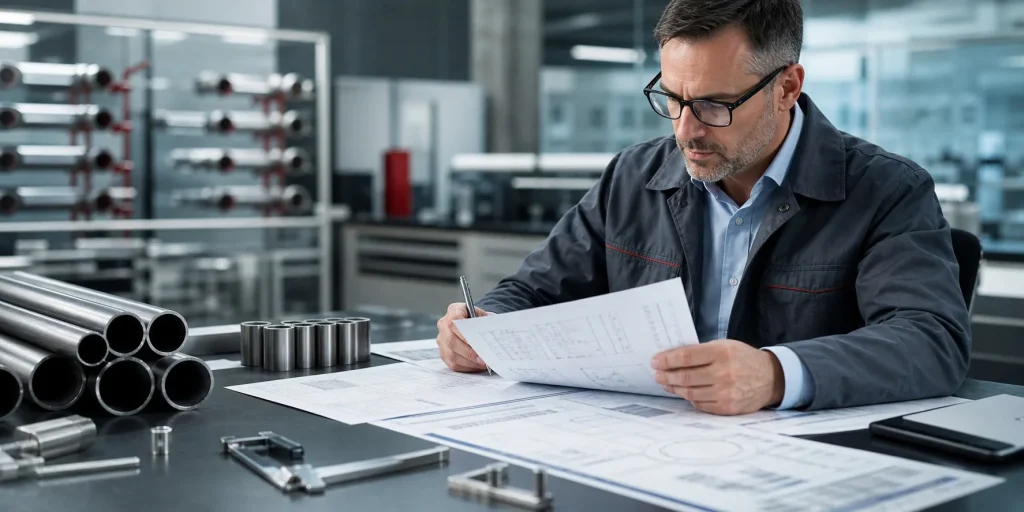
Steel tube compliance starts with the correct product standard, grade, delivery condition, and inspection documents. Buyers must then check the application code and destination-market rules separately. This guide explains how to keep those requirements aligned, including traceability, national EN adoptions, and the EU’s 2026 CBAM regime.
Why Steel Tube Standards and Regulations Are Moving Quickly
Steel tube standards have always changed slowly because they are consensus documents. What has changed is the operating environment around them. A tube that meets the correct standard today may still fail a project if the material data cannot be verified, if the inspection document is incomplete, or if the importer cannot demonstrate embedded carbon values.
Three forces are responsible for the current pace:
- Harmonization — the same technical requirement now appears across EN, ISO, and national standards, which simplifies global sourcing but also creates confusion when old and new designations are mixed.
- Digital traceability — paper mill test reports are being supplemented by machine-readable records, but the burden of proof still falls on the purchasing team.
- Regulation beyond geometry — carbon, chemical safety, and pressure-equipment rules increasingly sit alongside dimensional and mechanical performance requirements.
In short, standards are no longer only about whether the tube fits. They are also about whether the tube can be proven to fit.
If you are reading this while holding a specification that already references one of these standards, the checklist near the end may be the fastest way to identify gaps.
Global Harmonization: One Requirement, Many National Names
One of the most practical trends is the continuing alignment between European, ISO, and national standards. CEN members adopt EN standards as national standards, which is why the same technical delivery condition can appear as BS EN, DIN EN, or another national prefix. A customer in Germany may simply write “DIN EN 10305-1,” while a customer in the United Kingdom writes “BS EN 10305-1” — and both are pointing at the same core document.
CEN-CENELEC explains that EN standards are implemented as identical national standards and conflicting national standards are withdrawn. A national prefix does not by itself create different grades or tolerances in the EN text. Confirm the same part, edition, amendments, and order options; assess separate national legal requirements independently.
Harmonization is helpful, but it also creates a documentation trap: a supplier may be certified to an older national standard while the buyer’s order references a newer EN version. The safest approach is to write the full standard designation, including the year or edition, on the purchase order and the inspection certificate.
Stronger Material Traceability and Digital Inspection Documents
The reliability of a steel tube ultimately depends on whether its material data can be tied to a specific heat, process route, and test result. This is where EN 10204 and equivalent inspection document rules come in.
EN 10204 defines the types of inspection documents buyers actually receive. A 3.1 certificate declares order compliance and supplies specific inspection results, validated by the manufacturer’s authorised inspection representative independent of manufacturing. A 3.2 certificate involves both that representative and the purchaser’s authorised representative or the inspector designated by official regulations. In demanding applications, the difference between 3.1 and 3.2 can determine whether a batch is accepted at all [1].
Digital tools are now tightening this process. Instead of scanning a paper MTR and hoping the heat numbers match, more buyers are requesting structured records with heat number, standard revision, test method, and inspector sign-off in a single traceable file. This is not yet a universal requirement, but it is becoming a common expectation in oil and gas, pressure equipment, and automotive tier supply chains.
EN 10204 certificates only work if the data behind them can be traced back to a specific heat and production lot. How Digital Traceability Tightens Steel Tube Quality Control covers what digital traceability changes for mill test reports, inspection records, and supplier confidence.
Tighter Dimensional and Non-Destructive Testing Expectations
Precision tube standards are placing more emphasis on measurable consistency, not just nominal dimensions. EN 10305-1, for example, sets technical delivery conditions for seamless cold-drawn precision tubes, including dimensional tolerances, surface quality, and testing requirements [2]. The challenge for buyers is that a tube can meet a standard on paper and still disappoint in assembly if an out-of-roundness or straightness issue is not controlled tightly enough for the application.
This is why non-destructive testing has moved from a special request to a routine part of discussion. Eddy current testing is widely used for surface and near-surface defects, while ultrasonic testing helps identify internal discontinuities. Positive material identification adds another layer by confirming that the alloy in front of the inspector is the alloy named on the certificate.
For precision applications, the practical trend is clear: the dimensional tolerance alone is no longer the final word. Buyers increasingly ask how straightness, ovality, and surface defects will be verified, and whether the supplier can document the test method used.
Dimensional accuracy is where standards and real-world fit often diverge. How EN10305 Steel Tube Standard Affects Precision Tube Procurement covers the purchasing consequences of tolerance, testing, and certification choices under EN 10305.
Specification checkpoint. If you are currently comparing EN 10305-1, ASTM A519, JIS G3445, or another mechanical tube standard for an active order, send the drawing and target standard to Sunny@tenjan.com or WhatsApp +86 13401309791. A standards review can clarify tolerances, test requirements, and inspection documents before you commit to a mill.
Sustainability, Carbon Accounting, and Chemical Compliance
Environmental regulation is now part of steel tube sourcing, even when the tube itself is hidden inside machinery. The European Union’s Carbon Border Adjustment Mechanism entered its definitive regime on 1 January 2026 after the 2023–2025 transitional phase [3]. Product classification, thresholds, exemptions, and the importer’s circumstances determine the applicable obligations; consult the current official guidance. This does not change the tube’s geometry, but it changes the information a buyer must collect from the supply chain.
Chemical compliance is a separate check. REACH requirements depend on the substance, concentration, use, and supply-chain role; inclusion on the Candidate List is not a blanket ban. For example, ECHA explains Article 33 communication duties for Candidate List substances in articles above 0.1% by weight [4]. Request relevant coating and material declarations rather than an unsupported claim that all regulated substances are absent.
The implication for sourcing teams is that environmental data should be requested early, not after production. Questions about carbon intensity, REACH compliance, and the origin of raw material are now routine parts of supplier qualification.
Pressure Equipment and Application-Specific Rules
When steel tubes are intended for pressure systems, application-specific regulation sits on top of material standards. In the European market, the Pressure Equipment Directive 2014/68/EU sets conformity assessment requirements for pressure equipment and assemblies, including the materials used in vessels, piping, and related components [5]. A tube may meet a mechanical standard and still require additional verification under pressure-equipment rules.
The same principle applies across applications. Hydraulic systems, high-temperature boilers, and process piping each carry their own combination of material standard, design code, and inspection expectation. The most common procurement mistake is to select a grade based on availability and then discover that the requested inspection document does not support the end-use approval.
Pressure vessel tube sourcing adds material standards, inspection documents, and design codes to the normal buying checklist. Selecting Steel Pipes for Pressure Vessels: Material, Standards, and Key Considerations covers what engineering teams should evaluate before a tube enters a pressure system.
Regional Standards Worth Watching
For international buyers, the trend is not the appearance of entirely new standards but the steady revision of existing ones and a shift in how they are enforced.
ASTM A519/A519M remains a commonly referenced U.S. mechanical tubing specification for seamless carbon and alloy grades [6]. Updated editions can adjust grade tables, testing frequency, or dimensional defaults, so a drawing that simply says “ASTM A519” without a revision can leave room for interpretation.
JIS G3445 continues to govern carbon steel tubes for machine structural purposes in Japanese-influenced supply chains [7]. In China, GB/T 3639 covers seamless cold-drawn tubes for precision applications and is frequently requested for domestically manufactured components [8].
The practical message is not that one regional standard is better than another. It is that the revision, grade, and acceptance requirements must be explicit. A supplier that asks which edition you need is usually doing you a favor.
A Five-Point Compliance Check Before You Source
Engineering teams can reduce risk by treating standards compliance as a verification process rather than a single checkbox.
- Write the full designation. Include the standard number, applicable part, grade, delivery condition, and edition or year.
- Confirm the inspection document. Decide whether 3.1, 3.2, or an equivalent independent verification is required for the application.
- Match the testing method. Clarify whether ultrasonic, eddy current, PMI, or a combination is expected and whether the supplier can document the procedure.
- Ask about the standard’s adoption path. If the requirement appears as a national adoption, verify that the supplier’s certificate references the correct national prefix and edition.
- Collect environmental data early. If the tube enters the EU or a carbon-sensitive program, request embedded emissions information and REACH-relevant process details before ordering.
Get a Standards Compliance Review Before You Source
If your drawing lists a standard — or if you are not sure which standard to call out — send the part drawing, required grade, and target market to Sunny@tenjan.com or WhatsApp +86 13401309791. Tenjan will map the appropriate ASTM, EN, DIN, JIS, or GB/T requirement, confirm inspection documentation, and clarify what the current revision means for tolerances, testing, and proof of compliance.
Frequently Asked Questions
What is the biggest steel tube standards trend right now?
The biggest trend is not a single new standard but the growing need to prove compliance through traceable data. Dimensional and mechanical performance remain important, but buyers now spend more time on inspection documents, digital mill test records, and environmental data.
How does EN 10305 affect precision tube procurement?
EN 10305 defines technical delivery conditions for precision steel tubes and sets expectations for dimensional tolerance, surface quality, and testing. For procurement, it means the order should specify the correct part of the standard, the grade, the delivery condition, and the inspection document required.
What is the difference between EN 10204 3.1 and 3.2?
Both types provide specific inspection results and a declaration of order compliance. Type 3.1 is validated by the manufacturer’s authorised inspection representative independent of manufacturing. Type 3.2 also involves the purchaser’s authorised representative or an inspector designated by official regulations. Specify the required type in the order.
Does CBAM apply to steel tube imports?
Certain steel tube products can fall within CBAM. Its definitive regime began on 1 January 2026. Importers should verify the customs classification, scope, thresholds, exemptions, and applicable authorisation, emissions-reporting, and certificate obligations using current official guidance.
How can I verify that a supplier really follows ASTM, EN, DIN, or JIS?
Ask for the full standard designation on the certificate, review the test method and values against the applicable edition, and verify the traceability of heat numbers and inspection documents. For critical applications, third-party inspection can provide additional confidence.
References
[1] European Committee for Standardization, EN 10204:2004, Metallic products — Types of inspection documents, CEN, 2004. See also TÜV NORD’s explanation of document types.
[2] European Committee for Standardization, EN 10305-1, Steel tubes for precision applications — Technical delivery conditions — Part 1: Seamless cold drawn tubes, CEN.
[3] European Commission, Carbon Border Adjustment Mechanism, Taxation and Customs Union, Brussels, Belgium.
[4] European Chemicals Agency, Candidate List of substances of very high concern for authorisation, ECHA, Helsinki, Finland.
[5] European Parliament and Council, Directive 2014/68/EU on the harmonisation of the laws of the Member States relating to the making available on the market of pressure equipment, Official Journal of the European Union, L 189, 2014.
[6] ASTM International, A519/A519M, Standard Specification for Seamless Carbon and Alloy Steel Mechanical Tubing, ASTM International, West Conshohocken, PA.
[7] Japanese Standards Association, JIS G3445, Carbon steel tubes for machine structural purposes, JSA, Tokyo, Japan.
[8] Standardization Administration of China, GB/T 3639, Seamless cold-drawn steel tubes for precision applications, SAC, Beijing, China.
If you’re interested, check out these related articles:
Steel Tubes for Engineering Applications: Precision, Standards, and Selection
How to Choose a Steel Tube Supplier for Your Next Project
How to Control Steel Pipe Polishing Process and Surface Ra
DIN 2448 Seamless Steel Pipe: Sizing, Weights and Ordering