How to Control Steel Pipe Polishing Process and Surface Ra
A polished steel pipe can hide more problems than it solves if the surface is bright but the Ra value was reached by skipping proper conditioning.
A polished steel pipe can hide more problems than it solves if the surface is bright but the Ra value was reached by skipping proper conditioning. I have spent too many inspection hours learning that polishing is not a standalone step. The steel pipe polishing process only works when descaling, straightening, and measurement come first. This article walks through the mechanical methods, the role of surface roughness, and the failure modes that show up after the pipe leaves the line. It is written for engineers and buyers who need a finish they can verify, not just a shine they can see.
Why Does Steel Pipe Polishing Start With Surface Preconditioning?
If the incoming tube still carries mill scale, drawing lubricant, or uneven ovality, polishing will amplify those patterns instead of removing them. A cold drawn tube can look clean and still carry a thin oxide film that breaks through only after buffing. The first job in any steel pipe polishing process is to get the surface into a stable condition.
Preconditioning starts with pickling or shot blasting to remove scale and rust. For cold drawn and cold rolled tubes from our lines, that usually means a controlled acid bath followed by neutralization and drying. Skipping this step leaves hard particles that roll across the surface during polishing and create fine longitudinal marks. I have seen a batch of hydraulic cylinder tubes fail a visual inspection because the bright OD showed exactly those marks, and the root cause was residual drawing lubricant, not the polishing wheel.
Straightness also matters before polishing because an oscillating tube wears the abrasive unevenly. We check bow and ovality before the polishing head touches the material. When roundness is off by even a small amount, the finishing belt removes more stock on high spots and leaves low spots dull. That produces a wavy reflectivity that no final buffing can fix. The better the incoming condition, the more predictable the polished result.
What Are the Main Steel Pipe Polishing Methods for Precision Tubes?
Different surface requirements demand different abrasive paths. The steel pipe polishing process for a hydraulic cylinder rod is not the same as the process for a decorative furniture tube, and using one method for every order is how finishes end up overspecified or underperforming.
Mechanical belt polishing remains the workhorse for outside diameters. A coated abrasive belt runs against the rotating tube to produce a consistent matte or bright surface. It is fast and controllable, but it generates heat. That heat can alter temper in thin wall sections or leave a light surface burn that shows up later under corrosion testing. We vary belt speed, contact pressure, and lubrication to keep the surface cool.
Centerless polishing handles long bars and tubes with better roundness control. The tube passes between a polishing wheel and a regulating wheel, which keeps the work rotating and moving forward. The result is a more uniform finish along the full length, which matters when the tube will be machined into piston rods or precision shafts. This method works well for outer surfaces but cannot reach internal bores.
For internal surfaces, honing or abrasive flow polishing is more useful. Honing removes stock from the bore and corrects geometry at the same time, while abrasive flow pushes a viscous abrasive through the tube to smooth internal passages. Both are slower than external belt work, so the cost goes up when the specification includes the ID. Buyers often miss that point and compare only the OD finish price.
Electropolishing is an electrochemical process rather than a mechanical one. It removes a very thin surface layer to reduce micro peaks and improve corrosion resistance. The process is common for stainless steel but less so for carbon steel because the bath chemistry and passivation requirements differ. We only recommend it when the application conditions justify the cost and the base material is compatible.
| Method | Typical strength | Main limitation |
|---|---|---|
| Belt polishing | Fast, controllable OD finish | Heat input, local dimensional drift |
| Centerless polishing | Excellent lengthwise uniformity | OD only |
| Honing | Corrects bore geometry | Slower, higher cost |
| Electropolishing | Smooths micro peaks, passive layer | Material specific, bath control |
If your program involves thin wall tubing or a sealing ID, confirm the abrasive path and final Ra before finalizing the BOM. Reach out at Sunny@tenjan.com.
How Do Ra Values Define the Steel Pipe Polishing Process?
Ra is the arithmetic average of surface height deviations across a measured length. A lower Ra means a smoother surface, but Ra alone can be misleading. Two tubes can share the same Ra and still look completely different under light. One may have a uniform finish and the other may show repeating chatter marks with the same average deviation. That is why a polished tube should be specified by more than a single roughness number.
When an engineer writes a finish requirement, the Ra value should match the sealing or sliding function. A hydraulic cylinder bore needs a controlled roughness that holds an oil film, while a decorative tube may need reflectivity that has less to do with Ra and more to do with visual uniformity. In practice, we ask for the function first and then translate it into a measurable finish. This prevents the common mistake of specifying a mirror finish for a part that only needed a clean matte surface.
Measurement matters as much as the polishing method. A contact profilometer gives a sampled roughness reading, while visual inspection under controlled lighting catches periodic defects. We use both during final inspection. If the Ra is within tolerance but the surface shows belt chatter, the part is still rejected because the customer sees the pattern before they ever run a stylus over it.
Why Does a Lower Ra Not Always Mean a Better Surface?
A lower Ra indicates less average deviation, but it does not describe the shape of the texture. A surface with fine, evenly spaced chatter can register the same Ra as a clean polished surface and still look streaky or perform poorly in a dynamic seal. Function defines what better means. A controlled roughness may outperform a mirror finish on a hydraulic sealing surface because it retains lubrication. The better question is not how low the Ra can go, but what texture the application actually needs.
How Is Surface Roughness Measured for Polished Steel Pipe?
A contact profilometer draws a diamond stylus across the surface and calculates Ra from the recorded profile. This works well on straight or gently curved surfaces, but it samples only a narrow line. For larger areas, we combine profilometer readings with visual inspection under controlled lighting. The two methods catch different defect types. A profilometer quantifies the finish, while the eye catches periodic marks, banding, and changes in reflectivity that a single trace can miss.
What Goes Wrong When Steel Pipe Polishing Is Rushed?
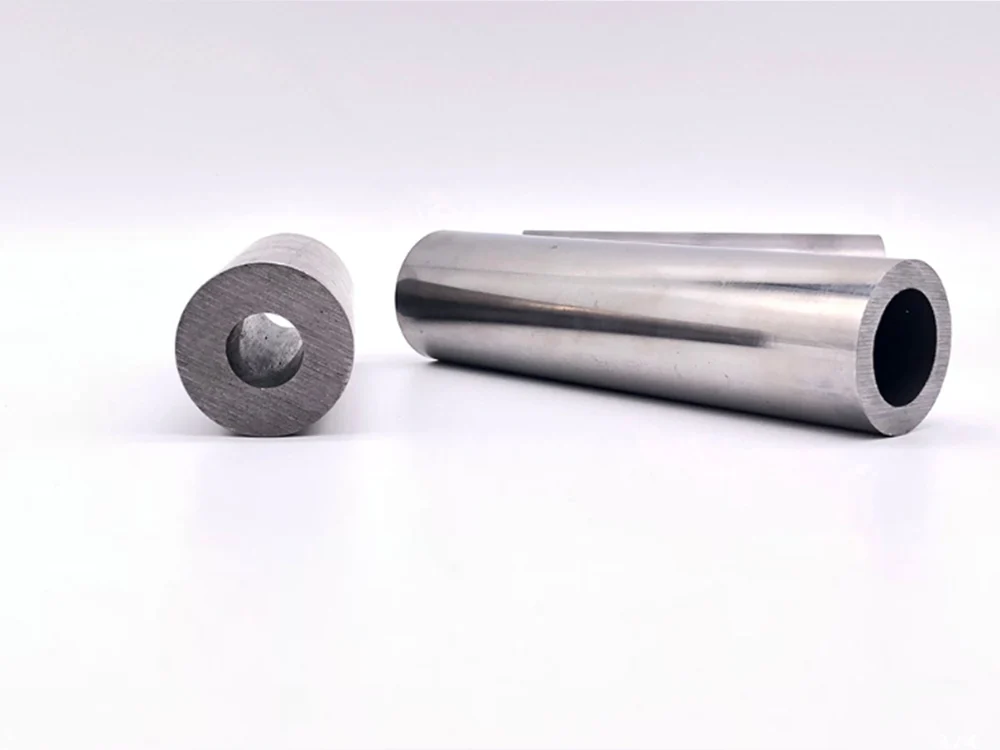
The most common failure I see in a rushed steel pipe polishing process is not a rough finish. It is a bright finish with a hidden dimensional shift. Polishing is a material removal process, even when it looks gentle. If the line speed is too high or the contact pressure too strong, the wall thickness changes in a way that later machining cannot recover. That matters for cold drawn tubes with tight tolerances.
Another failure mode is surface burn. On thin wall tubes, aggressive polishing can create a localized heat band that changes the microstructure. The tube may pass a surface roughness check and still fail a hardness test or show a temper color after heat exposure. We avoid this by limiting stock removal per pass and by checking the surface temperature of sample pieces.
Residual abrasive contamination is easier to miss. Polishing media breaks down and can embed into softer material, especially on carbon steel surfaces. If the tube is not cleaned after polishing, those particles end up in the customer’s assembly and accelerate wear. We run a cleaning stage after polishing and inspect under UV light when the specification calls for it.
Overpolishing a decorative tube can also remove corrosion protection. If a zinc or chrome layer is already in place, polishing should be limited or omitted. A bright surface is not always a better surface. The right finish depends on what the part must do after it leaves the line.
How Do We Confirm a Steel Pipe Polishing Process Before You Order?
Before an order enters production, we map the finished surface requirement to a specific process sequence. That means selecting the abrasive path, defining the incoming surface condition, and agreeing on inspection criteria. If your program involves thin wall tubing or a sealing ID, it is worth confirming the final Ra and the cleaning method before finalizing your bill of materials. At Tenjan Steel Tube we can confirm stock, process feasibility, and lead time. Send your part number, quantity, and finish target to Sunny@tenjan.com or call +86 51988789990, and we will get you a clear answer. For urgent checks, WhatsApp +86 13401309791 is the fastest route.
What Do Engineers and Buyers Ask About Steel Pipe Polishing?
Why Not Just Specify a Mirror Finish for Every Steel Pipe?
A mirror finish is often treated as a universal quality mark, but that assumption causes problems. On a carbon steel hydraulic tube, a mirror finish can cost more and deliver no functional benefit. The bright surface may also be less stable in a corrosive environment unless the material or passivation is compatible. We ask buyers to define what the surface must do: hold pressure, seal, slide, or simply look uniform. That answer leads to the right polishing method and the right inspection. Polishing for appearance and polishing for function are not the same job, and treating them as one is how budgets get wasted.
Does Polishing Change the Dimensions of a Steel Pipe?
Yes, polishing removes material, so dimensional change is real and must be planned. On a cold drawn tube with a tight wall tolerance, even a small amount of stock removal can move the part outside the acceptable range. We control this by limiting passes, measuring wall thickness between operations, and adjusting the starting stock accordingly. If the finished wall is critical, tell us before polishing begins. We can start with enough material to compensate for the removal, but that works only when the requirement is known at the quoting stage. Dimensional change is manageable, but it cannot be ignored.
How Do We Choose Between Mechanical Polishing and Electropolishing?
It depends on the base material and the application environment. Mechanical polishing is a physical stock removal process that works well for outside diameters and for parts where reflectivity and geometry both matter. Electropolishing removes a thin electrochemical layer and works best on stainless steel when corrosion resistance is part of the requirement. For carbon steel, electropolishing is less common because the bath chemistry and passivation steps are more involved. If the tube must hold tight dimensions after finishing, mechanical polishing gives us more control. If the priority is a passive surface on stainless steel, electropolishing is worth evaluating.
Can You Polish the ID of a Small Bore Steel Tube?
In programs we have handled, internal finishing was often the biggest cost driver. Honing and abrasive flow polishing can improve the ID, but they are slower than external polishing and become harder as the bore gets smaller. The abrasive must reach the full length and remove material evenly without bell mouthing at the ends. We recommend internal finishing only when the bore truly needs it for sealing, sliding, or flow performance. If you are unsure whether your application needs an ID finish, share the bore size, length, and operating condition, and we will confirm feasibility and the practical surface range.
If you’re interested, check out these related articles:
Precision Tube Quality Inspection Checklist
How to Choose the Right Seamless Steel Tube
Understanding ASTM, EN, DIN and JIS Tube Standards
Custom-Shaped Steel Tubes: Design Considerations
Carbon Steel vs Alloy Steel Tubes