Welcome to Changzhou Tenjan Steel Tube Co., Ltd
Sunny@tenjan.com



Seamless tubes show up everywhere—automotive frames, boiler systems, hydraulic lines—and their performance comes down to how well they’re made. Getting these tubes right means understanding the metallurgy, nailing the forming techniques, and running tight quality checks throughout. Here’s what actually goes into producing seamless tubes that hold up under demanding conditions.
Production starts with solid steel billets. These get heated to specific temperatures before the real work begins. Two main approaches dominate: piercing and extrusion.
Piercing works by rotating a heated billet while pushing it over a mandrel, which creates the hollow center. This hot rolling seamless pipe method moves fast and produces consistent initial tube forms. Extrusion takes a different route—forcing the heated billet through a die and over a mandrel to shape it into a tube.
Both methods produce tubes without weld seams. That continuous structure matters when applications demand high integrity, since there’s no joint that could become a weak point.
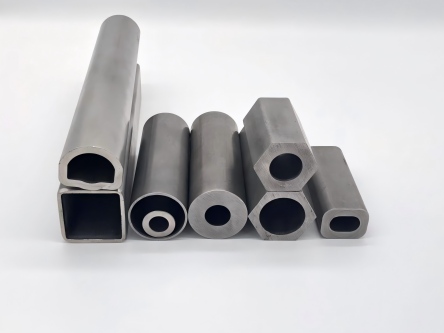
Many seamless tubes go through cold drawing after initial formation. This step refines dimensions, improves surface finish, and boosts mechanical properties in ways hot forming alone can’t achieve.
The process pulls the tube through a die, often over a mandrel, reducing both outer diameter and wall thickness. Cold pilgering offers another option, using oscillating dies and a mandrel to hit precise dimensions with excellent surface quality.
These cold working techniques increase tensile strength and yield strength while smoothing out the surface. Hydraulic systems and automotive components benefit most from these improvements.
| Feature | Hot Rolled Seamless Tubes | Cold Drawn Seamless Tubes |
|---|---|---|
| Dimensional Accuracy | Moderate | High |
| Surface Finish | Rougher | Smoother |
| Mechanical Properties | Good | Excellent |
| Wall Thickness | Thicker sections | Thinner sections possible |
| Cost | Lower | Higher |
For more on what affects material integrity during production, see 《Analysis of Key Causes and Prevention Strategies for Cracking in Seamless Steel Tubes during Bending and Flattening》.
Material selection drives seamless tube performance more than most people realize. Carbon and alloy steels each serve different purposes.
Seamless Carbon Steel Tubes work well for general structural applications where strength and cost need to balance out. When conditions get tougher—high pressure, elevated temperatures, corrosive environments—Seamless Alloy Steel Tubes like 4140 Steel Pipe or 25CrMo4 Steel Pipe become the better choice. These alloys deliver superior strength, toughness, and wear resistance.
International specifications from ASTM, EN, DIN, and JIS guide material selection and ensure the seamless pipe meets specific industry demands, whether that’s boiler tubes or automotive parts.
| Alloy Type | Key Characteristics | Typical Applications |
|---|---|---|
| Carbon Steel | Good weldability, cost-effective | General structural, fluid transport |
| Chromium-Molybdenum | High strength, toughness, wear resistance | Automotive, high-pressure boilers, petroleum cracking |
| Nickel-Chromium-Molybdenum | Excellent hardenability, toughness | Carburizing treatments, heavy machinery |
| Boron-containing Alloys | Exceptional hardenability, strength | Heat-treated components |
| Corrosion-Resistant | Weather resistance | Outdoor structures, specific industrial environments |
Tube integrity depends on catching issues before they leave the facility. ISO-certified protocols cover the entire manufacturing process.
Positive Material Identification (PMI) confirms alloy composition matches specifications. Non-Destructive Testing (NDT) methods—ultrasonic and eddy current inspections—find internal and surface defects that visual inspection would miss. Dimensional checks verify that specifications are met within tolerance.
These inspections matter most for OEM requirements and applications where failure isn’t an option.
| Test Type | Objective | Significance |
|---|---|---|
| Positive Material Identification (PMI) | Verify chemical composition of materials | Prevents material mix-ups, ensures alloy integrity |
| Ultrasonic Testing (UT) | Detect internal flaws and discontinuities | Critical for high-pressure and structural safety |
| Eddy Current Testing (ECT) | Identify surface and near-surface defects | Ensures surface quality and fatigue resistance |
| Dimensional Measurement | Confirm OD, ID, and wall thickness accuracy | Guarantees fit and function in assemblies |
| Mechanical Property Testing | Assess tensile strength, yield strength, hardness | Verifies material performance under load |
Precision industries need dimensional accuracy checks down to ±0.1mm tolerance, which Precision Pipe&tube can achieve. Eddy current testing catches surface imperfections that could cause problems in aerospace or hydraulic systems. Ultrasonic testing handles internal defect detection. Together, these measures deliver the reliability these demanding applications require.
Seamless tubes appear across sectors that can’t afford weak points. Automotive applications include chassis components and hydraulic systems. Boiler applications rely on DIN 17175 Steel Pipe and ASTM A192 Steel Pipe for high-temperature, high-pressure fluid transport.
Custom shapes like Hexagonal Steel Pipes&Tubes and Oval Steel Pipes&Tubes address unique project specifications. Tailored solutions optimize material selection and manufacturing processes for specific demands, giving OEMs and engineering projects exactly what they need.
Seamless tubes have no weld seams, which means a homogeneous structure throughout. This gives them better burst strength and fatigue resistance than welded alternatives. Welded tubes have improved significantly, but the seam remains a potential weak point. For high-pressure applications like hydraulic systems or boilers, Seamless Pipe&Tube offer better reliability and safety under extreme conditions.
Cold drawing increases tensile and yield strength through work hardening. It also tightens dimensional tolerances and smooths the surface finish. Applications requiring precise fit and strong mechanical performance—like EN10305-1 Steel Pipe in precision engineering—benefit most from these improvements.
Changzhou Tenjan Steel Tube Co.,Ltd has spent over two decades focused on precision seamless tube manufacturing. Vertical integration and ISO-certified quality control deliver consistent material integrity and performance. Production follows ASTM, EN, DIN, and JIS standards, providing high-precision tubing solutions for automotive, boiler, construction, and hydraulic projects. Reach out to Sunny@tenjan.com or call +86 51988789990 to discuss your requirements.
Seamless tubes are manufactured without welded seams, typically through hot piercing or extrusion. The continuous structure eliminates weld-related defect potential, making them stronger and more reliable under high pressure, temperature, and corrosive conditions. Oil and gas, hydraulics, and high-pressure boiler applications favor seamless tubes for their integrity and safety.
The company runs a comprehensive, ISO-certified quality control system covering raw material sourcing through finished product. This includes PMI verification, NDT methods like ultrasonic and eddy current inspections, dimensional accuracy checks, and mechanical property testing. Full process control ensures every seamless tube meets ASTM, EN, DIN, and JIS standards.
Changzhou Tenjan Steel Tube Co.,Ltd specializes in Shaped Steel Pipes&Tubes, including square, rectangular, hexagonal, and other complex geometries. The company works with OEMs and engineering projects globally, optimizing material selection and manufacturing processes to meet precise application demands for strength, ductility, and corrosion resistance.


Home Product Capabilities Case Studies Blogs About Get a Quote
Pipe & Tube Manufacturing Process Shapes & Profiles Pipes & Tubes Material Standard Steel Pipes & Tube Rebar Couplers Cold Drawn Steel Profiles & Bars
Oil & Petrochemical Industry Automotive & Motorcycle Components Mechanical Engineering Components Mining Construction Support Structures High-Pressure Boiler System Construction Machinery Geological Drilling Agricultural Machinery Parts Industrial Fluid Transfer Systems


© 2024 Changzhou Tenjan Steel Tube Co., Ltd All rights reserved. Privacy StatementTerms-ConditionsSitemap
