Custom Steel Tube Manufacturing: The Shift to Tailored Profiles
For most of the last century, buying steel tube was a bit like ordering from a fixed menu: choose a diameter, choose a wall thickness, and design backward from what the catalog happened to offer. That…
For most of the last century, buying steel tube was a bit like ordering from a fixed menu: choose a diameter, choose a wall thickness, and design backward from what the catalog happened to offer. That logic has quietly reversed. In a growing number of industries, engineers now start from the part geometry, the load case, and the assembly interface, then ask the manufacturer to shape the tube around the constraints.
That reversal is the real meaning of the customization trend. It is not simply about odd dimensions or exotic grades. It is about treating the tube as an engineered component rather than a commodity — so the question becomes: are you still designing around the tube, or is the tube finally being designed around you?
What “Customization” Actually Means in Steel Tube Terms
When people in the industry say “custom steel tube,” they rarely mean a single thing. The term covers at least five dimensions: cross-section geometry, dimensional tolerance, material grade and heat-treatment condition, surface finish, and the inspection documentation that travels with the product. A hexagonal profile held to ±0.1 mm is customization; a round tube in ST52 with a specified normalized microstructure and an EN 10204 3.1 certificate is customization too.
The off-the-rack suit analogy works here. Standard tube is the rack: it covers most bodies, but not exactly. Custom tube is the tailor — same raw material, but cut, shaped, and finished so the component drops into place without stacks of adapters, washers, and quiet compromises.
The European precision-tube framework, EN 10305-1, is one of the most useful reference points for what customized precision actually means in delivery terms [1]. It groups tubes by tolerance class, inside-diameter options, and surface condition, giving buyer and mill a shared vocabulary before a single die is cut.
Cross-section design is where customization starts, but small geometry choices ripple into die life, straightness, and final cost. <Custom-Shaped Steel Tubes: Design Considerations> covers the shape-level trade-offs engineers should weigh before releasing a drawing.
Why Demand Shifted From Standard Sizes to Tailored Profiles
Several forces pushed custom tube from specialty to strategy. Automotive lightweighting is the loud one: every gram saved on a suspension sleeve or a drive-shaft tube compounds, so designers press for shapes that carry load only where load actually exists. Electric-vehicle platforms tightened underfloor packaging even further, because batteries and cooling circuits leave little room for round tubes with generous clearances.
Hydraulic systems push the other way but reach the same destination. A cylinder body with a custom wall profile can merge what used to be tube, end fitting, and machined adapter into one cold-drawn piece. That removes a weld joint, shortens the bill of materials, and often improves straightness in the process — three wins from one geometry choice.
There is also a quieter driver: the ambition to stop machining away expensive steel. In one DFM review pattern we see repeatedly, a customer plans to produce a hexagonal sleeve by machining round stock, sacrificing a large share of the material before the first tolerance check. A cold-drawn hexagonal tube does the same job near-net-shape, leaving only finishing work. At Tenjan, this kind of suggestion is part of the design conversation rather than an upsell, because the material savings usually dwarf the tooling cost.
One honest caveat: customization is not automatically cheaper. If annual volumes stay low, tooling amortization and longer setup times can erase the machining savings. The shift toward tailored profiles is strongest where volume, repeatability, and assembly simplicity all point in the same direction — which is why it has won first in automotive and hydraulics, not in hand-built one-off parts.
The Process: Cold Drawing, Cold Rolling, and the Tooling That Makes It Possible
The reason custom tube is more than a sales promise comes down to cold working. Cold drawing pulls a mother tube through a shaped die and over a plug or mandrel, reducing outer diameter and wall while tightening tolerance, straightness, and surface finish. Cold rolling works the tube with grooved rolls and a mandrel in a reciprocating motion, which suits thin-wall and high-reduction jobs that would tear in a drawing pass. Each route leaves its own fingerprint on residual stress, cost, and how the tube behaves in later machining.
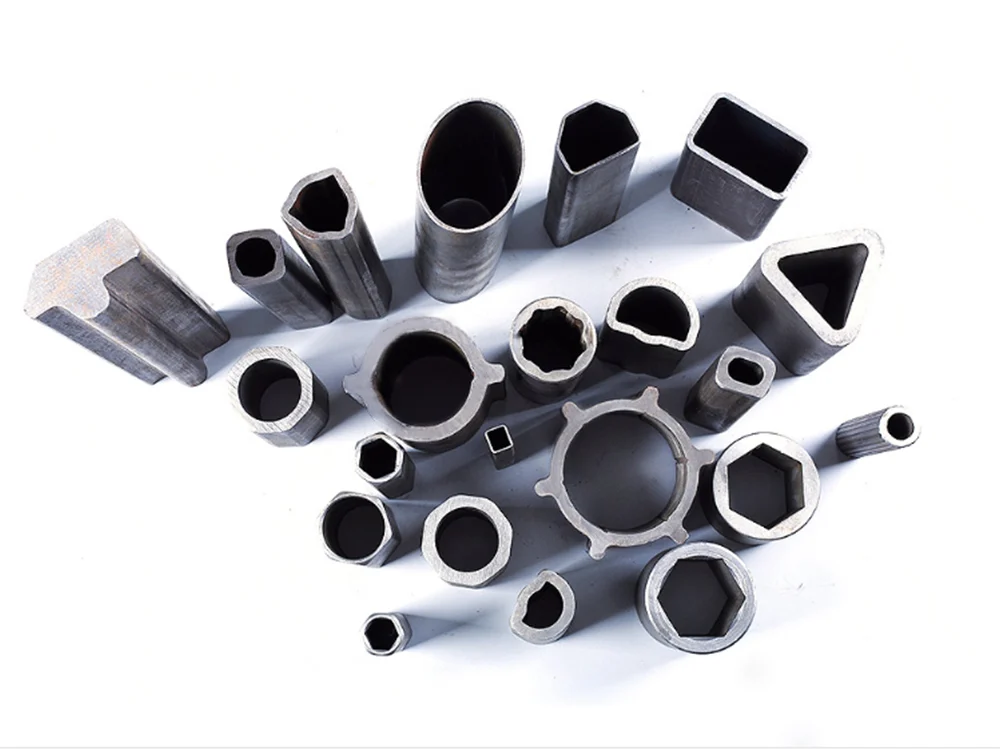
For custom geometries, the die set is the secret sauce. A square, hexagonal, oval, D-shaped, or double-finned profile needs a shaped die and matching tooling that holds the cross-section stable through the draw. This is why lead time and tooling cost are so tightly linked to the number of profile variants a buyer requests.
DIN 2391-2 sets out technical delivery conditions for seamless precision tubes and remains a common contractual anchor for the dimensional results cold working should deliver [2]. On the mechanical-tubing side, ASTM A519 defines seamless carbon and alloy grades used across automotive and machinery applications [3].
Understanding the cold-working route helps buyers see why some tolerances are easier than others, and why a "small" profile change sometimes costs more than a big one. <Cold Drawn vs Cold Rolled Steel Tubes> compares the two processes from a design and cost viewpoint.
Where Customized Tubes Do the Heavy Lifting
Applications are where the trend becomes visible. Automotive shock-absorber tubes, steering-column shafts, and drive-shaft sleeves use tailored dimensions because they interface directly with seals and bearings. Construction machinery and hydraulic props use custom profiles to carry side loads and simplify assembly. Hexagonal tubes show up in fasteners and wrench-related machinery; double-finned tubes improve heat exchange in compact spaces; oval and shaped sections appear in structural and decorative frames.
What ties these examples together is that dimensional accuracy is load-bearing information, not cosmetic detail. A tube that drifts out of round by a few hundredths of a millimeter may still hold pressure, but it may also destroy a seal or force a bearing to run off axis. In automotive supply chains this is exactly why quality systems run so deep: IATF 16949 pushes the entire production chain toward error prevention rather than final sorting [4].
So the practical test before you customize is simple. Will a tighter tolerance or a different cross-section remove an operation downstream? If the answer is yes, the custom profile is earning its keep. If the only payoff is a slightly neater drawing, a standard product may serve just as well.
Planning a custom tube project? Send the drawing, the required standard, and the target annual volume to Sunny@tenjan.com, and we will review manufacturability and tolerance feasibility before you commit tooling budget.
What Customization Changes for Procurement Teams
For buyers, the customization trend moves the purchasing conversation upstream. Instead of asking “what do you have in stock,” the first question becomes “can this design be drawn, and what is the most economical route to the tolerance?” That requires a different kind of supplier dialogue — one that combines process understanding with honest feedback on manufacturability.
The documentation burden grows with customization as well. Buyers increasingly require EN 10204 3.1 or 3.2 inspection certificates, which tie each delivered batch to the heat analysis and test results [5]. That certificate is not a formality: when a custom tube becomes a safety-relevant component, traceability is the difference between a controlled recall and a very long night.
Lead time is the third piece. A custom profile usually means tooling review, die procurement or modification, a trial draw, and then production. Buyers who treat custom tube like off-the-shelf inventory tend to discover the schedule risk late. The stronger approach is to lock the drawing early and treat tooling approval as a milestone in its own right.
A clear lead-time plan is one of the cheapest forms of risk control in a custom tube program. <Managing Custom Steel Tube Lead Times for OEM Buyers> explains how to set realistic milestones and avoid end-of-schedule surprises.
Ready to Put Customization to Work?
If your next project involves a custom profile — square, hexagonal, oval, double-finned, or something your current supplier said was impossible — send the drawing to Sunny@tenjan.com. Tenjan’s custom tube capability spans outer diameters from 10 mm to 108 mm and wall thicknesses from 1 mm to 20 mm, with precision tolerances down to ±0.1 mm.
Include the material grade, tolerance requirements, required inspection certificate, and expected annual quantity, and our engineering team will assess the most economical process route and return a quotation.
Phone/WhatsApp: +86 13401309791 — or call +86 51988789990 for technical consultation.
Frequently Asked Questions
What minimum production quantity applies to custom steel tubes?
For profile-based custom work, small-batch orders are generally possible, especially when the cross-section fits an existing die family. Prototype and pilot quantities can usually be arranged before full production tooling is released. Exact minimums depend on profile complexity and the chosen cold-working route.
Which standards apply to custom-shaped precision tubes?
The most relevant frameworks depend on the target market: EN 10305-1 for precision delivery conditions, DIN 2391-2 for seamless precision tube dimensions and delivery, ASTM A519 for seamless mechanical tubing, and GB/T 3094 for special-shaped steel profiles. Stating the target standard early helps the mill align tolerance classes and test methods.
How long does a custom steel tube order take?
Lead time depends mainly on whether new tooling is required. Existing tooling may allow production within a few weeks, while a new or modified profile adds die design, trial drawing, and approval time. Locking the drawing early and approving tooling as a milestone has the largest effect on final schedule.
Can I order a small batch for prototyping before committing to full production?
Yes, in most cases a pilot batch is recommended. It lets the engineering team validate dimensions, surface finish, and downstream processing before volume production. The pilot run should use the same heat-treatment condition and inspection documents planned for production.
What information should I include in a request for quote for custom tube?
Include the drawing with cross-section geometry, material grade, required tolerance class, surface finish, heat-treatment condition, required inspection certificate such as EN 10204 3.1, and expected annual quantity. The annual quantity matters most because it drives per-piece cost and determines how tooling investment is amortized.
References
[1] EN 10305-1:2016, Steel tubes for precision applications — Technical delivery conditions — Part 1: Seamless cold drawn tubes. European Committee for Standardization, Brussels.
[2] DIN 2391-2:1994, Seamless precision steel tubes — Technical delivery conditions. Deutsches Institut für Normung, Berlin.
[3] ASTM A519/A519M-17, Standard Specification for Seamless Carbon and Alloy Steel Mechanical Tubing. ASTM International, West Conshohocken, PA.
[4] IATF 16949:2016, Automotive Quality Management System Standard. International Automotive Task Force.
[5] EN 10204:2004, Metallic products — Types of inspection documents. European Committee for Standardization, Brussels.
If you’re interested, check out these related articles:
Selecting Steel Pipes for Pressure Vessels: Material, Standards, and Key Considerations
Special Shaped Steel Tube: Design and Cold Drawing Rules