Welcome to Changzhou Tenjan Steel Tube Co., Ltd
Sunny@tenjan.com



Cold-formed steel tubing doesn’t get much attention until something fails. Then everyone wants to know what grade it was, who made it, and whether the specs were actually met. ASTM A500 structural steel tubing sits at the center of that conversation—it’s the standard that defines what cold-formed welded and seamless carbon steel tubes should be, and it’s been quietly holding up buildings, machines, and hydraulic systems for decades. The difference between a tube that performs and one that doesn’t often comes down to understanding what this standard actually requires and why those requirements exist.
ASTM A500 covers cold-formed welded and seamless carbon steel structural tubing in round, square, rectangular, and special shapes. The standard sets requirements for chemical composition, mechanical properties, and dimensional tolerances. Engineers depend on these specifications because they create predictable performance—when a tube meets ASTM A500, you know what you’re getting.
The standard includes several grades. Grade B and Grade C see the most use in structural applications. Each grade has distinct mechanical properties that determine where it fits in load-bearing scenarios. Yield strength and tensile strength numbers aren’t just data points—they’re the foundation of material selection decisions.
The practical difference between ASTM A500 Grade B and Grade C comes down to strength numbers. Grade C delivers higher minimum yield and tensile strength values. For square and rectangular sections, Grade C typically hits a minimum yield strength of 46 ksi (315 MPa) and minimum tensile strength of 62 ksi (425 MPa). Grade B comes in at 42 ksi (290 MPa) yield and 58 ksi (400 MPa) tensile.
That 4 ksi difference in yield strength matters when you’re designing for demanding structural applications. Higher load-bearing capacity means Grade C handles more stress before permanent deformation occurs. But Grade B isn’t inferior—it’s often the right choice when the application doesn’t need that extra margin, and the cost savings make sense.
| Property | ASTM A500 Grade B (Square/Rectangular) | ASTM A500 Grade C (Square/Rectangular) |
|---|---|---|
| Minimum Yield Strength | 42 ksi (290 MPa) | 46 ksi (315 MPa) |
| Minimum Tensile Strength | 58 ksi (400 MPa) | 62 ksi (425 MPa) |
| Elongation in 2 in. | 23% | 21% |
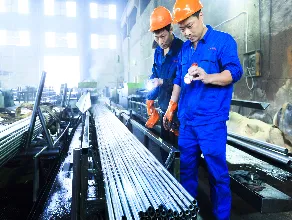
Cold drawing is where ASTM A500 tubes gain their edge. The process pulls steel tubes through a die at room temperature, and that mechanical working transforms the material. Surface finish improves. Dimensional tolerances tighten. Mechanical properties get a boost from the grain structure refinement that happens during cold working.
This manufacturing approach also enables custom steel profiles that match specific engineering requirements. The precision achievable through cold drawing simply isn’t possible with hot-formed alternatives.
When steel passes through a cold drawing die, the grain structure compresses and realigns. This increases hardness and yield strength beyond what the base material would otherwise provide. The dimensional accuracy improvements are equally significant—cold-drawn tubes achieve tolerances that hot-formed or as-welded tubes can’t match.
For applications requiring exact fits and consistent performance under stress, these improvements aren’t optional. The cold working effects directly determine whether a tube can handle high-stress conditions reliably.
For more information on the causes and prevention of cracking in steel tubes, you may find this article helpful: 《Analysis of Key Causes and Prevention Strategies for Cracking in Seamless Steel Tubes during Bending and Flattening》.
ASTM A500 structural steel tubing shows up across industries because it delivers reliable performance in demanding environments. The applications reveal why the standard matters.
Automotive components need strength without excess weight. Chassis structures, roll cages, and suspension parts all benefit from the favorable strength-to-weight ratio. Construction machinery demands tubes that handle heavy loads and harsh conditions—boom supports, frame components, and protective structures rely on ASTM A500 tubing’s structural integrity.
Hydraulic systems and high-pressure boilers present different challenges. Pressure containment, smooth internal surfaces, and precise dimensions become critical. The same ASTM A500 specification that works for a building frame also serves these fluid-handling applications.
| Application Area | Key Benefits of ASTM A500 Tubes | Example Products |
|---|---|---|
| Automotive Components | High strength, dimensional accuracy, fatigue resistance | Chassis, roll cages, suspension parts |
| Construction Machinery | Structural integrity, impact resistance, durability | Boom supports, frame components, protective structures |
| Hydraulic Systems | Pressure resistance, smooth internal surface, precise dimensions | Cylinders, fluid lines, structural supports |
| High-Pressure Boilers | Temperature resistance, pressure containment, reliability | Boiler tubes, heat exchanger components |
| General Structural Work | Weldability, formability, cost-effectiveness | Building frames, support columns, railings |
Quality assurance for ASTM A500 structural steel tubes involves more than paperwork. The testing methods used determine whether problems get caught before they cause failures.
Positive Material Identification (PMI) confirms the chemical composition matches what’s specified. This prevents material mix-ups—a tube labeled as one grade but actually made from different chemistry. Non-Destructive Testing (NDT) methods detect internal and surface imperfections without destroying the tube. Ultrasonic testing finds internal flaws. Eddy current testing catches surface discontinuities. Magnetic particle inspection reveals cracks that visual inspection would miss.
ISO certification adds another layer. It indicates the manufacturer follows documented quality management processes consistently. These protocols work together to verify material integrity and compliance.
The essential quality control measures for ASTM A500 structural steel tubes include eddy current testing, ultrasonic testing, and magnetic particle inspection. Each method targets different types of defects. Eddy current testing excels at finding surface and near-surface discontinuities. Ultrasonic testing penetrates deeper to detect internal flaws. Magnetic particle inspection reveals surface cracks with high sensitivity.
PMI verification prevents a surprisingly common problem—material substitution or mix-up during production or handling. When a tube’s actual chemistry doesn’t match its documentation, the consequences can be severe in critical applications.
Sourcing ASTM A500 structural steel tubing from a vertically integrated manufacturer changes the procurement equation. When one company controls the entire production process from raw material sourcing through finished product, several things improve.
Raw material traceability becomes straightforward. Quality consistency increases because the same organization manages every step. Custom solutions like custom shaped steel tubes and OEM steel tube solutions become more feasible when the manufacturer doesn’t need to coordinate across multiple suppliers.
Changzhou Tenjan Steel Tube Co.,Ltd operates this way, maintaining full control over production. This streamlined supply chain reduces risks and improves reliability for high-precision tubing orders.
Changzhou Tenjan Steel Tube Co.,Ltd has manufactured high-precision steel tubing for over two decades. The company’s vertical integration and ISO-certified processes ensure ASTM A500 structural steel tubing meets international standards and specific project requirements. Custom solutions and reliable supply are available for engineering projects requiring precision and performance. Contact the team to discuss specifications. Email: Sunny@tenjan.com | Tel: +86 51988789990 | Phone/WhatsApp: +86 13401309791| Tel: +86 51988789990 | Phone/WhatsApp: +86 13401309791
Lead times for custom ASTM A500 structural steel tube orders depend on complexity, volume, and processing requirements. Vertical integration allows Changzhou Tenjan Steel Tube Co.,Ltd to optimize production scheduling. Contact the sales team with your specifications for an accurate estimate based on current capacity and your particular needs.
Changzhou Tenjan Steel Tube Co.,Ltd manufactures precision steel tubing compliant with ASTM, EN, DIN, and JIS standards. This capability ensures ASTM A500 structural steel tube orders meet global specifications regardless of where projects are located or what regulatory frameworks apply.
Changzhou Tenjan Steel Tube Co.,Ltd performs comprehensive non-destructive testing on ASTM A500 structural steel tubes. Testing methods include eddy current testing, ultrasonic testing, and magnetic particle inspection. These techniques verify material soundness and detect internal or surface imperfections before tubes ship to critical applications.


Home Product Capabilities Case Studies Blogs About Get a Quote
Pipe & Tube Manufacturing Process Shapes & Profiles Pipes & Tubes Material Standard Steel Pipes & Tube Rebar Couplers Cold Drawn Steel Profiles & Bars
Oil & Petrochemical Industry Automotive & Motorcycle Components Mechanical Engineering Components Mining Construction Support Structures High-Pressure Boiler System Construction Machinery Geological Drilling Agricultural Machinery Parts Industrial Fluid Transfer Systems


© 2024 Changzhou Tenjan Steel Tube Co., Ltd All rights reserved. Privacy StatementTerms-ConditionsSitemap
