Welcome to Changzhou Tenjan Steel Tube Co., Ltd
Sunny@tenjan.com



If you have ever specified a steel tube for a hydraulic cylinder, a high-pressure boiler, or a load-bearing component in a vehicle chassis, you have likely confronted the gap between a “standard” tube and one that actually fits. The difference often comes down to a single decision: whether the tube is cold drawn. Most engineers understand that cold drawn steel tube offers tighter tolerances and a better surface finish, but fewer know exactly how the process works at the grain level, or why it can double the yield strength of the same base material. When I first walked into a cold drawing plant in 2004 as a junior engineer, I saw a 12-meter-long red-hot piercer lurch into a shell, and I thought the hard part was over. I was wrong. The cold drawing step is where precision actually happens. This article explains what cold drawn steel tube is, how the drawing process transforms mechanical properties, where it outperforms other tubing methods, and what you should ask a supplier before you commit to a purchase order.
A cold drawn steel tube is a steel tube that has been reduced in outside diameter and wall thickness at room temperature by pulling it through a die, rather than being shaped hot. The starting blank is typically a hot-finished seamless or welded tube, though seamless stock dominates for critical applications. The cold drawing process does more than just shrink dimensions. It work-hardens the material, refines the grain structure, and straightens the tube. For an engineer, the practical outcome is a tube that can hold a tolerance of ±0.1 mm while the same steel in hot-rolled form might swing ±0.5 mm or more. That difference is the reason you choose cold drawn when the tube forms part of a sealing surface, a bearing fit, or a machine structure that will be machined later.
I have watched a customer reject an entire shipment of hot-rolled tubes because the ovality exceeded 0.3 mm, making them impossible to centerless-grind into hydraulic cylinder rods. That single incident taught me a lesson: “precision” isn’t a marketing word; it’s a go/no-go gate for downstream processing.
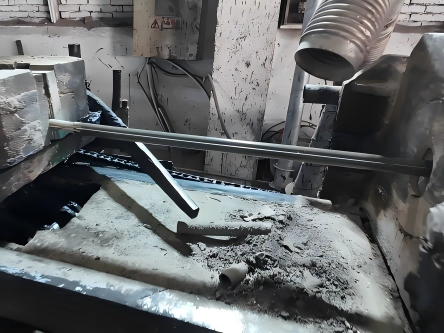
The cold drawing process may look straightforward on paper, but each step has a knock-on effect on the final quality. Here is the typical sequence on a modern draw bench:
Surface preparation. The incoming hot-rolled tube is pickled to remove mill scale, then coated with a phosphate or oxalate lubricant carrier. If the lubricant film is uneven, the drawn tube will show chatter marks.
Pointing. One end of the tube is swaged down to a smaller diameter so it can be fed through the die. This is not cosmetic; the swaged section must carry the entire drawing force, which can exceed 100 tonnes for larger diameters.
Drawing. The tube is pulled through a tungsten carbide die at ambient temperature. The die reduces the outer diameter and, in conjunction with a floating or fixed mandrel, controls the inner diameter and wall thickness. The area reduction per pass typically ranges from 10% to 35%, depending on the steel grade. If you try to reduce too much in one pass, the tube tears; too little, and you pay for an extra pass without meaningful property improvement.
Straightening and cutting. After drawing, the tube passes through a multi-roll straightener and is cut to the ordered length. Even a tiny residual bow can cause feed problems in an automated lathe later.
Stress-relief annealing (optional but common). Cold drawing builds up residual stresses that can cause distortion during machining or welding. A low-temperature stress-relief cycle, usually between 450°C and 600°C, relieves those stresses without undoing all the work-hardening. Many customers will ask for “cold finished stress-relieved” (CFSR) tube precisely for this balance of strength and stability.
If you have ever had a bearing seat walk out of tolerance after a few thermal cycles, residual stress was often the culprit. I have found that ordering the tube in the CFSR condition rather than just “as-drawn” eliminates most of those surprises in the machine shop.
The mechanical properties of a cold drawn steel tube depend on the starting grade, the amount of reduction, and whether any heat treatment follows. The table below gives a practical comparison for S355JR, a common structural steel.
| Property | Hot Finished (S355JR) | Cold Drawn (S355JR) |
|---|---|---|
| Tensile Strength (MPa) | 470–630 | 550–750 |
| Yield Strength (MPa) | 355 min | 480 min |
| Elongation (%) | 22 min | 12 min |
| Hardness (HBW) | ~150 | 190–230 |
| Dimensional Tolerance | ±0.5 mm | ±0.1 mm |
The mechanism is work-hardening: the drawing operation multiplies dislocations in the crystal lattice, which impede further dislocation movement, raising strength. The trade-off is a drop in elongation, which is why cold drawn tubes for structural applications often undergo a normalising or stress-relieving step to restore some ductility.
For alloy grades like 25CrMo4 or 42CrMo4, a post-drawing quench and temper can push tensile strength beyond 1000 MPa. I have supplied 25CrMo4 tubes to a European hydraulic cylinder manufacturer that required a minimum yield of 750 MPa after machining; the only reliable way to hit that number was to start with a cold drawn blank, then quench and temper to the exact hardness window.
The surface finish of a cold drawn tube typically falls between Ra 0.8 µm and Ra 1.6 µm, compared to Ra 3.2 µm or rougher for a typical hot-rolled tube. This matters in three practical ways:
Sealing surfaces: a smoother bore reduces friction and seal wear in hydraulic cylinders. I have seen oil leakage tests pass with a cold drawn tube that had failed with an as-hot-rolled tube of the same dimensional specification.
Coatings and platings: zinc plating, chrome plating, and paint adhere better to a smooth, scale-free substrate.
Machining allowance: a cold drawn tube can be machined with a smaller stock removal, saving time and tool wear. For a 50 mm diameter bar, switching from hot-rolled to cold drawn often means the customer can go from a 3 mm rough pass to a 1 mm finish pass.
Dimensional accuracy is just as important. Cold drawn tubes routinely meet tolerances of ±0.1 mm on diameter and ±0.05 mm on wall thickness within the same batch. Hot-rolled tubes might need a turn-skimming operation just to clean up the surface, which adds cost and lead time.
If your part print calls for a tolerance of h8 or better on the outside diameter, a hot-rolled tube is unlikely to get you there without extra machining. I always ask customers to share their finish machining sequence; in many cases, ordering the tube in cold drawn condition is cheaper than paying for extra machining hours.
Cold drawn steel tubes are not the cheapest option per kilogram, but in applications where the cost of machining, assembly, or failure runs high, they are often the cheapest total-cost solution. The most common application areas I have supported include:
Hydraulic cylinders: the inner bore must be smooth and dimensionally stable. Cold drawn tube is the starting stock for honed cylinder tubing; without the cold drawn step, honing time doubles.
Automotive drivetrain components: driveshafts, steering columns, and hollow stabiliser bars use cold drawn tubes for their fatigue strength and weight reduction.
High-pressure boilers and heat exchangers: ASTM A192 and ASTM A179 tubes are cold drawn to meet the strength and surface requirements for high-pressure service.
Precision mechanical components: bearing races, bushings, and spacer rings benefit from the tight size control of cold drawn stock.
Construction machinery: boom pins, bushings, and undercarriage parts often start as cold drawn alloy tubes, then are induction-hardened at the wear points.
For hydraulic cylinder tube specifically, we stock a wide range of cold drawn seamless tubes under Precision Pipe&Tube category, ready to be honed or machined to the customer’s final diameter.
The following table summarises the key differences.
| Characteristic | Hot Rolled | Cold Rolled | Cold Drawn |
|---|---|---|---|
| Manufacturing Temperature | Above recrystallisation | Room temperature | Room temperature |
| Dimensional Tolerance | ±0.5 mm typical | ±0.1 mm typical | ±0.1 mm typical |
| Surface Finish (Ra) | >3.2 µm | 0.8–1.6 µm | 0.8–1.6 µm |
| Strength (relative) | Base | Higher | Highest |
| Ductility (relative) | Highest | Medium | Lower, but adjustable via heat treatment |
| Internal Stress | Low | Medium | High, can be stress-relieved |
| Typical Shapes | Round, thick wall | Round, thin wall | Round, profile, special shapes |
Cold rolled tube is often conflated with cold drawn, but they are different. Cold rolling uses a set of rolls to reduce wall thickness in small increments, producing very thin-walled, high-precision tube, often for heat exchanger applications. Cold drawing, by contrast, can handle much thicker walls and is the primary process for mechanical tubing and hydraulic cylinder stock.
After two decades of watching procurement teams choose tube suppliers, I have distilled the conversation down to a handful of questions that separate a factory that understands your application from one that is simply filling an order.
Can you confirm the starting blank process? Whether the tube starts as a pierced seamless shell or a welded tube affects the final microstructure and certification path.
What area reduction per pass do you use for this grade? A supplier who can explain why they choose 20% versus 30% for 4130 alloy is worth more than a lower price.
Is stress-relieving included, and at what temperature? Stress-relief is not just a box to tick; the temperature matters for retaining strength while removing residual stress.
Can you supply a heat number traceability report? For critical components, you need full traceability from the cast heat to the shipped tube.
What is your batch-to-batch tolerance on wall thickness? A single data point on a certificate means nothing; ask for the statistical distribution (Cp and Cpk) across a production run.
Sending a drawing with these questions early in the sourcing process often cuts months off the back-and-forth of sample qualification. If you are working on a new hydraulic cylinder design or a pressure vessel that must meet ASME Section II, I would suggest you email your tube specification and required certifications to Sunny@tenjan.com or call +86 13401309791; we can walk through the standard options and confirm which process route will meet your deadline.
The three most significant advantages are tighter dimensional tolerance, higher strength due to work-hardening, and a smoother surface finish. These translate directly to less machining stock, better surface for sealing or coating, and the ability to use a thinner wall for the same load-bearing capacity. The trade-off is a higher cost per metre and lower as-delivered ductility, which may need to be addressed with a stress-relief anneal.
Yes, they can be welded, but the cold-worked microstructure increases the risk of cracking in the heat-affected zone, especially in higher-carbon and alloy grades. The best practice is to stress-relieve or normalise the tube before welding, or to use a low-hydrogen welding process with an interpass temperature control. In applications I have supported for automotive chassis parts, the tube supplier and the fabricator work together to define the pre-weld condition and the post-weld inspection criteria.
Cold drawn tube is generally the right choice when the wall thickness is above 2 mm and the application requires high strength, while cold rolled tube excels in thin-walled, high-surface-finish applications such as instrumentation tubing or heat exchangers. If your wall thickness is below 1 mm, cold rolled usually makes more sense; above 3 mm, cold drawn is the standard option.
Per kilogram yes, but per finished component often no. The higher base cost is offset by reduced machining time, less material waste, and lower rejection rates. In one hydraulic cylinder project I followed, switching from hot-rolled to cold drawn starting stock increased the tube cost by roughly 15% but cut total machining hours by 35%, resulting in a net saving. Your mileage will vary depending on the complexity of the part and the hourly machine rate.
The most relevant standards depend on the application. For mechanical and general engineering use, ASTM A519 (USA), EN 10305-1 (Europe), and DIN 2391 (Germany) are common. For boiler and heat exchanger applications, ASTM A179 and ASTM A192 specify cold drawn seamless tubes. In Asia, JIS G3445 and GB/T 3639 are frequently referenced. Always check that the steel grade inside the standard matches your strength and service temperature requirements. If your program requires a combination of standards, like meeting EN 10305-1 dimensional tolerances while satisfying ASME B31.3 material requirements, it is worth confirming the supplier’s ability to dual-certify before placing an order. Send your technical requirements to Sunny@tenjan.com, and we can verify which certifications are available for the grade and size you need.


Home Product Capabilities Case Studies Blogs About Get a Quote
Pipe & Tube Manufacturing Process Shapes & Profiles Pipes & Tubes Material Standard Steel Pipes & Tube Rebar Couplers Cold Drawn Steel Profiles & Bars
Oil & Petrochemical Industry Automotive & Motorcycle Components Mechanical Engineering Components Mining Construction Support Structures High-Pressure Boiler System Construction Machinery Geological Drilling Agricultural Machinery Parts Industrial Fluid Transfer Systems


© 2024 Changzhou Tenjan Steel Tube Co., Ltd All rights reserved. Privacy StatementTerms-ConditionsSitemap
