Welcome to Changzhou Tenjan Steel Tube Co., Ltd
Sunny@tenjan.com



Thick wall steel tubing is often mistaken for simply being stronger than its thinner counterparts. The real advantage is more nuanced: a well-chosen thick wall tube balances pressure containment, structural rigidity, and fabrication practicalities—while avoiding the weight and cost of a tube that’s heavier than necessary. A tube with a diameter-to-thickness (D/t) ratio below about 12 is generally classified as thick wall, but the threshold shifts with material grade and the type of loading. This matters because specifying an off-the-shelf schedule without checking the D/t ratio sometimes leads to a part that is heavier than needed, or worse, one that limits bending and machining options you were counting on.
Wall thickness classification is mostly about the D/t ratio. For a tube with a 2‑inch outside diameter, a wall of 0.188 inch gives a D/t of 10.6—well into thick-wall territory in mechanical applications. The same OD with a 0.049 inch wall (D/t ≈ 41) would behave like a thin-wall tube, prone to ovality during bending and more sensitive to external pressure.
It’s not always intuitive. A 6‑inch pipe in Schedule 80 has a wall of 0.432 inch—D/t ≈ 13.9, which many engineers would still call thick wall for high-pressure systems. The pipe world uses schedules, while mechanical tubing is specified directly by OD and wall thickness. Thick wall tubing sits at the intersection: it can replace heavy schedule pipe when tight tolerances and better surface finish are required, especially in machined components.
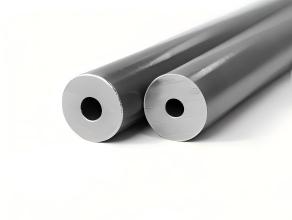
Thick wall tubes are almost always seamless, produced either by hot‑finishing or cold‑drawing. Hot‑finished tube is cost‑effective for basic structural use, but the wall thickness tolerance is wider and the surface has mill scale. When precision matters, cold‑drawing over a mandrel brings the wall down to exact dimensions while raising material strength through work hardening. For very heavy walls, multiple cold‑drawing passes might be necessary, with inter‑stage annealing to restore ductility.
The most common carbon steel grades are 1020 and 1035, often supplied to ASTM A519 or EN10305‑1. Alloy grades like 4140 and 4130 appear when high strength or hardenability is needed—think hydraulic cylinder rods and piston accumulators. We’ve seen projects where a switch from 1020 hot‑finished to 1026 cold‑drawn seamless tube reduced machining time by nearly 15% because the tighter wall concentricity meant less stock to remove. In one motor grader cylinder program, using normalized 1026 with a 0.312‑inch wall instead of a 0.375‑inch Schedule 80 cut weight by eight pounds per tube without sacrificing burst margin—a gain the OEM’s vehicle dynamics team really appreciated.
Standards tell you more than just chemistry. They also mandate wall thickness tolerances, straightness, and end finish—details that matter when you’re feeding a tube into a CNC lathe or butt‑welding it into a manifold.
| Standard | Scope | Typical Wall Tolerance |
|---|---|---|
| ASTM A519 | Seamless carbon and alloy mechanical tubing | ±10% of nominal wall for cold‑finished |
| EN 10305‑1 | Cold‑drawn seamless steel tubes for precision applications | ±10% (±0.15 mm for thin walls) |
| DIN 2391‑2 | Seamless precision steel tubes for high‑precision applications | Class A or B, often ±0.05 mm on OD |
| ASTM A106 | Seamless carbon steel pipe for high‑temperature service | Minimum wall per specification; mill tolerance –12.5% |
| JIS G3445 | Carbon steel tubes for machine structural purposes | ±0.25 mm on wall thickness for cold‑finished |
The differentiation comes down to what you’re building. For a construction machinery pivot pin, A519 1020 with a standard tolerance works. For a high‑pressure fuel injection accumulator where wall stress is near yield, DIN 2391‑2 Class A might be mandatory.
Thick wall tubing earns its keep where pressure, bending loads, or internal machining demand heft. Hydraulic cylinders are the obvious example: the tube body must contain 3000–5000 psi (and sometimes higher) with cyclic loading, while resisting bore wear. Seamless 4140 with a honed ID is common here.
Beyond hydraulics, thick wall tubes turn up in high‑pressure boiler headers where creep resistance matters, in drill collar stock for oil and gas, and in structural roll‑over protection bars for construction equipment. A less obvious place is machined bearing housings—starting with a thick wall tube saves material removal compared to a solid bar. Our earlier article on bending and flattening failure in seamless tubes touches on why wall thickness influences cracking during forming, a factor that becomes critical when thick wall tubes are cold‑bent into U‑shapes for heat exchanger coils. (See: [Analysis of Key Causes and Prevention Strategies for Cracking in Seamless Steel Tubes])
For highly stressed components, it’s worth verifying that the tube’s wall thickness is adequate not just for internal pressure but also for the bending deflection the assembly will see. If your design involves a combination of pressure and severe bending, reach out with your loading conditions—we can check if the D/t ratio and material grade you’ve chosen are compatible.
Start with the pressure calculation. Barlow’s formula (P = 2 · S · t / OD) gives a quick burst estimate, but you need a derated design pressure that includes a safety factor—typically 4:1 for hydraulic systems. Then apply a material derating factor if operating above the material’s creep threshold.
After pressure, consider your fabrication steps. Thick walls reduce bore clearance, so if you’re going to weld a neck or machine internal threads, the wall must be thick enough to leave sufficient material after these operations. The same thick wall that handles pressure can resist bending too, but it also demands a larger bend radius—roughly 3× the tube OD for cold bending without a mandrel, sometimes more for alloy grades. We often see specifications that over‑compensate by jumping to the next schedule or doubling the wall; while that certainly won’t fail, it adds dead weight and can push the tube into a range where machining becomes slower and more expensive.
There’s a more efficient path. Modern cold‑drawn seamless tube can achieve the same burst pressure with a thinner wall because the cold work raises yield strength. For instance, a cold‑drawn 1026 tube with a 0.250‑inch wall may match the pressure capacity of a hot‑finished tube with a 0.312‑inch wall, saving roughly 20% on weight while also offering a tighter tolerance. The key is working with a supplier who can adjust wall thickness in fine increments rather than being locked into standard schedules.
If you’re between two wall thickness options or unsure whether a custom wall makes economic sense, send your minimum pressure, expected loads, and any fabrication sequence to Sunny@tenjan.com. We’ll run through the numbers and suggest a tube specification that meets your operating conditions without overbuilding.
What D/t ratio is considered thick wall?
A D/t ratio below 12–15 is typically thick wall in mechanical applications, but the exact cutoff depends on the load type and material grade. For buckling‑critical columns, a D/t under 20 might still behave as thick wall because local buckling is less likely.
Is thick wall tubing the same as heavy wall pipe?
Not exactly. Pipe is assigned a schedule (e.g., Schedule 80, 160, XXS) and a nominal bore, while tubing is ordered by actual OD and wall thickness. A heavy wall pipe can perform the same function, but tubing offers tighter tolerances and more consistent mechanical properties, which simplifies machining and welding.
Can thick wall steel tubes be bent without cracking?
Yes, but the minimum bend radius increases with wall thickness. For cold bending without a mandrel, plan on a centerline radius of at least 3× OD for carbon steel. Alloy grades like 4130 may require pre‑heating or a larger radius. Post‑bend annealing can relieve residual stresses if the component will see pressure loading.
What’s the most common material for thick wall mechanical tubing?
1020 and 1026 carbon steels under ASTM A519 are the most frequently used. When higher strength is needed, 4130 and 4140 chromium‑molybdenum grades are common, especially for hydraulic service above 5000 psi.
Does a thicker wall always make the tube stronger?
Not in a linear sense. Strength against internal pressure follows wall thickness, but the yield strength of the material matters just as much. A thinner wall 4140 tube can outperform a thicker 1020 at a lower weight. Over‑thick walls also add cost and may complicate bending and welding without a proportional safety gain. If you’re weighing different material grades against wall thickness options, sharing your performance requirements with an experienced tube manufacturer can often reveal a lighter, more cost‑effective specification. Reach out at Sunny@tenjan.com and we’ll help you compare feasible grade‑thickness combinations.


Home Product Capabilities Case Studies Blogs About Get a Quote
Pipe & Tube Manufacturing Process Shapes & Profiles Pipes & Tubes Material Standard Steel Pipes & Tube Rebar Couplers Cold Drawn Steel Profiles & Bars
Oil & Petrochemical Industry Automotive & Motorcycle Components Mechanical Engineering Components Mining Construction Support Structures High-Pressure Boiler System Construction Machinery Geological Drilling Agricultural Machinery Parts Industrial Fluid Transfer Systems


© 2024 Changzhou Tenjan Steel Tube Co., Ltd All rights reserved. Privacy StatementTerms-ConditionsSitemap
