Welcome to Changzhou Tenjan Steel Tube Co., Ltd
Sunny@tenjan.com



Steel pipes in heat exchangers fail in predictable ways, and most of those failures trace back to decisions made long before installation. The material grade, the manufacturing tolerances, the surface finish—these choices compound over years of thermal cycling and fluid contact. I’ve seen exchangers last decades with the right tube selection, and I’ve seen others pit through in under five years because someone underestimated the chloride content in the cooling water. What follows covers the technical ground that separates those outcomes: material properties, manufacturing precision, durability factors, and the standards that hold everything together.
The operating environment dictates which steel grade belongs in a heat exchanger. This isn’t a matter of preference—it’s physics and chemistry working against you if the material doesn’t match the conditions.
The split between alloy steel tubes and carbon steel tubes comes down to what the application demands. Carbon steel handles moderate temperatures and non-aggressive fluids well. It conducts heat efficiently and costs less. But introduce chlorides, sulfur compounds, or temperatures above 400°C, and carbon steel starts losing the fight against corrosion and creep.
ASTM A179 Steel Pipe represents the workhorse specification for heat exchanger service. It’s a seamless cold-drawn low-carbon tube designed specifically for condensers and heat exchangers where good thermal conductivity matters more than extreme strength. The cold-drawing process gives it a smooth interior surface that reduces fouling and improves heat transfer coefficients.
For European specifications, DIN 17175 Steel Pipe covers high-temperature boiler and heat exchanger applications. The standard includes both carbon and alloy grades, with elevated-temperature tensile requirements that ASTM A179 doesn’t address.
When the environment turns aggressive—think flue gas condensation with sulfuric acid dew points—grades like 09CrCuSb earn their place. The chromium, copper, and antimony additions create a protective oxide layer that resists the specific corrosion mechanisms found in coal-fired power plant economizers and air preheaters.
High-pressure applications often call for 4140 Steel Pipe. The chromium-molybdenum composition delivers strength and toughness that plain carbon steel can’t match, particularly important when wall thickness needs to stay thin for heat transfer reasons but pressure containment can’t be compromised.
| Steel Grade | Type | Key Properties | Common Applications |
|---|---|---|---|
| ASTM A179 | Carbon | Low-carbon, good thermal conductivity | Heat exchangers, condensers |
| DIN 17175 | Carbon/Alloy | High-temperature resistance | Boilers, heat exchangers |
| 4140 | Alloy | High strength, toughness, wear resistance | High-pressure, high-temperature units |
| 09CrCuSb | Alloy | Atmospheric corrosion resistance | Corrosive environments |
| S355JR | Carbon | Good mechanical properties, weldability | Structural, general purpose |
Seamless steel tubes eliminate the weld seam that can become a corrosion initiation site or a weak point under pressure cycling. The uniform wall thickness that seamless manufacturing provides also means more predictable heat transfer calculations and fewer surprises during hydrostatic testing.
Dimensional accuracy in heat exchanger tubing isn’t about aesthetics—it’s about fit, seal integrity, and consistent thermal performance across thousands of tube-to-tubesheet joints.
Cold drawn tubes go through a process that simultaneously reduces diameter, controls wall thickness, and improves surface finish. The metal flows through a die while a mandrel controls the inner diameter. This work-hardening increases yield strength and tensile strength compared to the as-rolled condition. For precision tubing applications where tolerances measured in hundredths of a millimeter matter, cold drawing is the only practical manufacturing route.
Cold rolling achieves similar results through a different mechanism—progressive reduction between rotating rolls. Both processes produce tubes with surface roughness values low enough to minimize fluid friction and fouling accumulation.
The testing protocols matter as much as the forming processes. Non-Destructive Testing inspections catch internal flaws, laminations, and inclusions that would otherwise become leak paths or crack initiation sites during service. Eddy current testing runs at production speeds and flags tubes with wall thickness variations or surface defects. Ultrasonic testing provides volumetric inspection for internal flaws that eddy current might miss.
Positive Material Identification testing confirms that the tube you’re installing actually matches the material test report. Mix-ups happen in supply chains, and PMI catches them before a carbon steel tube ends up where an alloy tube was specified.
Beyond round profiles, custom tube geometries serve specific heat transfer optimization needs. Square, rectangular, and hexagonal cross-sections can improve packing density in certain shell configurations or enhance turbulence in the fluid flow. Special-Shaped Alloy Steel Tubes and Special-Shaped Carbon Steel Tubes require more complex tooling and tighter process control, but they enable designs that round tubes simply can’t achieve.
Heat exchanger tubes face a combination of stresses that individually might be manageable but together create failure conditions that demand careful material selection and design.
Corrosion takes multiple forms in heat exchanger service. Pitting corrosion creates localized penetrations that can breach a tube wall while leaving the surrounding metal apparently intact. Chlorides in cooling water are the usual culprits. Crevice corrosion attacks the geometry where tubes meet tubesheets or baffles—anywhere stagnant fluid can concentrate corrosive species. Stress corrosion cracking combines tensile stress with specific corrosive environments to propagate cracks at stress levels well below the material’s normal strength limits.
Temperature resistance involves more than just not melting. Metals lose strength as temperature increases, and the design must account for the elevated-temperature properties, not room-temperature values. Creep—the slow deformation under constant load at high temperature—becomes a design consideration above roughly 400°C for carbon steels and higher for alloy grades. Thermal fatigue from repeated heating and cooling cycles can initiate cracks even when the maximum stress never approaches the yield strength.
ASTM A192 Steel Pipe addresses high-pressure boiler service where both temperature and pressure push material limits. The specification includes requirements for elevated-temperature tensile properties and more stringent testing than general-purpose tube specifications.
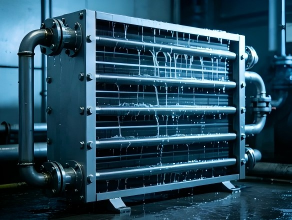
Pressure resistance calculations follow well-established formulas, but the inputs matter. Wall thickness, outside diameter, allowable stress at operating temperature, and joint efficiency factors all enter the equation. Seamless alloy steel tubes and seamless carbon steel tubes eliminate the joint efficiency penalty that welded tubes carry, allowing thinner walls for the same pressure rating.
Fluid dynamics inside the tubes affect both heat transfer and erosion potential. High velocities improve heat transfer coefficients but can erode tube walls, particularly at inlet ends and where flow direction changes. The balance point depends on the fluid properties, the tube material, and the acceptable service life.
Standards exist because engineers learned from failures. Each specification represents accumulated knowledge about what works and what doesn’t in specific applications.
ASTM standards dominate North American practice. ASTM A179 covers the basic heat exchanger tube. ASTM A213 adds alloy grades for higher temperatures. ASTM A519 Steel Pipe addresses mechanical tubing applications where the tube serves structural or mechanical functions beyond simple fluid containment.
European standards follow a different numbering system but cover similar ground. EN10305-1 Steel Pipe specifies precision cold-drawn tubes with tight dimensional tolerances and surface quality requirements. The standard includes multiple delivery conditions—annealed, normalized, stress-relieved—each with different mechanical property ranges.
JIS G3461 Steel Pipe serves Japanese industrial requirements for boiler and heat exchanger tubes. The specification parallels ASTM A179 in many respects but includes some grades and requirements specific to Japanese practice.
DIN 17175 remains widely referenced even though European harmonization has technically superseded it with EN standards. Many specifications and drawings still call out DIN grades because the installed base of equipment designed to those standards continues operating.
The standards specify more than just chemistry and mechanical properties. Dimensional tolerances, surface finish requirements, testing frequencies, marking requirements, and documentation all appear in the specifications. Meeting a standard means meeting all of it, not just the material composition.
For understanding how manufacturing processes affect tube integrity, the analysis in 《Analysis of Key Causes and Prevention Strategies for Cracking in Seamless Steel Tubes during Bending and Flattening》 covers failure mechanisms that apply to heat exchanger tube fabrication.
The best tube material and manufacturing quality can’t overcome poor installation or neglected maintenance. The decisions made after the tubes leave the factory determine whether they reach their design life.
Installation practices set the stage. Tube-to-tubesheet joints—whether rolled, welded, or both—require proper procedures and qualified personnel. Over-rolling damages tubes and creates stress concentrations. Under-rolling leaves leak paths. The tubesheet hole finish and tube end preparation both affect joint quality.
Thermal expansion and contraction create stresses that accumulate over operating cycles. Fixed tubesheet designs restrain this movement and must be designed for the resulting stresses. Floating head and U-tube designs accommodate differential expansion but introduce their own complications. The design choice affects which failure modes become most likely.
Fouling reduces heat transfer efficiency and can accelerate corrosion under deposits. Cleaning schedules depend on the fouling characteristics of the process fluids. Some services require cleaning every few months; others run for years between cleanings. The cleaning method matters too—chemical cleaning, mechanical cleaning, and hydroblasting each have appropriate applications and potential to damage tubes if misapplied.
Inspection programs catch degradation before it becomes failure. Eddy current testing of installed tubes can map wall loss from corrosion or erosion. The data supports remaining life assessments and helps prioritize tube plugging or bundle replacement decisions.
Predictive maintenance approaches can extend tube service life by 30% or more compared to run-to-failure strategies. The key is catching problems early enough that intervention options exist beyond emergency shutdown and replacement.
Pitting corrosion leads the list in cooling water service, particularly where chloride levels exceed the material’s tolerance. Erosion corrosion appears at tube inlets and anywhere flow velocities exceed design limits. Stress corrosion cracking affects susceptible materials in specific environments—austenitic stainless steels in chloride-containing fluids, for example. Fatigue cracking develops from vibration or thermal cycling. Creep becomes relevant in high-temperature service above 400°C. Each failure mode has characteristic appearances that help identify root causes during failure analysis.
Cold drawing reduces surface roughness to values below 1.6 micrometers Ra, which decreases fluid friction and fouling tendency. The process improves dimensional accuracy to tolerances tighter than hot-finished tubes can achieve, ensuring consistent fit in tubesheet holes. Work hardening during drawing increases yield and tensile strength, allowing thinner walls for the same pressure rating. The combination of smoother surfaces, tighter tolerances, and higher strength translates directly to better heat transfer coefficients and longer service life.
ASTM A179 and ASTM A213 cover most North American heat exchanger tube applications—A179 for carbon steel, A213 for alloy and stainless grades. EN 10216-2 serves European high-temperature applications. DIN 17175 remains referenced in legacy specifications and some current German practice. JIS G3461 applies to Japanese industrial requirements. Each standard specifies chemistry, mechanical properties, dimensional tolerances, testing requirements, and marking. Selecting the appropriate standard depends on the geographic location, the end-user’s specifications, and the operating conditions.
As a vertically integrated manufacturer since 2004, Changzhou Tenjan Steel Tube Co.,Ltd specializes in precision seamless and cold-drawn steel tubes, compliant with ASTM, EN, DIN, and JIS standards. Our expertise in alloy and carbon steel tubes serves critical applications from automotive to high-pressure boilers. For tailored, high-precision tubing solutions that meet your most demanding engineering project requirements, contact our specialists today. Let us partner with you to ensure the integrity and efficiency of your heat exchanger systems. Reach us at Sunny@tenjan.com or call +86 51988789990.


Home Product Capabilities Case Studies Blogs About Get a Quote
Pipe & Tube Manufacturing Process Shapes & Profiles Pipes & Tubes Material Standard Steel Pipes & Tube Rebar Couplers Cold Drawn Steel Profiles & Bars
Oil & Petrochemical Industry Automotive & Motorcycle Components Mechanical Engineering Components Mining Construction Support Structures High-Pressure Boiler System Construction Machinery Geological Drilling Agricultural Machinery Parts Industrial Fluid Transfer Systems


© 2024 Changzhou Tenjan Steel Tube Co., Ltd All rights reserved. Privacy StatementTerms-ConditionsSitemap
