Welcome to Changzhou Tenjan Steel Tube Co., Ltd
Sunny@tenjan.com



When engineers face tight tolerances and demanding load conditions, off-the-shelf tubing rarely fits the bill. The gap between what’s available and what’s actually needed pushes projects toward custom solutions—not as an upgrade, but as a baseline requirement. Getting these specifications right means understanding how material grades, manufacturing methods, and quality protocols interact across different industrial contexts.
Custom steel tube customization addresses a straightforward problem: generic components cannot satisfy the precise demands of specialized systems. Hydraulic steel tube requirements call for mirror-smooth internal surfaces and pressure ratings that standard inventory simply doesn’t offer. Automotive steel tube components must balance strength-to-weight ratios with fatigue resistance across millions of load cycles. Boiler tube customization involves materials rated for sustained exposure to extreme temperatures and pressures that would compromise ordinary grades.
Construction machinery steel tubes face a different challenge entirely—they need robust wall thicknesses and impact resistance for equipment that operates under constant vibration and shock loading. Each application demands its own combination of material properties, dimensional accuracy, and surface characteristics. Engineering design standards often specify these requirements down to the decimal point.
The variation across industries illustrates why a one-size-fits-all approach fails:
| Industry | Key Requirement | Example Steel Tube Type |
|---|---|---|
| Automotive | High strength, fatigue resistance, light weight | 4140 Steel Pipe, 25CrMo4 Steel Pipe |
| High-Pressure Boilers | High-temperature strength, corrosion resistance | JIS G3461 Steel Pipe, ASTM A192 Steel Pipe |
| Construction Machinery | Durability, impact resistance, structural integrity | Q355B Steel Pipe, ST52 Steel Pipe |
| Fluid Transport Systems | Pressure resistance, smooth internal surface | Seamless Pipe&Tube, ASTM A106 Gr.B Steel Pipe |
| Geological Drilling | Wear resistance, torsional strength | 4130 Seamless Pipe, 5140 Steel Pipe |
| Agricultural Machinery | Corrosion resistance, formability | S235JR Seamless Pipe, 1020 Steel Pipe |
Seamless steel tube customization ensures components integrate into complex assemblies without the clearance issues or performance compromises that come with adapting standard parts. Cold drawn steel tube applications benefit from the enhanced mechanical properties and tighter tolerances that this process delivers. The result is reduced risk and improved system efficiency.
Material selection determines whether a custom steel tube will perform as intended or fail under operational stress. The choice between alloy steel tube grades and carbon steel tube specifications depends entirely on what the application requires.
Alloy steels like 4140 Steel Pipe or 25CrMo4 Steel Pipe bring superior strength, toughness, and wear resistance to the table. The chromium and molybdenum content in these grades improves hardenability and high-temperature performance. Carbon steels such as 1020 Steel Pipe or S45C Steel Tubes offer good formability and weldability at lower cost points, making them practical choices when extreme mechanical properties aren’t the primary concern.
Cold drawing plays a central role in precision steel tube manufacturing. The process works the metal through dies at room temperature, refining grain structure and improving both mechanical properties and dimensional accuracy. Cold drawn welded tube combines the cost advantages of welded production with the precision benefits of cold finishing. This hybrid approach works well for applications where seamless production isn’t strictly necessary but tight tolerances still matter.
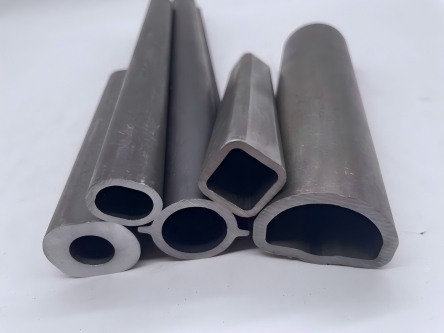
Beyond round profiles, custom steel tube shapes extend to square, rectangular, hexagonal, and Special-Shaped Alloy Steel Tubes or Special-Shaped Carbon Steel Tubes. Vertical integration steel tube production keeps every step under one roof, from raw material through finished product. This control eliminates the quality variations that can creep in when multiple suppliers handle different production stages.
Material selection establishes the baseline properties a tube can achieve. Seamless Alloy Steel Tubes deliver high strength and temperature resistance because their alloying elements form stable carbides and improve grain boundary strength.
Heat treatment takes those baseline properties and optimizes them for specific service conditions. Quenching and tempering can push hardness and tensile strength to levels the as-rolled material couldn’t reach. Normalizing refines grain structure and relieves internal stresses from manufacturing. These processes also improve corrosion resistance steel tubes by creating more uniform microstructures that resist localized attack.
The relationship between steel tube grades and heat treatment response varies significantly. A 4140 grade responds well to oil quenching and tempering, achieving excellent toughness at high hardness levels. A 1020 grade has limited hardenability but gains improved ductility through normalizing. Understanding these interactions is essential for specifying heat treatment steel tubing that will actually perform as intended.
Precision in custom steel tubing isn’t about hitting targets occasionally—it’s about hitting them consistently across production runs. Steel tube dimensional tolerances within ±0.1mm are achievable and often necessary for components in hydraulic systems where clearances between pistons and cylinder walls are measured in hundredths of a millimeter.
Cold drawn profiles deliver superior surface finish steel tubes because the drawing process burnishes the material surface while simultaneously sizing it. Lower surface roughness means less friction in dynamic applications and better sealing in static ones. For hydraulic cylinders, this surface quality directly affects seal life and leak prevention.
Custom-shaped steel tubes extend well beyond standard round profiles. Complex geometries steel tubing includes Hexagonal Steel Pipes&Tubes, Oval Steel Pipes&Tubes, and profiles like triangular or octagonal cross-sections. These shapes serve specialized structural and mechanical designs where round tubing would require additional machining or wouldn’t fit the available space envelope at all.
Reliability in custom tubing depends on quality control steel tubing that catches problems before they reach the customer. An ISO-certified quality control system provides the framework, but the specific tests and inspections determine whether that framework actually works.
Material integrity testing starts at receiving. Positive Material Identification inspection steel tubes uses X-ray fluorescence or optical emission spectroscopy to verify that incoming material matches its certification. This step catches mix-ups that could put the wrong alloy into a critical application.
Non-destructive testing steel tubes methods like ultrasonic and eddy current inspection detect internal flaws that visual examination would miss. Ultrasonic testing finds voids, inclusions, and laminations within the tube wall. Eddy current inspection identifies surface and near-surface defects with high sensitivity. These methods are particularly important for precision steel tubing destined for pressure-containing or fatigue-critical service.
Compliance with ASTM, EN, DIN, and JIS steel tube standards provides a common language between manufacturers and customers. These standards define acceptable ranges for chemical composition, mechanical properties, dimensional tolerances, and testing requirements. Meeting them demonstrates that the product has been manufactured and verified according to internationally recognized practices.
Raw material inspection establishes the foundation. PMI confirms that the material is actually what the paperwork claims it to be. Dimensional inspection steel tubes verifies outer diameter, wall thickness, and length against specification requirements.
Mechanical testing steel tubes provides objective data on material performance. Tensile testing measures yield strength, ultimate tensile strength, and elongation. Hardness testing confirms that heat treatment achieved the intended results. Impact testing evaluates toughness at specified temperatures.
NDT methods screen for defects that would compromise service performance. Certification custom steel tubes, including mill test reports with actual test results, documents compliance and provides traceability back to specific heats and production lots.
Successful custom steel tube projects require coordination across design, manufacturing, and logistics. Early collaboration during the design phase helps identify potential issues before they become expensive problems. Questions about material suitability, achievable tolerances, and manufacturing feasibility are easier to address when drawings are still preliminary.
Prototyping custom steel tubes allows validation before committing to full production quantities. A small batch of parts can confirm that the specified material, dimensions, and surface finish actually work in the intended application. This step catches design assumptions that don’t hold up in practice.
Lead time custom steel tubes depends on material availability, production scheduling, and any secondary operations required. Full process control steel tube capabilities keep more of the production sequence under direct management, reducing the coordination overhead that comes with multiple suppliers. For OEM steel tube solutions and complex engineering projects, this integrated approach simplifies procurement and improves schedule reliability.
Cost-effective steel tube customization comes from optimizing the entire project, not just minimizing the price per piece. Specifying the right material grade avoids paying for properties that aren’t needed. Designing to achievable tolerances eliminates unnecessary precision that adds cost without adding value. Ordering in quantities that match actual consumption reduces inventory carrying costs.
Customizing steel tubes delivers advantages that standard options cannot match. Application-specific tubing solutions mean the component fits its operational environment precisely rather than approximately.
A hydraulic cylinder needs tubing with exact internal dimensions and surface finish to ensure smooth piston travel and prevent leakage past seals. Specifying those requirements directly produces a tube that works correctly from installation. Adapting standard tubing to the same application typically requires honing or other secondary operations that add cost and lead time.
Enhanced performance steel tubes result from designing the tube for its actual service conditions. A tube specified for specific stresses, temperatures, and corrosive elements will outperform a general-purpose tube that wasn’t designed with those conditions in mind. This performance advantage translates to greater reliability and reduced maintenance over the product’s service life.
Cost savings custom steel tube come from several sources. Specifying precise lengths eliminates cutoff waste. Custom shapes reduce or eliminate machining operations that would be needed to adapt standard profiles. Optimized material selection avoids paying for alloy content that doesn’t contribute to performance.
Design flexibility steel tubes enable solutions that standard catalogs cannot provide. When the application requires a specific combination of dimensions, material properties, and surface characteristics, custom production is the only path to getting exactly what’s needed.
Enhanced performance steel tubes characteristics follow from that design flexibility. Higher strength, better corrosion resistance, or improved fatigue life become achievable when the tube is designed for the specific application rather than selected from available inventory.
Reduced material waste and optimized system integration complete the picture. Custom tubes arrive ready to use without the scrap and secondary operations that come with adapting standard parts to non-standard requirements.
For vertically integrated, high-precision steel tube solutions tailored to your exact specifications, partner with Changzhou Tenjan Steel Tube Co.,Ltd. Since 2004, we’ve delivered ISO-certified quality and full process control from raw material to finished product. Contact us today to discuss your OEM and engineering project requirements. Email: Sunny@tenjan.com | Tel:+86 51988789990 | WhatsApp:+86 13401309791| Tel:+86 51988789990 | WhatsApp:+86 13401309791
Changzhou Tenjan Steel Tube Co.,Ltd produces square, rectangular, Hexagonal Steel Pipes&Tubes, and other complex cross-sections through advanced cold-drawing processes. These capabilities extend to Oval Steel Pipes&Tubes and triangular profiles, all manufactured to precise dimensional tolerances for diverse industrial applications.
ISO-certified quality control covers the entire vertically integrated manufacturing process. PMI verifies incoming material composition. NDT inspections including ultrasonic and eddy current testing detect internal and surface defects. All precision steel tubing meets ASTM, EN, DIN, and JIS standards with full documentation.
Yes. Alloy and carbon steel tubes are manufactured specifically for high-pressure boilers, hydraulic systems, and automotive components. Seamless Alloy Steel Tubes provide the material integrity and pressure ratings these applications require, with specifications tailored to each project’s performance and safety requirements.


Home Product Capabilities Case Studies Blogs About Get a Quote
Pipe & Tube Manufacturing Process Shapes & Profiles Pipes & Tubes Material Standard Steel Pipes & Tube Rebar Couplers Cold Drawn Steel Profiles & Bars
Oil & Petrochemical Industry Automotive & Motorcycle Components Mechanical Engineering Components Mining Construction Support Structures High-Pressure Boiler System Construction Machinery Geological Drilling Agricultural Machinery Parts Industrial Fluid Transfer Systems


© 2024 Changzhou Tenjan Steel Tube Co., Ltd All rights reserved. Privacy StatementTerms-ConditionsSitemap
