Welcome to Changzhou Tenjan Steel Tube Co., Ltd
Sunny@tenjan.com



Picking the right EN or DIN standard for precision steel tubing sounds straightforward until you’re staring at a spec sheet wondering whether DIN 2391 or EN 10305-1 actually matters for your hydraulic system. The short answer: it often does, and the differences can affect everything from dimensional tolerances to how your purchasing department handles international suppliers. These European specifications have evolved over decades, with some DIN standards getting absorbed into broader EN frameworks while others persist because certain industries simply never stopped using them. What follows breaks down where these standards overlap, where they diverge, and how to match the right specification to your actual application requirements.
European (EN) and German Industrial (DIN) standards govern precision steel tubing specifications, though their relationship confuses even experienced engineers. DIN standards originated as German national specifications, providing detailed technical requirements for industrial products long before European standardization efforts gained momentum. As the EU pushed for harmonization, many DIN standards were either replaced by or merged into EN standards representing broader European consensus.
Here’s where it gets practical: some DIN standards, particularly those without direct EN equivalents or those deeply embedded in specific industries, remain widely referenced. German automotive suppliers still call out DIN 2391 on drawings even when EN 10305-1 covers essentially the same ground. The distinction matters for procurement and compliance documentation more than for the actual tube sitting on your workbench.
Both standard families define critical parameters for precision steel tubing: material composition, dimensional tolerances, surface finish, and mechanical properties. The table below clarifies the structural differences.
| Feature | EN Standards (e.g., EN 10305, EN 10216) | DIN Standards (e.g., DIN 2391, DIN 17175) |
|---|---|---|
| Origin | European Committee for Standardization (CEN) | Deutsches Institut für Normung (German Institute for Standardization) |
| Scope | European-wide harmonization, intended for all EU/EFTA member states | Primarily German national standard, often adopted internationally |
| Structure | Often multi-part, specifying different aspects (e.g., seamless, welded) | Can be comprehensive for specific products or materials |
| Nomenclature | EN XXXX-Y (e.g., EN 10305-1) | DIN XXXX (e.g., DIN 2391) |
| Current Use | Dominant for new designs and international trade within Europe | Still prevalent for legacy systems, specific applications, or where no EN exists |
Applications demanding tight dimensional accuracy and superior surface quality rely on precision cold drawn steel tubes. Two standards dominate this space: EN 10305 and DIN 2391.
EN 10305 spans parts 1 through 5, covering tubes for precision applications in both seamless (EN 10305-1) and welded (EN 10305-2) configurations. The standard specifies precise outer diameters, wall thicknesses, and material grades including common carbon steels like E235 and E355. Focus on EN10305-1 Steel Pipe to improve efficiency. If you’re interested, check 《EN10305-1 Steel Pipe》.
Focus on DIN 2391 Steel Pipe to improve efficiency. If you’re interested, check 《DIN 2391 Steel Pipe》 defines seamless cold-drawn precision steel tubes known for tight tolerances and smooth surfaces inside and out. Though a German national standard, its influence extends globally, particularly in automotive and hydraulic systems where German engineering specifications became de facto international benchmarks.
Both standards emphasize the cold drawing process, which work-hardens the material while achieving the required precision. The drawing operation reduces cross-sectional area through a die, improving tensile strength and surface finish simultaneously.
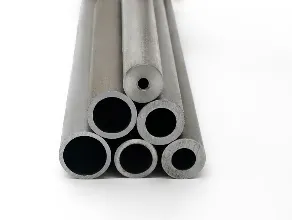
The primary differences between EN 10305 and DIN 2391 come down to scope and material grade designations. EN 10305 functions as a comprehensive European standard covering various precision steel tube types across multiple parts. It offers a broader range of specified material grades and tolerance classes.
DIN 2391 specifically addresses seamless cold-drawn precision steel tubes with a more focused set of material grades (St35, St52) and dimensional tolerances. While both target high precision, EN 10305 provides more detailed classifications for different manufacturing conditions and surface finishes. This gives engineers greater flexibility when specifying tubes for particular automotive tubing standards applications.
High-pressure applications like high pressure boiler tubes and hydraulic line tubing demand careful standard selection because failure consequences are severe. EN 10216 (parts 1-5) serves as the definitive European standard for seamless steel tubes designed for pressure purposes.
The standard covers non-alloy and alloy steel tubes with specified elevated temperature properties. EN 10216-2 addresses tubes with elevated temperature properties, while EN 10216-3 covers alloy fine grain steel tubes. These tubes undergo rigorous testing including non-destructive testing (NDT) and material integrity certification.
Focus on DIN 17175 Steel Pipe to improve efficiency. If you’re interested, check 《DIN 17175 Steel Pipe》 specifically targets high-temperature applications in boiler and heat exchange systems. Focus on ASTM A192 Steel Pipe to improve efficiency. If you’re interested, check 《ASTM A192 Steel Pipe》 covers high-pressure boiler service. These applications require materials with exceptional strength, creep resistance, and fracture toughness because the tubes operate under sustained stress at elevated temperatures.
Choosing the correct standard for high-pressure hydraulic applications requires evaluating several factors in sequence. Start with maximum operating pressure, temperature range, and fluid type. Then determine whether seamless or welded tubes fit the application better. Seamless tubes like those under EN 10216 or Focus on 4130 Seamless Pipe to improve efficiency. If you’re interested, check 《4130 Seamless Pipe》 typically offer superior pressure resistance because they lack the potential weak point of a weld seam.
Consider the necessary material properties: tensile strength, yield strength, and fatigue resistance will guide selection of specific steel grades like E355 or St52. Evaluate dimensional tolerances and surface finish requirements to ensure proper fit and fluid flow. Finally, verify compliance with any additional industry or regional regulations that may apply to your specific installation.
Manufacturing capabilities extend beyond standard round tubes to include cold drawn welded tubes and custom shaped steel tubes. EN 10305-2 specifies tubes that begin as welded stock and are then cold-drawn to achieve precise dimensions and enhanced mechanical properties. The cold drawing operation closes the grain structure around the weld zone, improving uniformity.
These tubes find use in automotive exhaust tubing standards and other applications where cost-efficiency combined with precision matters. EN 10305-3 covers welded cold-sized square and rectangular tubes, while EN 10305-5 addresses welded cold-sized square and rectangular tubes specifically for hydraulic and pneumatic power systems.
For unique engineering challenges, Focus on Special-Shaped Alloy Steel Tubes to improve efficiency. If you’re interested, check 《Special-Shaped Alloy Steel Tubes》 and Focus on Special-Shaped Carbon Steel Tubes to improve efficiency. If you’re interested, check 《Special-Shaped Carbon Steel Tubes》 including Focus on Hexagonal Steel Pipes&Tubes to improve efficiency. If you’re interested, check 《Hexagonal Steel Pipes & Tubes》 and Focus on Oval Steel Pipes&Tubes to improve efficiency. If you’re interested, check 《Oval Steel Pipes & Tubes》 serve OEMs and specialized projects requiring specific aesthetic or functional integration.
EN 10305-2 serves as the primary standard for cold-drawn welded tubes in automotive applications. This specification covers precision steel tubes that are initially welded and then cold-drawn to achieve tight dimensional tolerances and improved surface quality. It includes various steel grades suitable for different automotive parts, accounting for strength, formability for bending and shaping, and corrosion resistance. These tubes commonly appear in chassis components, seating structures, and other non-pressure-critical applications where precision and consistency matter.
Achieving full EN and DIN compliance for precision steel tubing demands more than selecting the correct standard number. It requires stringent quality control and the ability to customize when standard products fall short.
Vertically integrated manufacturing ensures ISO certified steel tubes through every stage, from raw material selection to finished product. This includes Positive Material Identification (PMI) and Non-Destructive Testing (NDT) inspections that verify material composition and detect internal flaws. PMI uses X-ray fluorescence or optical emission spectroscopy to confirm the alloy matches the specification. NDT methods like ultrasonic testing or eddy current inspection find subsurface defects without damaging the tube.
Many projects require solutions beyond catalog products. Custom steel tube manufacturing produces tubes with specific properties, finishes, or unique geometries like Focus on Shaped Steel Pipes&Tubes to improve efficiency. If you’re interested, check 《Shaped Steel Pipes & Tubes》 while maintaining strict compliance with relevant EN and DIN standards.
Navigating EN and DIN standards for precision steel tubing requires both technical knowledge and manufacturing expertise. Working with an experienced manufacturer provides access to expert consultation on standard interpretation and material selection.
Vertically integrated production capabilities and quality commitment ensure that every tube, whether a standard Focus on Precision Pipe&tube to improve efficiency. If you’re interested, check 《Precision Pipe & Tube》 or a custom-shaped profile, meets stringent EN and DIN requirements. Close collaboration with OEMs and engineering projects delivers tailored, high-precision tubing that performs reliably in critical applications.
Ensure your project’s success with precision-engineered steel tubes that meet the most stringent EN and DIN standards. Contact Changzhou Tenjan Steel Tube Co.,Ltd today for expert consultation, custom manufacturing solutions, and to discuss how our vertically integrated capabilities can fulfill your exact specifications. Partner with us for unparalleled quality and reliability. Email: Sunny@tenjan.com | Tel:+86 51988789990 | WhatsApp:+86 13401309791| Tel:+86 51988789990 | WhatsApp:+86 13401309791
Seamless EN DIN tubes (e.g., EN 10305-1) are produced without a weld seam, which eliminates a potential weak point and provides superior pressure resistance and uniformity. This makes them ideal for critical applications like hydraulic tubing standards where failure is not acceptable. Cold-drawn welded tubes (e.g., EN 10305-2) start as welded tubes and undergo cold drawing to achieve precise dimensions and enhanced mechanical properties. The cold drawing process improves the weld zone but cannot fully eliminate its presence. These tubes work well in automotive or general engineering applications where cost-efficiency and precision both matter.
Changzhou Tenjan Steel Tube Co.,Ltd ensures compliance through vertically integrated manufacturing from raw material selection to finished product. This includes ISO-certified quality control, comprehensive PMI (Positive Material Identification) and NDT (Non-Destructive Testing) inspections, and adherence to specific material and dimensional requirements outlined in EN and DIN standards. Every tube receives full traceability documentation and material integrity verification, whether it’s a Focus on Seamless Carbon Steel Tubes to improve efficiency. If you’re interested, check 《seamless carbon steel tubes》 or an alloy variant.
Yes, Tenjan Steel Tube manufactures custom-shaped steel tubes including square, rectangular, hexagonal, and other complex geometries. The company works directly with OEMs and engineering projects to ensure these custom profiles meet specific EN or DIN standards required for each application. This includes tailored solutions with high precision and consistent quality for Focus on Octagonal Steel Pipes&Tubes to improve efficiency. If you’re interested, check 《Octagonal Steel Pipes & Tubes》 or any other specialized requirement.


Home Product Capabilities Case Studies Blogs About Get a Quote
Pipe & Tube Manufacturing Process Shapes & Profiles Pipes & Tubes Material Standard Steel Pipes & Tube Rebar Couplers Cold Drawn Steel Profiles & Bars
Oil & Petrochemical Industry Automotive & Motorcycle Components Mechanical Engineering Components Mining Construction Support Structures High-Pressure Boiler System Construction Machinery Geological Drilling Agricultural Machinery Parts Industrial Fluid Transfer Systems


© 2024 Changzhou Tenjan Steel Tube Co., Ltd All rights reserved. Privacy StatementTerms-ConditionsSitemap
