Welcome to Changzhou Tenjan Steel Tube Co., Ltd
Sunny@tenjan.com



Ordering ASTM A335 pipe for a high-temperature header or steam line isn’t like buying structural tube off a catalog. When the specification calls for chromium-molybdenum alloy pipe that must hold integrity at 550 °C and beyond, getting the grade right is only half the battle — verifying that the pipe actually meets the chemistry and mechanical requirements in A335 is where projects go off the rails. This article walks through the A335 grade family, what the material properties mean for high-temperature service, how the pipe is produced, and what to check during incoming inspection so that the pipe you receive is the pipe your design called for.
ASTM A335 covers seamless ferritic alloy steel pipe intended for high-temperature service. The standard is built around chromium-molybdenum (Cr-Mo) grades — P11, P22, P5, P9, P91, and a few less common variants — where the chromium and molybdenum content gives the pipe improved creep strength and oxidation resistance compared to carbon steel. Unlike A106, which tops out around 400 °C in practical sustained service, A335 grades are specifically designed for main steam piping, boiler superheaters, and refinery heater tubes where metal temperatures regularly exceed 500 °C.
The material is always seamless. Welded pipe is not permitted under A335 because a longitudinal weld would introduce a metallurgical discontinuity that compromises creep life. Every pipe starts from a solid billet of vacuum-degassed alloy steel, pierced and rolled to rough dimensions, then heat treated to produce a microstructure that is stable at elevated temperature.
Ferritic alloy pipe strikes a balance between high-temperature strength and thermal expansion. In power piping, the lower coefficient of thermal expansion compared to austenitic stainless grades reduces the thermal stress on hangers and pipe supports, which is why A335 remains the dominant Class 1 piping material in fossil fuel power plants worldwide.
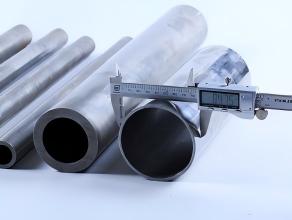
The first thing an engineer checks on a material test report is the chemistry, because a slight shift in chromium or molybdenum can change the maximum allowable stress significantly. Below is a summary of the major A335 grades and their key alloying elements, drawn from the A335/A335M table.
| Grade | C Max | Cr (nominal) | Mo (nominal) | Other | Typical Service Temp Range |
|---|---|---|---|---|---|
| P11 | 0.15 | 1.25% | 0.50% | — | 480–540 °C |
| P22 | 0.15 | 2.25% | 1.00% | — | 540–590 °C |
| P5 | 0.15 | 5.00% | 0.50% | — | 500–600 °C |
| P9 | 0.15 | 9.00% | 1.00% | — | 540–640 °C |
| P91 | 0.12 | 9.00% | 1.00% | V, Nb | 580–650 °C |
I’ve seen procurement specifications that specify “P11 equivalent” without checking the P5 or P9 option, particularly when the pipe sees cyclic thermal loading. Higher chromium content improves oxidation resistance, but it also changes the heat treatment window and weldability — a trade-off that can matter more on-site than the chemistry table suggests.
A335 pipe is supplied in one of several heat treatment conditions: full anneal, isothermal anneal, or normalize plus temper. The condition directly determines the tensile and hardness values on the MTR.
Minimum tensile requirements for the common grades are as follows:
– P11, P22: 415 MPa minimum tensile, 205 MPa minimum yield
– P5, P9: 415 MPa minimum tensile, 205 MPa minimum yield
– P91: 585 MPa minimum tensile, 415 MPa minimum yield
The jump in strength from P22 to P91 is not trivial. P91 achieves its properties through controlled nitrogen alloying and a normalizing-and-tempering heat treatment that produces a tempered martensite structure. This microstructure is sensitive to overtempering if welding procedures are not tightly controlled, so while the mechanical properties on the MTR may look good, the as-welded joint properties can degrade if post-weld heat treatment temperatures are not held within a narrow range.
Aside from room-temperature tensile testing, A335 pipe intended for critical service should also come with grain size determination and, in some cases, short-term creep rupture data. For P91, hardness traverses across the wall thickness can reveal whether the product was properly tempered. A hardness reading above 250 HBW on a P91 pipe section often indicates incomplete tempering, which correlates with poor toughness and reduced long-term creep ductility.
Hardness testing is common, but the real tell is the microstructure. A micrograph showing fully tempered martensite with fine carbide distribution tells you more than a single hardness number. Many end users now require a microstructure evaluation on one sample per heat for P91, a practice I’ve found catches issues that pass the mechanical tests but fail in service.
Seamless A335 pipe begins as a high-purity alloy billet. The billet is pierced in a rotary piercer at around 1200 °C, then stretched in a rolling process — either a continuous mandrel mill or a plug mill — to achieve the rough diameter and wall thickness. The hot-rolled pipe is then heat treated to refine the grain structure and achieve the required mechanical properties.
For most grades, normalize plus temper is the standard treatment. The normalize operation dissolves carbides and produces a fine austenitic grain; the subsequent temper relieves stresses and precipitates carbides in a controlled size distribution. P91 requires a more precise tempering step — typically in the 730–780 °C range — and any deviation can shift the hardness and creep strength. Some mills, especially those producing smaller quantities, may use full annealing instead, which produces a softer, more ductile pipe that often still meets the minimum tensile values but may not have the long-term creep strength of a normalized-and-tempered product. That distinction rarely appears on a purchase order, but it determines service life.
A MTR is not a guarantee. Over the years, I’ve seen MTRs that listed correct tensile values but, when the pipe was tested again by the customer, the yield strength came in 30 MPa below the minimum — often because the heat treatment had not been applied uniformly, or a sample had been selected from a more favorable location. This is why major EPC contractors now require third-party inspection at the mill, including PMI on every pipe end and UT on random samples.
Positive Material Identification using handheld XRF or OES can confirm chromium and molybdenum content within seconds. It won’t detect carbon or nitrogen, but it will catch a grade mix-up before the pipe leaves the yard. For dimensional checks, A335 does not specify the tightest OD and wall tolerance — it references the general seamless pipe tolerances — but for high-temperature service, wall thickness variation across a single cross-section should be less than 10% of nominal, because thinner sections will creep faster.
If the pipe is destined for a header or steam line where field welds are planned, insist on end-prep bevels that are machined to the WPS and protected from corrosion during shipping. Nothing slows a turnaround like having to re-bevel pipe on-site because the factory bevel was cut oversize or rusted in transit.
It depends on the grade and wall thickness. P11 and P22 weldments generally require PWHT when the nominal thickness exceeds certain code limits — often around 10 mm — while P91 requires PWHT for nearly all thicknesses to avoid cracking in the heat-affected zone. The holding temperature and time are grade-specific: P91 typically needs 730–780 °C for one hour per 25 mm of thickness. If your welding procedure hasn’t been qualified for that exact cycle, the hardenability of these alloys can lead to brittle fractures.
Yes, but with grade-specific caveats. Low-chromium grades like P11 may be used in certain hydrogen-containing environments at moderate temperatures, but as temperature and hydrogen partial pressure increase, higher-chromium grades such as P22 or P9 are preferred. P91 is also used, but its higher strength can make it more susceptible to hydrogen embrittlement if not properly heat treated. In a recent project involving a reformer tube replacement, we specified P22 with an additional hydrogen bake-out step after welding to mitigate residual hydrogen.
Because high-temperature pipe often operates under creep conditions, surface imperfections can act as stress risers. Seamless pipe made from good-quality billets and properly cold-finished or machined after heat treatment typically has fewer laps and seams, reducing the risk of crack initiation. A visual inspection per ASTM A999 or equivalent should be performed, and any suspect linear indication should be checked with MT or PT before acceptance.
At a minimum, a mill test report per EN 10204 Type 3.1 or 3.2 showing heat number, chemical analysis, tensile test results, hardness, and the heat treatment condition. For P91, also request a grain size determination and, if the specification calls for it, a microstructure report. The MTR must trace back to the heat number stamped on each pipe. If the pipe has been through a distributor, verify that the heat number hasn’t been ground off or painted over.
If your design operates close to the upper temperature limit of a P22 or P91 specification, send the intended service conditions and a target wall schedule to Sunny@tenjan.com or call +86 13401309791. We’ll confirm whether the grade you’re considering is conservative enough, and walk you through what the as-delivered microstructure should look like.


Home Product Capabilities Case Studies Blogs About Get a Quote
Pipe & Tube Manufacturing Process Shapes & Profiles Pipes & Tubes Material Standard Steel Pipes & Tube Rebar Couplers Cold Drawn Steel Profiles & Bars
Oil & Petrochemical Industry Automotive & Motorcycle Components Mechanical Engineering Components Mining Construction Support Structures High-Pressure Boiler System Construction Machinery Geological Drilling Agricultural Machinery Parts Industrial Fluid Transfer Systems


© 2024 Changzhou Tenjan Steel Tube Co., Ltd All rights reserved. Privacy StatementTerms-ConditionsSitemap
