Welcome to Changzhou Tenjan Steel Tube Co., Ltd
Sunny@tenjan.com



Seamless vs welded steel tube: the choice isn’t about pressure ratings alone. After two decades in precision tube manufacturing, I’ve seen engineers default to seamless for perceived safety, only to learn that a cold-drawn welded tube could have hit the same specs for 20-30% less. The real decision lives in the details: surface finish, concentricity, and what your supplier can actually deliver. In many mechanical applications, a properly processed welded tube performs indistinguishably from seamless, and the cost difference can fund better material elsewhere in your assembly.
Understanding the manufacturing steps clarifies where costs and quality variables come from. Seamless tubes start as a solid billet, heated, pierced, and rolled over a mandrel, a process that consumes more energy and material. Welded tubes form from flat steel strip, roll-formed into a cylinder and joined by electric resistance welding (ERW) without filler metal. That sounds simpler, and it is, but the weld seam introduces a hoop that downstream processing must erase.
| Step | Seamless Tube | Welded Tube |
|---|---|---|
| Raw material | Solid round billet | Steel coil or strip |
| Primary forming | Piercing and hot rolling | Roll forming and ERW |
| Post-forming | Sizing, heat treat | Weld normalizing, sizing |
| Cold finishing | Cold drawing (optional) | Cold drawing (often required for precision) |
Seamless tubes waste about 15-20% of the billet during piercing; welded tubes convert roughly 95% of the strip into finished product. But that efficiency flips for heavy walls: above 10 mm in small diameters, seamless often becomes the more economical route.
The seam is a microstructural discontinuity, but modern ERW lines with post-weld normalizing can homogenize the grain structure to the point where the tube behaves uniformly in tensile and burst tests. We regularly cold-draw ERW tubes through dies that compress the cross-section 10-15%, which refines the grain and raises yield strength through work hardening. After a subsequent normalizing cycle, properties are consistent across the circumference.
Our in-house testing on EN 10305-3 E355 welded cold-drawn tubes shows yield strengths within 5 MPa of seamless E355+AR material. For most mechanical parts, bushings, spacers, shaft sleeves, that is an imperceptible difference. Seamless remains the safer bet where service cycles push above 400 bar at elevated temperature, because the seam’s slightly different response to fatigue can shorten life. In those cases, failure usually traces to poor weld quality, not to an inherent process ceiling.
Drawn Over Mandrel (DOM) is simply a welded tube that goes through a cold-drawing pass over an internal mandrel, improving ID finish and dimensional control. Many engineers treat DOM as a separate product, but it’s the same base material. A DOM tube from a well-run ERW line can achieve straightness of 0.5 mm/m and OD tolerances of ±0.05 mm, numbers that compete with seamless and typically cost 15-25% less.
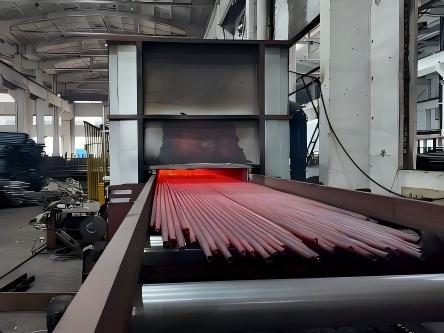
For high-volume orders with walls under 6 mm, welded tube is hard to beat on price. The steel coil market is deep and liquid; strip prices normally sit well below billet prices per ton. Lead times for standard-size welded tubes can be 2-4 weeks, while seamless billets, especially in alloy grades, may take 8-12 weeks. That gap matters when a production line is waiting.
But once you require cold-drawn tolerance regardless of base type, the cost gap narrows. Drawing adds similar processing cost to both. At that point, the decision hinges on availability and whether you need the metallurgical confidence of a seam-free structure.
If your program involves both hydraulic and structural components with dissimilar pressure ratings, specifying one tube type across the board looks neat but often spends too much on the structural parts. I’ve redesigned assemblies where mixing a DOM welded tube for the low-pressure side saved 20% of the total tube spend with no performance change. If you are not sure where your design can relax the spec, send your part number and target price to Sunny@tenjan.com, we can run a quick analysis for you.
Yes, and it often is. EN 10305-3 explicitly covers welded cold-drawn tubes for hydraulic and pneumatic power systems. The standard demands that base metal and weld meet specified yield and elongation, and many OEM cylinder manufacturers use DOM tubing for rod and barrel applications. The catch is verifying that the weld seam has been properly normalized and that the tube passes ultrasonic or eddy-current testing for any seam defects. We have supplied thousands of tonnes of EN 10305-3 DOM tube for agricultural and construction cylinders where pressure cycles rarely exceed 250 bar, and it holds up as well as seamless.
| Standard | Seamless | Welded (if cold-drawn) | Typical Use |
|---|---|---|---|
| ASTM A519 | Yes | Yes | Mechanical tubing |
| EN 10305-1 | Yes | No | Seamless cold-drawn precision |
| EN 10305-3 | No | Yes | Welded cold-drawn for hydraulics |
| DIN 2391 | Yes | No | Seamless precision |
| ASTM A500 | Yes | Yes | Structural tubing |
When you request a quote, specify the standard and indicate whether you will consider a welded alternative if it meets the mechanicals. That single line often lowers the price tier.
After processing thousands of tube orders, I have seen one pattern repeat: specs that say “seamless only” but stress levels, pressure cycles, and budget all point to welded. The right answer is not in a catalog, it lives in the test data, tolerance stack, and the economics of your project. If your current supplier has not walked you through the trade-offs, send your drawing to Sunny@tenjan.com. We will review the load case, suggest an appropriate standard, and give you an honest assessment of whether welded can do the job. That conversation costs nothing, but it could save you a lot of steel.
Which is cheaper: seamless or welded steel tube?
Welded tube almost always costs less for thin to medium walls. The strip stock is cheaper than billet, and the forming process wastes less material. Once you add cold drawing, the cost advantage shrinks but persists. For walls above 8-10 mm in small diameters, seamless can become cost-competitive because extremely thick strip may not be readily available.
Can welded steel tube be used for high-pressure applications?
It depends on the code and the pressure class. Up to about 250-300 bar in hydraulic service, a properly normalized and tested DOM welded tube works well under many standards. For high-cyclic, high-temperature scenarios or when ASME B31.3 demands seamless for a specific fluid service, you do not have a choice, but those are the exceptions, not the rule.
What is the difference between ERW and DOM tubing?
ERW is the base welding process; DOM is a downstream cold-working step applied to an ERW tube. You can buy ERW tube as-welded, but DOM goes further by drawing over a mandrel to refine dimensions and mechanicals. DOM tubes have tighter tolerances and a smoother ID, making them suitable for hydraulic and mechanical parts without the “seamless” label.
How do I check the quality of welded tube?
Ask the mill for their weld seam test reports: longitudinal tensile across the weld, flattening tests, and if possible, ultrasonic or eddy-current inspection records. A good manufacturer should deliver a fully traceable package showing that the weld region meets the same properties as the parent metal after normalizing.
Is seamless tube always stronger than welded?
Not necessarily. A cold-drawn welded tube in 1020 or similar can hit the same yield and tensile numbers as seamless. The real difference shows up in fatigue or fracture toughness over millions of cycles, where the seam can be an initiation site. For static loads or moderate cycling, the performance is often equal. Share your load case and we will confirm which approach fits best. Email Sunny@tenjan.com or call +86 13401309791.


Home Product Capabilities Case Studies Blogs About Get a Quote
Pipe & Tube Manufacturing Process Shapes & Profiles Pipes & Tubes Material Standard Steel Pipes & Tube Rebar Couplers Cold Drawn Steel Profiles & Bars
Oil & Petrochemical Industry Automotive & Motorcycle Components Mechanical Engineering Components Mining Construction Support Structures High-Pressure Boiler System Construction Machinery Geological Drilling Agricultural Machinery Parts Industrial Fluid Transfer Systems


© 2024 Changzhou Tenjan Steel Tube Co., Ltd All rights reserved. Privacy StatementTerms-ConditionsSitemap
