Welcome to Changzhou Tenjan Steel Tube Co., Ltd
Sunny@tenjan.com



As a precision steel tube engineer, I’ve seen many procurement specs arrive with only a surface finish requirement—overlooking the deeper differences between cold drawn and cold rolled processes. Cold drawn vs cold rolled steel tubes each produce distinct grain structures, work hardening levels, and tolerance capabilities that directly affect how the tube performs under pressure, in machining, or after heat treatment. This article breaks down what those differences mean for your part’s mechanical integrity, so you can specify with confidence rather than guess.
In cold drawing, a hot-finished hollow is pulled through a die at room temperature. The tube’s outer diameter shrinks slightly while the wall thickness thins in a controlled manner. I’ve watched this process countless times on the shop floor—the draw bench operator adjusts the die angle and drawing speed depending on the material grade, and that decision alone affects final straightness and residual stress. The tube emerges with a shiny, burnished surface because the die burnishes the outer face during reduction.
Cold rolling, by contrast, uses a pair of grooved rolls that rotate around the tube while the tube advances through them. This Rockwell-type or cold pilger process compresses the wall in multiple small increments. The result is a more uniform wall thickness and, in my experience, better concentricity, especially on tubes with a diameter-to-wall ratio above 20:1. The surface is smooth but typically has a matte appearance rather than the bright finish of a drawn tube.
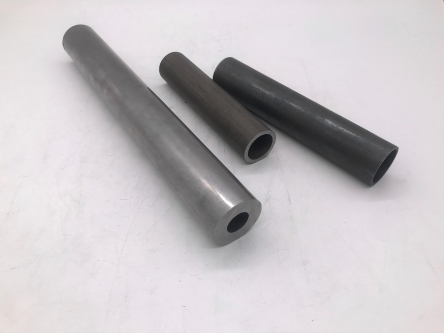
Both methods work the material below its recrystallization temperature, so work hardening is part of the package. The choice between them often comes down to whether your application prioritises surface finish or dimensional uniformity.
When steel is cold worked, its yield and tensile strengths increase, while elongation and impact toughness drop. Cold drawn tubes tend to show a slightly higher surface hardness because the die friction concentrates deformation near the outer surface. I’ve measured hardness gradients across a drawn tube wall—the outside can be 8-12 HRB harder than the inside. That matters if you plan to machine threads or snap-ring grooves on the OD.
Cold rolled tubes, because the reduction is more symmetric, usually have a more uniform hardness through the wall. The grain structure elongates in the direction of rolling and drawing, but in rolling, the alternating compression from the rolls produces a finer, more equiaxed subgrain structure once the tube is annealed. If you order a cold rolled tube in the annealed condition, it will typically have a more isotropic grain structure than a drawn-and-annealed tube.
One failure I’ve seen repeatedly in hydraulic cylinder applications: specifying a cold drawn tube with a tight ID tolerance, then machining the OD to fit a gland, only to find that the residual stress from drawing relaxes during machining and the ID ovalizes. A cold rolled tube with a stress-relief anneal before final sizing avoids that pitfall. It’s a combination of process and heat treatment, not just the cold working method.
| Parameter | Cold Drawn Tube | Cold Rolled Tube |
|---|---|---|
| Surface roughness (Ra) | 0.8–1.6 µm typical | 1.6–3.2 µm typical |
| OD tolerance (mm) | ±0.05–0.10 | ±0.04–0.08 |
| Wall thickness tolerance | ±7.5–10% | ±5–7% |
| Straightness (mm/m) | 0.8–1.5 | 1.0–2.0 |
| Concentricity (max ID/OD deviation) | 60–80% of wall | 50–70% of wall |
Values reflect our in-house QC data for carbon steel tubes in the 20–80mm OD range. Higher precision is achievable with extra finishing passes, but the numbers above represent standard production capabilities for most mills working to EN 10305-1 or ASTM A519.
Cold drawn tubes win on surface smoothness—the burnishing effect of the die is hard to beat. That bright finish also aids in post-processing like phosphating or coating. Cold rolled tubes offer better wall thickness uniformity, which means more predictable pressure retention in hydraulic or boiler service. If your part requires a honed ID, a cold drawn tube often needs less stock removal, saving time and cost.
The straightness difference is real but manageable. Drawn tubes undergo a straightening operation after drawing; rolled tubes may need an additional straightening pass, which can add a small cost. I tell engineers to look at the total processing chain, not just the raw tube specification.
Cold drawn tubes dominate where surface finish and tight ID control matter most. We supply drawn tubes to hydraulic cylinder manufacturers who specify an ID tolerance of H8 or better—the smooth surface reduces seal wear and extends cylinder life. Other typical applications include telescopic components, automotive steering columns, and precision mechanical parts where low friction is critical. Standards like DIN 2391 and EN 10305-1 are naturally associated with cold drawn tubes.
Cold rolled tubes excel when wall thickness uniformity is the priority. Structural tubes for construction equipment, outer shafts where concentricity affects vibration, and tubes destined for subsequent cold forming or flaring often come from the cold rolling process. The high reduction ratios achievable in a cold pilger mill make rolled tubes a favourite for special-shaped sections—we’ve produced hexagonal and oval profiles via cold rolling because the process can maintain uniform walls around complex geometries.
A mid-article consideration: If your program involves a high-strength alloy like 4140 or 25CrMo4, the tube’s condition before heat treatment matters. Cold rolled 4140 responds more uniformly to quench-and-tempering because the strain distribution is more even. If you’re unsure about the pre-condition for your heat treat, it’s worth confirming with your tube engineer before finalising the BOM. Reach out at Sunny@tenjan.com.
Start with your part’s most critical dimension. Is it the ID for a sliding fit? Or the OD that must locate in a housing? If the ID is king, a cold drawn tube and a subsequent honing or grinding operation gives you the best outcome. If the OD and concentricity are paramount, a cold rolled tube with its tighter wall control might save you from an extra truing operation.
Next, factor in downstream processing. Will you weld, machine, or heat-treat the tube? The residual stress pattern from drawing can cause distortion during machining, as I mentioned earlier. Cold rolled tubes, especially stress-relieved ones, tend to stay dimensionally stable through secondary operations. But if you’re ordering small quantities with tight delivery schedules, drawn tubes are often easier to source quickly because they dominate the precision tube market.
Cost differences are not enormous at commodity diameters. Cold rolled tubes in standard grades like E355 or ST52 can be 8-12% more expensive than an equivalent drawn tube, mainly because cold pilgering is slower. However, if the improved wall uniformity eliminates a scrappage or rework step, the rolled tube pays for itself. Our team often runs a quick cost-benefit analysis for customers weighing these options.
Choosing between cold drawn and cold rolled isn’t a one-time decision. The right answer changes with alloy, wall ratio, and end use. I’ve seen a drawn tube outperform a rolled one in a hydraulic application simply because the mill used a superior straightening process, while a rolled tube from another supplier failed due to inadequate stress relief. The process method is only half the story; the manufacturer’s control over that process determines real-world results.
At Changzhou Tenjan Steel Tube Co., Ltd, we produce both cold drawn and cold rolled tubes from a single vertically integrated facility. That means we don’t have to push one process over another—we match the method to your part’s requirements. Whether you need a drawn tube to EN 10305-1 with a guaranteed ID finish or a rolled tube with wall tolerances down to ±5%, our ISO-certified QC, PMI, and NDT testing verify that the tube leaves the factory in the condition you specified. Send your part number, material grade, and critical dimensions to Sunny@tenjan.com or call us at +86 13401309791. We’ll confirm stock availability or propose a custom production timeline so you can move forward with data, not guesswork.
It depends on the alloy and size. For plain carbon steel tubes in high-volume sizes, cold rolling is often a few percentage points more expensive because the pilgering cycle times are longer. But in alloy grades where rejection rates from wall-thickness non-conformity are higher, the rolled tube can be cheaper overall once you account for scrap savings. I’ve seen that trade-off flip both ways depending on the specific diameter/wall ratio.
Yes, but the surface preparation differs. Cold rolled surfaces have a residual oil film from the rolling lubricant that must be thoroughly cleaned—usually with alkaline degreasing. Cold drawn tubes also carry drawing lubricant but often clean up faster because the surface is smoother and less porous. If you’re powder coating, I’d lean toward a drawn tube for better adhesion without extra blasting.
Not inherently. Both processes work harden the steel. The hardness level depends more on the total reduction and the material grade than the method. In our lab, we’ve measured similar as-drawn and as-rolled hardness for a given reduction. The difference emerges after annealing: a rolled tube often shows a finer grain structure, which can give a slightly higher annealed hardness for the same temper, but the difference is usually within 2 HRB.
Mention the operations you plan. If you’re machining the OD, a drawn tube with a stress-relief anneal avoids distortion—request “stress-relieved cold drawn to EN 10305-1 SR.” If you’re machining the ID, a cold rolled tube with a clean and concentric bore will let you start with less stock removal. Providing the supplier with your machining steps helps them select the right starting condition and can reduce your scrappage. Share your machining sequence and we’ll confirm the optimal tube condition.


Home Product Capabilities Case Studies Blogs About Get a Quote
Pipe & Tube Manufacturing Process Shapes & Profiles Pipes & Tubes Material Standard Steel Pipes & Tube Rebar Couplers Cold Drawn Steel Profiles & Bars
Oil & Petrochemical Industry Automotive & Motorcycle Components Mechanical Engineering Components Mining Construction Support Structures High-Pressure Boiler System Construction Machinery Geological Drilling Agricultural Machinery Parts Industrial Fluid Transfer Systems


© 2024 Changzhou Tenjan Steel Tube Co., Ltd All rights reserved. Privacy StatementTerms-ConditionsSitemap
