Welcome to Changzhou Tenjan Steel Tube Co., Ltd
Sunny@tenjan.com



When a German hydraulic cylinder drawing calls for DIN2391‑ST52 but your supplier quotes EN10305‑E355, the EN10305 vs DIN2391 steel tube question becomes a real procurement obstacle. Dig into the actual specifications, though, and these two cold‑drawn precision tube standards overlap far more than they clash. Most of the confusion comes from treating the document label as a material grade, when the real differentiator is how tightly the mill controls its process. I have seen projects lose weeks waiting for a DIN2391 certificate that the tube already met dimensionally and mechanically — the paperwork simply hadn’t kept up with the production reality. This article picks apart the tolerance tables, grade chemistry, and manufacturing practicalities so you can decide whether the standard on the drawing is a hard requirement or a legacy box you can cross without risk.
Both EN10305‑1 and the superseded DIN2391 cover seamless, cold‑drawn precision steel tubes intended for hydraulic, pneumatic, and mechanical engineering applications. EN10305‑1 is part of a broader European family that also includes welded and DOM tubes; DIN2391 was the pre‑2004 German benchmark that many European designers still quote from memory. The fundamental scope is the same: deliver a tube with tight dimensional control and predictable mechanical properties, supplied in the cold‑drawn (hard) or stress‑relieved condition.
If you pull a typical E355 tube made under EN10305‑1 and compare its chemical composition to a ST52 tube to DIN2391, you will find the carbon and manganese ranges sit within the same band. The real divergence is that EN10305‑1 classifies tolerances into a structured table (e.g., class A, B, C), while DIN2391 attached specific tolerance grades to each steel designation. In practice, a modern tube mill running a capable cold‑draw bench produces tube that satisfies both sets of limits on most dimensions.
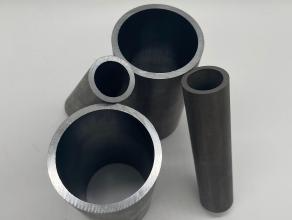
The tolerances are where buyers most often trip. DIN2391‑2 defined an OD tolerance of ±0.08 mm for tubes up to 30 mm outside diameter, while EN10305‑1 puts a slightly tighter ±0.07 mm in its default B class for the same range — a difference that matters only if you are measuring with a laser micrometer. Below is a snapshot of the limits you will typically encounter:
| Dimension | DIN2391‑2 (ST52, NBK) | EN10305‑1 (E355, +C) |
|---|---|---|
| OD ≤30 mm | ±0.08 mm | ±0.07 mm (class B) |
| OD 30–50 mm | ±0.15 mm | ±0.10 mm (class B) |
| Wall ≤3 mm | ±10%, min ±0.15 mm | ±7.5%, min ±0.15 mm |
| Straightness | 0.0015 × L | 0.001 × L (typical) |
The numbers look close, and they are. What the table hides is that EN10305‑1 also offers an “A” class for OD tolerances ≤30 mm at ±0.05 mm if you need it, while DIN2391 had no equivalent tighter bracket. So if your hydraulic cylinder’s seal life depends on concentricity, specifying EN10305‑1 class A gives you a usable, documentable advantage over the old DIN call‑out.
The workhorse grades are E355 (EN10305) and ST52‑3 (DIN2391). Both are non‑alloy structural steels with a minimum yield strength of 355 MPa in the normalized condition. The phosphorous and sulfur limits are effectively identical (P≤0.025%, S≤0.025%), so weldability and corrosion behavior follow the same rules.
Where the standards drift apart is the documentation of elevated‑temperature properties. EN10305‑1 includes a verification path for stress‑relieved and normalized states, while DIN2391 left heat‑treatment reporting mainly to negotiation. For applications like compact hydraulic cylinders running at 80–100 °C, having an EN10305‑certified heat‑treatment report can replace a separate material qualification — a time‑saving I have personally seen pay for the modest cost of selecting a properly certified batch from the mill.
For lower‑strength requirements, E235 (EN10305) maps to St35 (DIN2391), and the same interchange logic holds. The chemical composition of both grades is stable across Chinese mills that hold ISO 9001 and IATF 16949 certifications, because these mills calibrate their raw material — typically 20MnV6 or similar billets — to meet the overlapping window of both standards. If your program involves tubes running at elevated pressure cycles above 250 bar, the stress‑relieved condition and documented proof strength become critical; sharing your working pressure and cycle requirement with a technical contact early can avoid a full‑batch requalification later. Reach out at Sunny@tenjan.com.
Cold drawing naturally produces a smooth surface, but the final Ra depends on whether the tube is pickled, phosphated, and oiled or simply drawn dry. EN10305‑1 acknowledges this by referencing surface condition codes (e.g., +C, +LC, +SR), while DIN2391‑1 left surface finish largely to the buyer‑supplier agreement. For hydraulic cylinder tubes where a 0.4 µm Ra internal surface is needed for polyurethane seals, you can specify a phosphated and oiled finish under EN10305 without a separate addendum.
Our mill’s standard process draws, straightens, and then passes the tube through a phosphating bath immediately after cutting, which gives a uniform grey‑black phosphate layer that holds oil and resists flash rust during transport. We have shipped tube that meets both EN10305‑1 and DIN2391‑1 surface requirements using that same line, because the control parameter is not the standard label but whether the phosphating stage is active. This is the kind of ground‑level detail that a spec sheet comparison skips.
When the original equipment drawing dates from the early 2000s and calls for DIN2391, the safest path for a direct replacement is to ask the tube supplier whether they can still issue a 3.1 certificate referencing DIN2391‑2. Many mills stopped re‑certifying to the old standard after it was withdrawn, but their process capability data can demonstrate that the material meets the old requirements. If the end customer insists on a formal DIN certificate, you may need to switch to EN10305‑1 and provide a materials‑equivalence letter — a document our engineering team has drafted for clients replacing hydraulic elevator ram tubes across Europe and the Middle East.
For new designs, EN10305‑1 is the clearer choice because it aligns with the EN ISO system used by most notified bodies, simplifies CE marking documentation, and provides a ready path to class‑A tolerances if your bore‑to‑seal clearance shrinks. The only reason to stay with DIN2391 is when the end user’s maintenance manual explicitly restricts replacement parts to that standard, and rewriting the manual would cost more than sourcing a certified DIN tube.
The standard on the certificate is only half the story. A capable supplier should provide a mill test certificate (EN 10204 3.1) showing actual chemical analysis, mechanical results, and eddy‑current test compliance for every heat. I recommend asking for two extra data points: the supplier’s historical Cpk values for OD and wall thickness on the size range you need, and a digital photograph of the tube ends as packed. The first tells you whether their process can hold the tolerance when you order repeatedly; the second confirms they understand your surface‑protection expectations without a conference call.
Tenjan has supplied precision EN10305‑1 and DIN2391 compatible tubes to hydraulic cylinder builders, construction machinery OEMs, and fluid‑transport system integrators since 2004. Our vertically integrated process — from raw material inspection through pickling, cold drawing, phosphating, and PMI testing — means you receive tube that meets the tolerance class you specify, with the paperwork that matches. For a quote, send your part number, quantity, and required standard to Sunny@tenjan.com, or call +86 519 8878 9990. We will confirm stock availability for your grade, diameter, and wall within one business day.
Can I directly substitute EN10305‑E355 for DIN2391‑ST52 in an existing hydraulic cylinder design?
In most cases yes, because the chemical composition and minimum yield strength match. However, if the cylinder design relies on a very specific elongation after fracture or a narrow hardness range, check the as‑supplied condition: a +C (hard) tube may have higher hardness than the original NBK (normalized) tube. Provide the hardness limits from the drawing and we can confirm whether our E355‑+SR (stress‑relieved) tube stays within your range.
Does choosing EN10305 over DIN2391 affect the tube’s weldability?
No. Both ST52 and E355 are classified as readily weldable low‑carbon steels with carbon equivalent typically below 0.45. If your application involves post‑welding, specify the stress‑relieved or normalized condition so residual stresses from drawing do not cause distortion during welding.
Is there any cost difference between ordering EN10305 and DIN2391 tubes?
If the mill draws both from the same billet stock and holds the same process parameters, the manufacturing cost is identical. The price difference, when it arises, comes from the re‑certification step: generating a DIN2391‑2 test certificate for an order after the mill has switched its quality system to EN10305 may require extra lab time. We handle this by assessing at the inquiry stage whether an equivalence letter satisfies your end customer, which often eliminates the extra cost entirely.
How do I know if my Chinese supplier actually follows the tolerances on the certificate?
Ask for a shipment‑specific inspection report that lists measured OD, wall, and straightness for the actual batch, not just a generic typetest. At Tenjan, we attach a dimensional report with 100% PMI verification and eddy‑current pass confirmation to every order. If your current supplier resists providing that, it is worth confirming whether their in‑house QC loop captures drift on every shift — our team can discuss how to set up receiving inspection criteria that catch non‑conformities before the tube reaches your machine. Share your requirements and we will confirm the appropriate test documentation.


Home Product Capabilities Case Studies Blogs About Get a Quote
Pipe & Tube Manufacturing Process Shapes & Profiles Pipes & Tubes Material Standard Steel Pipes & Tube Rebar Couplers Cold Drawn Steel Profiles & Bars
Oil & Petrochemical Industry Automotive & Motorcycle Components Mechanical Engineering Components Mining Construction Support Structures High-Pressure Boiler System Construction Machinery Geological Drilling Agricultural Machinery Parts Industrial Fluid Transfer Systems


© 2024 Changzhou Tenjan Steel Tube Co., Ltd All rights reserved. Privacy StatementTerms-ConditionsSitemap
