Welcome to Changzhou Tenjan Steel Tube Co., Ltd
Sunny@tenjan.com



Precision tube vs standard tube—it’s a decision that comes down to more than just a line on a drawing. As a precision steel pipe engineer who has spent two decades in mills, I’ve watched too many specs overlook the real-world consequences of a few microns. In this article, I’ll walk you through what actually separates a cold-drawn precision tube from a standard hot-rolled pipe, where those tolerances bite you on the shop floor, and how to know when you’re paying for precision you don’t need.
A precision tube is a seamless steel tube manufactured through cold-drawing or cold-rolling processes that achieve dimensional control far tighter than hot-finished alternatives. The od, wall thickness, and straightness are held to tolerances that can be as fine as ±0.1 mm. I regularly work with tubes off our line that slip into a gage where a 0.05 mm deviation would flag a reject.
These tubes typically conform to standards like EN10305-1, DIN2391, or ASTM A519. They are not just measured; they are engineered for applications where fit and surface quality are critical. At Tenjan, our precision pipe and tube range starts from 10 mm od up to 108 mm, in carbon and alloy grades, all cold-drawn and often stress-relieved to lock in those dimensions.
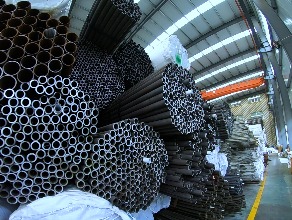
A standard tube usually refers to hot-finished or cold-finished seamless or welded pipe made to broader commercial tolerances. I’m talking about the kind you’d find in general structural supports, low-pressure fluid conveyance, or fabrication where a millimeter or two of slop won’t cause problems. Standards like ASTM A500, A106, or even generic EN10210 fit here.
The manufacturing process prioritizes throughput over micron-level precision. Od tolerances might be ±1% of diameter, and wall thickness can vary ±12.5%. For a 50 mm od tube, that means a ±0.5 mm swing on the diameter alone. That’s five times the tolerance my precision line runs every morning without a second thought.
When a tube hits your machining fixture or slides onto a piston, it’s the accumulated tolerances that decide whether you spend the afternoon with a Dremel or just torque it down. I’ve seen a 0.3 mm od deviation on a standard tube turn an automated welding cell into a manual rework station. The table below shows numbers I pull from real inspection sheets:
| Parameter | Precision Tube | Standard Tube |
|---|---|---|
| OD tolerance (50 mm od) | ±0.1 mm | ±0.5 mm |
| Wall thickness tolerance | ±0.1 mm | ±12.5% of nominal |
| Straightness (per meter) | 0.5 mm max | 2 mm max |
| Roundness (ovality) | ≤ 0.1 mm | often 0.3–0.5 mm |
Roundness is the one that sneaks up on you. A tube that’s 0.3 mm oval might slide into a cylinder bore once you muscle it, but the seal lip will remember. I recall a hydraulic cylinder project where replacing standard tubes with precision ones eliminated a 12% early-life seal failure rate. Not magic—just geometry.
If your process involves robotic welding, the straightness callout alone can save you from reprogramming the torch path every shift. It’s worth confirming your supplier’s actual inspection data before you commit to a BOM—reach out at Sunny@tenjan.com if you need a comparison against your current specs.
Surface roughness on a standard tube can be six times rougher than on a precision tube. I’m not simplifying for drama—standard hot-rolled surfaces can come in around Ra 12.5 µm, while our cold-drawn precision tubes routinely hold Ra ≤ 3.2 µm without secondary polishing. On a hydraulic rod, that roughness difference means the seal wears faster; on a bearing journal, it means a shorter life. A micron here is like skipping your morning coffee—it seems small until the whole day goes sideways.
The surface isn’t just about cosmetics. It’s about fatigue initiation points. A deeper surface groove acts as a stress riser. For dynamic applications—rotating shafts, reciprocating cylinders—the smoother the surface, the higher the fatigue limit. I’ve worked with automotive customers who moved from standard to precision tubes and dropped their post-machining polishing step entirely. That swap paid for the material premium in six weeks.
The price tag on a precision tube is higher, no question. You’re paying for the cold-drawing, the annealing, the straightening, and the inspection. But the cost equation flips when you look at what happens after the tube arrives at your dock. A standard tube that needs to be ground, straightened, or sorted out because of wall variation chews up labor and cycle time. In contrast, a precision tube drops into the fixture. I’ve watched a customer’s per-part cost go down 15% after switching—higher material cost, but lower total conversion cost.
That said, if you’re building a rack structure or a conduit that never sees more than 10 psi, you don’t need ±0.1 mm. I tell engineers the same thing: spend the precision budget where failure is expensive. A boiler tube, a high-pressure fuel line, a telescopic cylinder—that’s where it earns its keep.
Start with the application, not the budget. Ask three questions: Is the tube loaded dynamically, sealed, or machined to tight fits? If yes to any one, lean toward precision. (If you answer yes to two, call me before you order.) For static structural members or utility piping, standard tubes are often fine.
The spec sheet is your friend. Compare the tolerance band from the supplier against your worst-case stack-up. I’ve seen engineers buy precision tubes for a non-critical bracket because they didn’t trust the standard supplier’s quality. That’s a sourcing problem, not a material problem. Tenjan’s standard tubes come with full mill test certificates and PMI verification, so you know exactly what arrived. Still, if your design margin is less than 0.2 mm on an od or wall, a precision tube is not optional.
Deciding which tube grade and tolerance band fits your part shouldn’t be a solo exercise. Send your part number and the required quantity to Sunny@tenjan.com, or call us at +86 13401309791. We’ll confirm stock, provide inspection data, and help you avoid ordering precision when standard would do—or the opposite, which costs more in the long run. Because nobody wants to explain a field failure that started with a tube that was only “close enough.”
They cost more because of the manufacturing steps. A precision tube goes through cold-drawing, often straightening, heat treating, and multiple non-destructive inspections. Standard tubes skip many of these. The extra steps use time, energy, and skilled labor. Additionally, the yield is lower because we scrap anything outside the tight tolerance window. In high-volume projects, the higher upfront cost is frequently offset by reduced machining time and assembly rework. If you’d like to compare a precision tube quote against your current part, send your drawings to Sunny@tenjan.com.
Technically, yes, if pressure is low and seal life is not critical. But in my experience, any hydraulic cylinder that uses a dynamic seal should have a precision tube for the barrel. The internal surface must be smooth and round to avoid seal damage and bypass leakage. Even a few tenths of ovality can cause a seal to groove or fail prematurely. For high-cycle or high-pressure cylinders, I would not approve a standard tube substitution without a thorough risk review.
It depends on your market and application. For mechanical engineering in Europe, EN10305-1 is the go-to. In Germany, DIN2391 is still heavily referenced. For US-bound mechanical applications, ASTM A519 covers seamless carbon and alloy tubing. I’ve seen all three pass through our quality lab, and each has a slightly different tolerance regime. The best approach is to specify the standard, the steel grade, and the dimensional acceptance criteria in your inquiry. That avoids misinterpretation and matches the tube to your end use. Share your target standard with us, and we’ll confirm compliance documentation availability.


Home Product Capabilities Case Studies Blogs About Get a Quote
Pipe & Tube Manufacturing Process Shapes & Profiles Pipes & Tubes Material Standard Steel Pipes & Tube Rebar Couplers Cold Drawn Steel Profiles & Bars
Oil & Petrochemical Industry Automotive & Motorcycle Components Mechanical Engineering Components Mining Construction Support Structures High-Pressure Boiler System Construction Machinery Geological Drilling Agricultural Machinery Parts Industrial Fluid Transfer Systems


© 2024 Changzhou Tenjan Steel Tube Co., Ltd All rights reserved. Privacy StatementTerms-ConditionsSitemap
